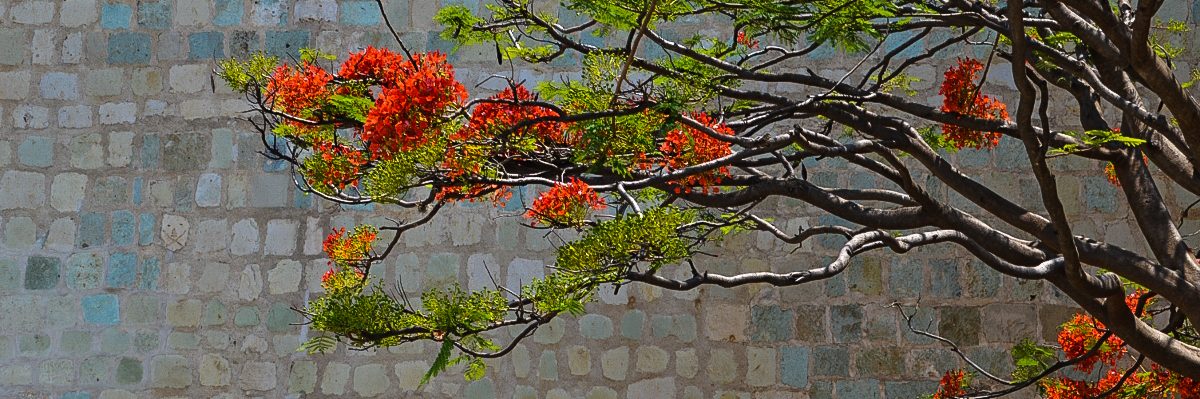
OK, I admit that I am the jealous type. Every autumn, pictures of brightly colored foliage flood my blog and Instagram feeds and my internal green-eyed monster comes out in force. Although I enjoy living in a warm climate, those of you who live in areas with enough chill to bring out the fall colors, are showing off and I’m envious. Other than a few liquid ambers here and there, most of our trees are green year-round.
So, in the spirit of “what about me?” I thought I’d share a few pictures of what’s happening in our front yard right now. It may not match the picturesque pigments some of you are currently enjoying, but I think it’s pretty sensational anyway.
Our yard’s landscape is made up of mostly low-water, low-maintenance succulents and agaves. Those who may not be familiar with these plants might be picturing:

But actually, succulents and agaves come in a dazzling array of colors, sizes, shapes, and textures. Often their foliage is multi-hued, and some have blooms that blaze even brighter than their leaves.
One of my favorites is the Blue Glow Agave. It has chalky blue-green leaves that are trimmed with a ribbon of red along its sharp margins and is especially stunning when backlit by the sun.

Unfortunately, all good things must come to an end, and one of our Blue Glows is, sadly, reaching the final chapter of its life… but what an exciting chapter it is. After sitting quietly in our yard for several years, it has suddenly begun its spectacular Danse Macabre.
At first, we noticed what looked like a greenish-blue muskrat with its head buried in the center of the plant.

As that center growth started to emerge, it began to resemble the head of an exotic bird.

Pretty soon, the spike was just a little taller than me.
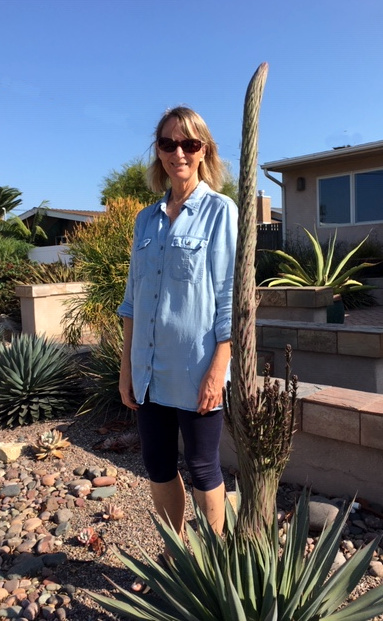
After reaching what appears to be its final height, a little over 11 feet tall…

…it began to flower along its stalk. These blossoms have become a pollination party bar for bees, butterflies, and hummingbirds.
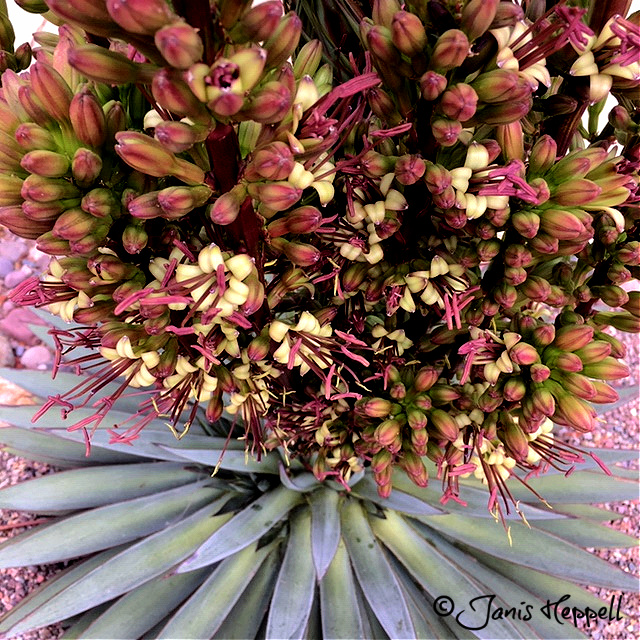
I don’t know how long the death bloom will last—maybe a month?—but since agaves are monocarpic, eventually the plant will die and will have to be removed.
But look! Just when you might think all is lost, nestled among the plant’s leaves are a whole litter of pups waiting to be removed and replanted.

It’s the whole circle of life playing out over a few months. The best part is that, pretty soon, I’ll have the perfect spot to plant one of the new baby Blue Glow Agaves.
Let’s see your maples, hawthorns, and aspens do that!
Discover more from Retirementally Challenged
Subscribe to get the latest posts sent to your email.

 Retirementally Challenged
Each area has its own special beauty. I have always envied the tropical flowers that don’t do well in my area even in the summer.
You are so right, Kate. I envy your peonies, you probably envy our plumerias.
OMG! Yes!
Wow, that is so cool!
I’m sad to see my plant die, but her last hurrah has been spectacular!
That is stunning!! Love the colours.
It has been amazing to see the changes. It seems that every day there is something different. I never expected the colorful blooms.
Oh and no autumn colours left here as the snow has fallen.
It must be disheartening to, one day, have the spectacular colors then, the next day, have most of it is gone due to wind or snow.
Usually it leaves due to wind so I’m happy if they leave for snow and then it sticks around. The dull brown of November and the dark days due me in so snow is good
This is another example of how absolutely amazing nature is. How does she do that?
You are very lucky to live in a warmer climate (as I write this I am attempting to dethaw near our fireplace). Your Blue Glow is stunning – may her offspring carry on her tradition!
I never expected this to happen… then it happened so quickly! It’s been a lot of fun to observe the daily changes. I am definitely going to replant those pups!
Excellent ode to your Blue Glow Agave and her pups…photos – both artistic and journalistic – enhance the reading.
Thanks, Janis for sharing this mini cycle-circle of life.
Although I’m sorry to see the plant in her final stages of life, I’m fascinated to watch the process. Every day brings something new.
Wow! I love your yard and plants, Janis. Yes, very different from what we have in the Pacific NW. I just brought all my cacti into the house, as we are expecting our first frost tonight. They came up here with us 40 years ago, when we moved up from California. They seem to enjoy spending summers outdoors, and then sitting by indoor windows and looking out during the autumn, winter, and most of spring. Sometimes, they even flower…
That is so great! It’s hard to imagine bringing a cactus inside but they must be happy since they flower now and then. Me writing that last sentence reminded me of that great 1960s-era movie The Cactus Flower, starring the lovely Ingrid Bergman.
A wonderful title, Janis! Intriguing and conjures up all sorts of images. I share some of your same feelings when I see photos of Eastern Canada, especially the Fall Maple Leafs. The Blue Glow Agave is unique and beautiful. I can only imagine how stunning in different sunlight. Ah, I see where the Danse Macabre fits in. I am glad you had the foresight to capture the different stages of this plant.
The “pollination party bar…” conjures up new images. A very descriptive, entertaining and informative post, Janis.
We have begun our road trip west, and although I will miss the colors in New England – like you missing eastern Canada Erica – I’m so looking forward to seeing the diversity in other parts of the country.
And I WON’T miss the cold!
Your road trip looks like fun, Nancy! You have already visited some really interesting locations and I’m sure that’s just the beginning. I’m also confident that you will encounter a lot of diverse vegetation as you move along. How far west will you be traveling?
Nice to see you here, Nancy. I look forward to reading about your new adventures.xx
The bees are going crazy at the bar right now – party! I bet you have some pretty stunning fall colors where you are too. Maybe not as much as in the east, but more than we have down here.
Janis, this was just fascinating to read and see as your agave plant grows through its final cycle! It’s a beautiful plant and I’m happy to see it has offspring! I’m moving my two potted plumeria to my daughter’s house in San Diego next month to live, while she trades me two of my mom’s potted roses taken from the home in Lemon Grove before it was sold. I’ve given away many plants to friends and neighbors. Spokane is in a whole other growing zone. Can’t wait to plant aspens and dogwoods next spring.
I imagine that your plumeria wouldn’t do so well in Spokane so I’m glad you were able to re-home them. You’ll have so much fun learning about your new area, and what plants will and won’t thrive. Not that I have to remind you to, but I look forward to you sharing lots of pictures of your aspens, dogwoods, and your mother’s roses!
No need to get jealous with photos like these! Every region has its own kind of beauty. It’s up to us to discover it. Have a great weekend, Janis!
Here-here! I’ll even add to your thought, Peter the contrast of urban/country slices of seasonal change.
You are so right Peter, although it’s really, really hard not to get jealous of those gorgeous fall colors. What I don’t get jealous of, though, is the winter snow that’s not too far behind. I’ll stick with my drought-tolerant landscape, I think.
Yes very cool. I tried to grow a palm tree indoors but it died. So much for my southwest garden.
It seems like I’ve seen indoor potted palms but maybe they were just there for a photo op. I guess it’s best to stick with what works in each area.
Your plant is exotic and exciting. Thanks for those marvelous photos.
I’m glad you enjoyed the pictures, Anne. The spire and flowers were completely unexpected… but fascinating (I think so, anyway).
Fabulous post about an amazing plant, Janis! The height of the inflorescence is quite impressive. I love your image of the backlit leaves. All habitats have their visual wonders and you’ve helped show that.
Oh, a new word! I had to look up inflorescence… which led me to another word: peduncle. Thanks for that! Succulents and agaves are so well suited to our climate and I’m always discovering new varieties.
Agaves just moved WAY up my awesome plants list!
Aren’t they great?! Some of the varieties can get quite big but the blue glow is nice and compact… at least until it starts to die.
A beautiful homage to a remarkable plant. And, great pictures too. Outside my inner London window, the horse chesnut lost most of its leaves in last nights windstorm. A crow hops from branch to branch, easily visible on the leafless tree. Thank you for sharing your observant experience of a far off eco-system. Best wishes, Simon
Thanks, Simon. I think I would be so sad to watch the colorful leaves fall in a windstorm… but then your view is opened up and you can watch the crow hop around. We don’t get the well-defined seasons like that here but there are tiny indications of seasonal changes… you just have to look a lot harder.
Okay, you win most interesting for sure. All my maples do is show off a rainbow of colors, drop thousands of leaves, and then they have to be moved. They’ve been blown twice in the last three days, and the ground is still covered. Happy plantings those new ones. 🙂
That is a (actually, one of the many) nice things about succulents: they don’t drop leaves that then need to be raked up. My agave’s leaves are quite pointy, though, so I’ll have to be very careful (goggles and leather gloves) when it is ready to be removed.
Wow! That is amazing. Did you already know that it would die like that? I’m not sure I’d have done the research if I had a plant like that to know to wait for all those steps.
And….I had to refollow your blog? And another blogger liked my autumn post that I had to refollow. What the heck? I wonder how many other blogs I’ve followed in the past that I no longer follow, unbeknownst to me. I have no idea how this happens but I’m glad you liked my autumn post so that I could follow you again……….anyway, I really enjoyed this post even if the plant died. I look forward to seeing more of your posts now!
I guess somewhere in the back of my mind I knew agaves were monocarpic and I had seen these “death blooms” on other varieties from time to time (not in our yard, though), but this came as a complete surprise. We planted three of these blue glow agaves several years ago but this is the only one to do this (so far 🙂 ).
I’ve also found myself unsubscribed to various blogs now and then. I have no idea how that happens, but I’m sure I’m missing other posts. I’m glad you enjoyed this one and re-subscribed!
oh good. I’m glad it’s not just me! ha! I had no idea that any plant does that, very interesting! and colorful 🙂
Lovely pictures
Thanks! I bet you don’t see many of these agaves in NYC 🙂 .
What an absolute treat to see the transformation – a stunning plant, and equally stunning photos.
I loved the blue glow agaves before this but, now that I’ve experienced the visual surprise they are holding inside, I love them even more!
What an amazing plant, Janis, and the “pollination party bar” creates buzzing images. Blue Glow Agaves are unique and beautiful and how entertaining for you to watch the transformation. Although we live with autumn’s hues now, we used to live in the desert, so we appreciate all the various types of beauty that Mother Nature cares to share with us. Great narrative with beautiful photos, also.
~Lauren 🌵🌾🍂🍁
Even though I hate to see this one die, I am very much enjoying watching its transformation. The party bar is open for business… the bees are buzzing around the flowers towards the base, and the hummers visit those higher up for their refreshments. I love the little pictures next to your name – from cactus to maple leaf. 🙂
Janis – A San Diego surprise, this escapade comes just in time for Halloween, right? What a gift to your yard those little baby agaves will be;) Fun California story – Thanks! Cheers – Susan
I thought the same thing! I don’t think the death blooms are seasonal at all, but this one was timed perfectly.
Gorgeous plant! Incredible that they provide pups to plant and enjoy after they’re gone.
The change of seasons was one of my favorite things when we lived in Denver. Fall was always beautiful and colorful…aspens were particularly glorious.
Fall can be such a beautiful season, especially when the trees light up with their colorful displays. I love the contrast of the yellow aspen leaves against the white bark.
Wow! That’s all I can say.
Pretty neat, huh?
Very neat!
Oh your front yard looks so different from ours here in the midwest. I love yours, the shapes, the colors, the textures. Fun post that has made my day, a gloomy gray wet one to be exact.
We could use some of that wet here but, fortunately, our plants can tolerate the lack of rain… for a while, anyway.
I saw that first pic and thought, “Wow! I want one of those!” But it probably wouldn’t be happy in Denver. I have some aspens in my yard, but they don’t turn gold in town like they do in the mountains. Just brown and gone.
I wasn’t aware that the aspens didn’t always change colors. Succulents probably wouldn’t be too happy there, but I bet you have a lot of plants that wouldn’t do well here. Of course with climate change, we may all be adjusting our lists of what works well in each zone. Who knows, succulents could be in your future 🙂
Wow! I’m impressed by that amazing plant. Your photos are as gorgeous as your writing. My oldest daughter lives in LA and has a yard full of succulents as well. I’m going to ask her about the Blue Glow Agave. I have a huge yucca that is pretty amazing when it blooms. Will post pics next time it does.
If your daughter doesn’t already have one, she may want to get a blue glow. I’d offer one of the pups if she lived closer 🙂 Yuccas are lovely too. And, fortunately, you (and the bees) get to enjoy their blooms year after year. I look forward to seeing your pictures!
How apropos since danse macabre was an art form that originated during the Black Plague of the 14th century … and here we are again.
Oh my, you are right… yikes!
Well, if it helps to know, I’m jealous of the beautiful plants you have growing in your yard…the agave leaves especially….and even more jealous of the fact that you aren’t facing a long, cold Winter in which to deal with the loneliness of the Covid restrictions. Please promise me you’ll post more photos in the upcoming months to cheer me up!
I promise! When I here the dire projections for the winter, I feel very grateful that we can get out year-round here. It can get cold and yucky but at least we don’t have to deal with snow. Please be safe!
Great pictures of those beautiful plants. They have beautiful colors, like I have never seen. Thank you for sharing your colors I truly enjoyed seeing them.
I’m glad you enjoyed the post and the pictures. It was fun to share my plant’s transformation.
Janis, Great shots of the beautiful Blue Glow Agave and its changes. I’m glad you have a few pups to plant soon. Thank you for sharing this.
I’m looking forward to removing the pups and re-planting them. So much more interesting then just buying a plant from the nursery… pedigree unknown 🙂
We high-desert dwellers, here in Albuquerque, have the best of both worlds: season changes and succulents. I will love my tequila even more now that I’ve seen the reproductive process of the Agave. Thank you!
How nice that you get both the seasonal changes and desert conditions. The agaves that tequila is made from are really pretty too – very spiky. I’ve never seen one bloom but I read that they have really pretty yellow flowers.
That’s amazing Janis – more amazing that it surged past your height and kept reaching for the sky. I’ve never seen a plant like your Agave before. Our colors are beautiful here in Michigan and peak was this past week for my area. The drawback is not only the raking/bagging of the leaves, but also the bare trees for the next six weeks. I have seen some amazing photos of bare trees in the fog – they look a little ethereal.
It is too bad the fall colors don’t stick around longer. I’ve seen those pictures of the fog too and they are really beautiful. I’ve often wondered how they are captured… maybe with a tripod and with a slow shutter speed? You should try it!
Yes, we have to enjoy them while they last as a swift wind comes along and then they are on the ground. I think the colors were more vibrant this year Janis. I wonder too how they do those beautiful fog or mist shots – I follow a photographer who gets up at the crack of dawn daily to take moon and sunrise photos … she is relentless at pursuing her early morning shots. I’ve followed her about a year, but no fog shots. She shoots time-lapse photography of the moon – just amazing.
Gorgeous! Thanks for sharing, Janis.
I’m glad you liked it. I thought the transformation was worth sharing.
Janis, that’s so wonderful! Beautiful.
Isn’t it interesting? The colors of the flowers was the most surprising to me… and the bees love them!
Always good to please the bees!
Nature never fails to amaze and in some of the most beautiful and intriguing ways possible. Thanks for the pics, Janis – and the education!
I was shocked when I first saw the growth in the center. Since I have never had a blue glow agave come to the end of its life before, I had no idea what was going to happen.
Your Blue Glow is amazing. I felt such a sense of hope with your last photo… the pups! I’m smiling as I type.
I love that too! Some agaves pup all through their lifespan but these just do that at the end… just when you need them.
Oh wow! That spike in bloom must have been really amazing to see in person. I’ve seen other plants similar bloom with white flowers, but not this Agave.
The colors of the flowers were totally unexpected, especially since the plant doesn’t have any ivory or mauve on its spiky leaves. Mother Nature really likes to play with her paint palette.
That is spectacular! We’ve occasionally come across agave blooming in the Southwest, but how fun to see the whole life cycle in your photographs. Your photo of the backlit agave is stunning.
I imagine each of the three agaves we have left will eventually do the same thing but I won’t be so surprised next time. I think they are pretty spectacular with the backlit leaves, but I never suspected what was to come.
One of our Florida neighbors had her agave do its death dance last fall. She had “free to a good home” seedlings as there were hundreds of them on the blooms. One I took is now an 8-10 inch plant, even with my black thumb. OK, I killed off about 15-20 of them and have 4-5 others that are still just 3 inches…. but the one is beautiful! (Tim wasn’t aware that each “free bloom” he brought home to me was over 20 seedlings!) Not a blue agave – I love the red stripe; I will need to see about getting a blue one for our Florida landscape. Your series of photos is great…most folks are not aware of the “death of an agave” sequence – we all learned about it last year watching our neighbor’s plant. Thanks for sharing the phenomenon.
I hope you can find a blue glow in your area. They are fairly compact and very well behaved (at least until the end when they let their freak flag fly 🙂 ). Good luck to you and your little plant!
Of course, those spectacular fall colors are followed by many days of raking, bagging and dragging to the curb…a joy you, sadly, will never experience.
Yeah, I’m really sad about that. I think I’ll just continue to enjoy the pictures others post. No fuss, no muss.
Oh, Janis…your yard is bursting with color too. How beautiful! The plants you picture here only grow as houseplants where I live.
I remember when a friend visiting from the east coast was fascinated by our jade plant, a plant that grows like weeds here. He had only seen one in a nursery and it was very expensive. He was thrilled to take a cutting back home with him (sadly, it didn’t survive). I guess we all have different, and beautiful, plants no matter where we live.
I feel your pain – we’re seasonally deprived where we live too and I love the seasonal colour in other people’s posts – autumn for those in the north and spring bulbs and blossoms here in Australia and New Zealand. That agave, though, is stunning – and you’ve found colour and texture in each of these pics.
Overall, I’m happy to live in a temperate climate… until I see those amazing fall colors. But I also know that the leaves are short-lived and will soon just be a pile on the ground that needs to be raked up (at least that’s what I tell myself to make me feel better 🙂 ). I love my succulents and agaves, though and will enjoy them throughout the year.
I have to agree with you on all counts. The seasonality would be lovely, but seriously, how good is a winter where the ocean temperature is still swimmable?
What a gorgeous plant! I think it’s so cool when what I would consider an exotic tropical houseplant is just someone’s outside plant…or even thought of as a weed!
Deb
Haha! That’s what I love about succulents… we can just stick offshoots into the ground and usually they grow just fine.
This is incredible, Janis! I’d take your agave over a colorful tree any day! Will you plant one of the pups in its spot after it dies or do you have another place in mind for the offspring? Strangely enough, when I lived and traveled in the tropics for a decade, I never missed or envied fall foliage. “I can always go back for a visit to see that phenomenon,” I thought. And, so can you. 🙂
I’ll probably remove the pups and plant them in pots temporarily and wait until they get a little bigger. My intention is to put one of them into the area where the mother plant is (after she dies back completely and we take her out).
I love the fall colors but I’d just as soon miss the clean up. So, I’m OK looking at pictures and going on a leafer peeper road trip now and then.
Janis, This is so interesting. I didn’t know they did that! Much better than falling leaves.!
I was surprised too. I had no idea what that hairy thing in the middle of the plant was when I first saw it. It’s been an interesting few weeks as we watch it grow and change.
Holy cow! That is a stupendous death dance. And rebirth all at the same time. What a miraculous plant. Your photos are stunning.
I am enjoying the dance. The bees are going crazy around the flowers right now… it’s really a sight to see.
This is a classic case of “the grass is always greener…” I’m jealous of where YOU live. Yes, we have beautiful fall colors in Minnesota, but you have so many cool plants that just can’t grow up here. Also, you live within driving distance of so many great places. There have already been two long weekends that I wanted to use to visit the West/Southwest, but it would have had to involve a plane ride and, you know… COVID. 😦 Idea: We should do an autumn home exchange some year! Ha ha! By the way, thanks for introducing me to a new word: monocarpic! Don’t know how often I’ll have a chance to use it up here, but still, it’s a cool word.
Funny, I have a half-written (among many half-written) tongue-in-check post about setting up a home exchange for bloggers. As we get to know each other through our blogs and even meet face-to-face when we can, it seems like the next logical step 🙂 Isn’t monocarpic a great word? I learned it as I was doing a bit of research for this post. Hard to fit it casually into a conversation, but I have faith that you will find a way to do it.
omg Janis – this plant is amazing! How interesting it must have been to witness this extraordinary spectacle.
Yup! You win – maple trees have got nothing on this.
Isn’t it great? It’s a gift that keeps on giving… the bees are having so much fun with the blooms right now. I have had plants die on me in the past, but never in such a spectacular fashion.
This plant has defined dying. Go in the grandest style possible!!
What fun! I see those around here too. We don’t have one of our own, but you and I must live in similar climes!
If you can grow one there, you should try it. Before this amazing transformation, the plant was very well-behaved and quite beautiful. I’m so excited to have 6-8 new pups to grow after this one is gone.
Awwh. The circle of life continues. If I come across one I may give it a try. Wait, I think my neighbor has one… Huh. Never looked too closely at it. Yours looks so beautiful!
We do have lots of succulents, though. They’re hard to kill, which is the only kind of plants I can keep. 🙂