Several weeks ago, my husband and I spent a few days in Los Angeles. The main reason for our visit was to see family but we also wanted to explore the downtown area.
When I research an unfamiliar destination for things we might want to do, I often turn to the website Atlas Obscura. Unlike other tourism resources, Atlas Obscura highlights lesser known, but fascinating places of interests. They call themselves “The Definitive Guide to the World’s Hidden Wonders,” and I have found their recommendations invaluable.
That’s where I learned about The Last Bookstore.
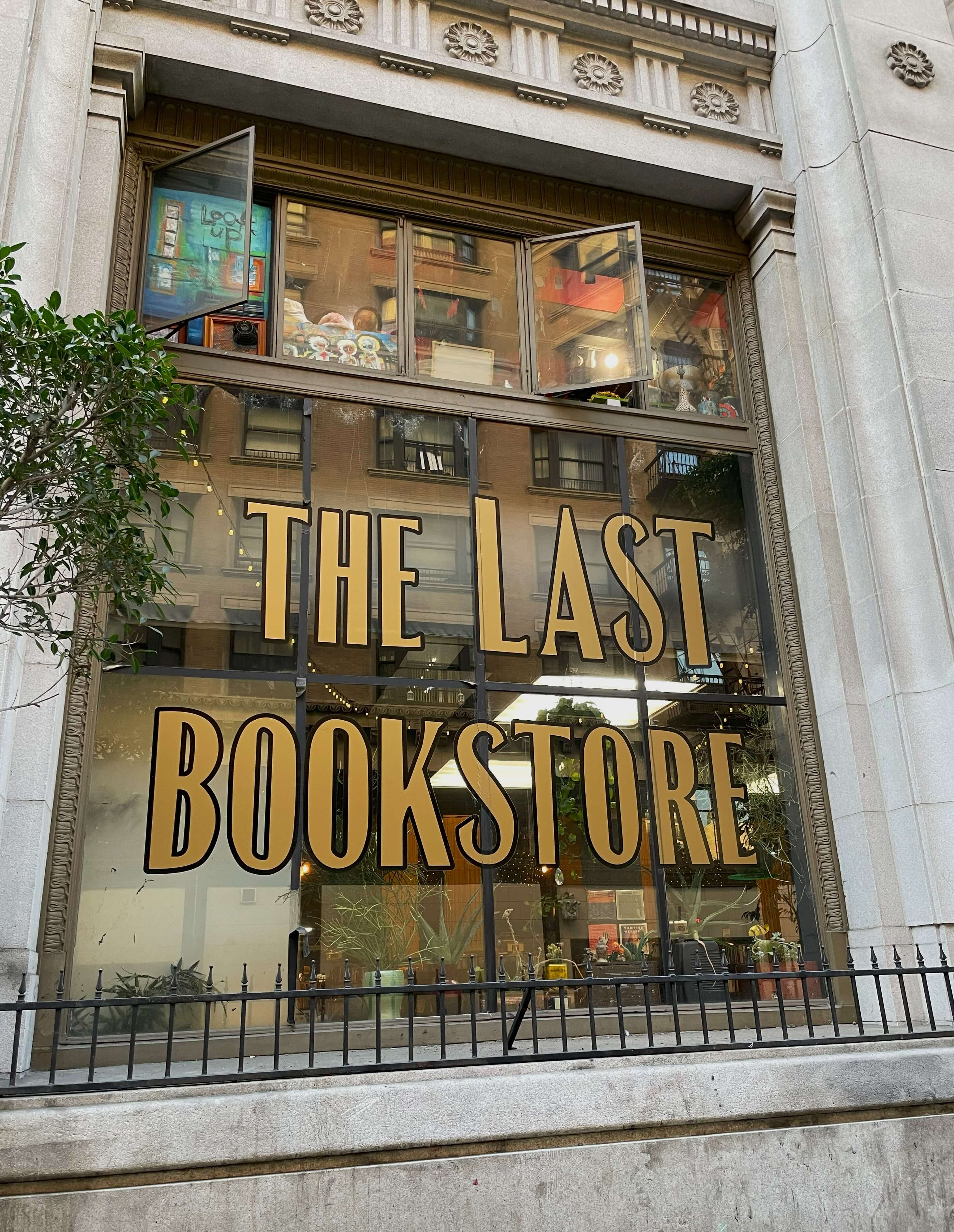
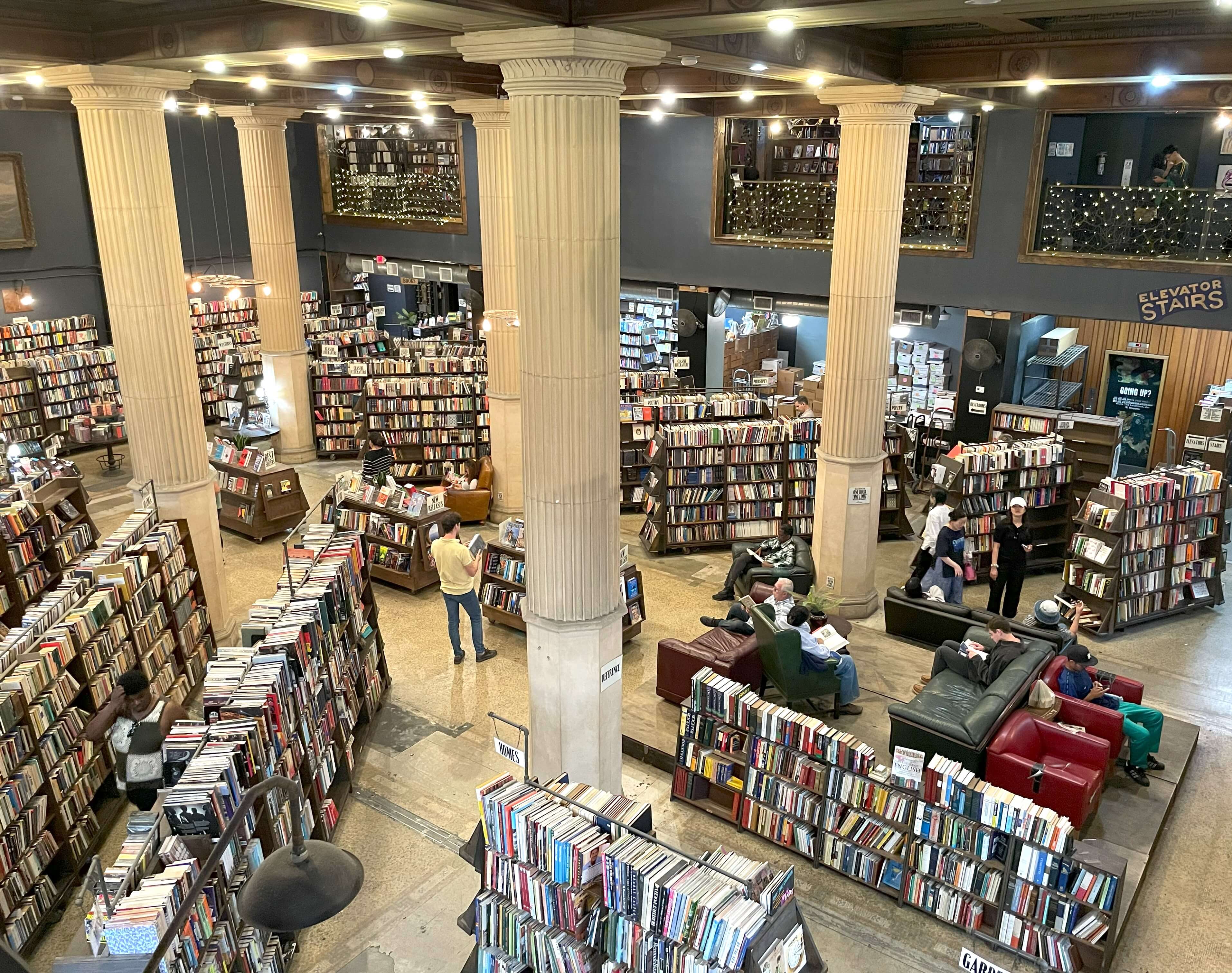
Housed in a hundred-year-old bank building, The Last Bookstore is known for its huge selection of used books and a well-curated collection of first editions, rare, and vintage books (complete with the deep, musty smell that bibliophiles cherish). Customers can also browse through new fiction and non-fiction books, as well as an extensive selection of vinyl records.
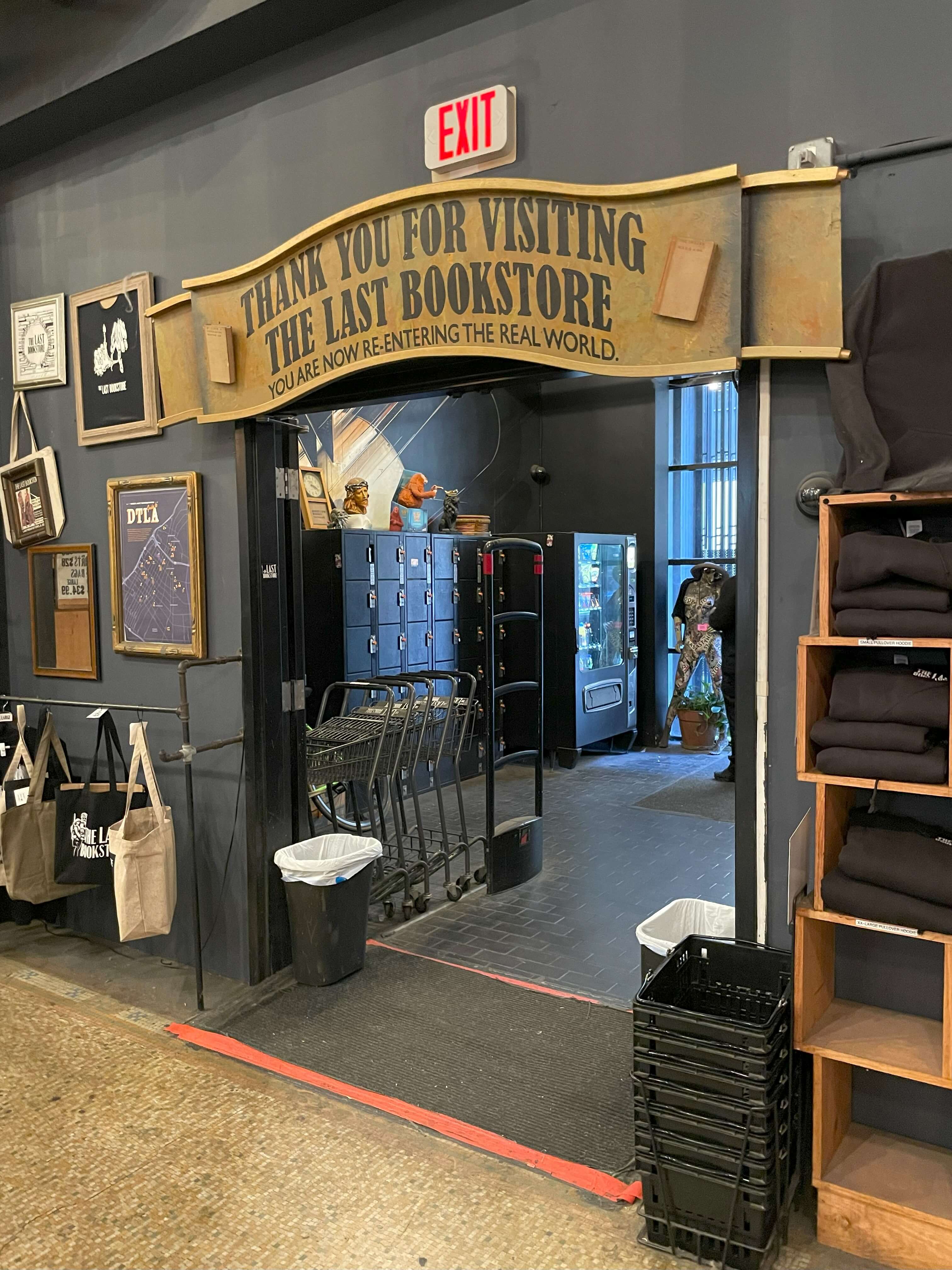
Almost as impressive as the books themselves, are the way they are displayed and the visual delights sprinkled throughout the two-story building.
The marble pillars of the former bank’s atrium support a beautifully carved and painted ceiling.
A bank vault serves as one of several themed book nooks.
The stairs leading up to the second floor.
Harry Potter meets Fantasia.
The door into a genre-themed room; this one focuses on True Crime.
The Book Tunnel.
One of several Book Loops found among the shelves.
In a time when so many independent bookstores have disappeared – and even the huge chains that spelled doom for the indies are closing – The Last Bookstore has managed to hold its own. Even at an impressive 22,000 sq. feet, it’s not as large as Amazon, but it has a lot more heart.
If you love books, check out the What’s on Your Bookshelf? linkup, hosted by Donna, Debbie, Jo, and Sue.
And, if you love doors (and tunnels and mysterious loops), visit Dan’s Thursday Doors challenge to see more.
We all know that each of us comes with an expiration date. If we are lucky, and we remain in decent health, that date is well into the future. Others aren’t so fortunate. Since none of us are privy to the exact day we will take our last breath, hopefully we all live our best life until then.
In her debut novel, The Measure, Nikki Erlick asks: what if we could know how long we had to live? What would happen if a small box containing that information was mysteriously delivered to every person on Earth? Those whose boxes contained a short string learned that they had just a few days, months, or years left. Others found longer strings and, therefore, had lengthier timelines. The novel’s premise is fascinating, and Erlick does a great job exploring how this knowledge could impact individuals, relationships, and whole societies, including how different governments might react.
When my book club met last week to discuss The Measure, our hostess greeted us with an arrangement of small, unmarked boxes. We were told to pick one but not to open it until instructed. After a lively and stimulating discussion about the book (it received a solid 4 out of 5 stars from most of us), things got even more interesting. We went around the room and answered the question: Would you choose to open your box and why or why not?
Some of us, including me, opted to leave our boxes closed. A few said they might have opened it when they were young but not now (most of us are 60+). I chose to leave my box closed because I felt that knowing exactly when I will die could negatively impact my mental well-being. If I found out that I only had until next October, for instance, I’m afraid that I’d spend my last few months worrying rather than enjoying the time I had left.
Others said that they’d absolutely open their box. A few cited current health issues or having children and/or grandchildren as reasons for their decision. Some knew that their curiosity would get the better of them, although they’d probably have to have several stiff drinks before opening their box. Interestingly, even though we all knew these particular strings had no magical powers, as the boxes were opened, there was relief if the string was long, disappointment if it was short.
Image curtesy of Pixaby
So, I’m curious. What would you do? Would you choose to know when – although not how – you will die?
If you’d open the box, would having a short or a long string change anything about how you’d choose to spend the rest of your life? Would you take more risks if you had a long string? Would you be more cautious if it was short?
If you would choose to keep your box closed, why? Would you have made a different decision at another time in your life?
Full disclosure: At the end of the evening, before I drove home, I opened my box out of curiosity. My string was long… whew.
Linking up to What’s On Your Bookshelf? hosted every month by Donna, Debbie, Jo, and Sue.
Every once in a while, a book comes along that inspires me to sing its praises to anyone who will listen. It is so special that long after reading the last sentence and closing the cover, the story stays wrapped around my heart.
I recently discovered such a book by luck. After dropping items off at my favorite charity store, I stopped by their used book section. The book’s blue and yellow cover attracted my attention despite its rather awkward title. I pulled it out, read the blurbs on the cover, and decided that it was going home with me. Normally, I happily pay the few dollars for a book, read it, then return it to the shop so it can be resold. I’m afraid this book won’t be going back anytime soon.
This is How it Always Is, by Laurie Frankel is a book about family. It is also about secrets, fairy tales, and acceptance. It is about life not always turning out the way we envision, and how we deal with the challenges we face.
Frankel’s novel is often laugh out loud funny even as it deals with a very serious subject: raising a gender non-conforming child. I fell in love with the parents, Rosie and Penn, and their four older boys but, most of all, their fifth child, Claude/Poppy, stole my heart.
“He said he wanted to be a chef when he grew up. He also said he wanted to be a cat when he grew up. When he grew up, he said, he wanted to be a chef, a cat, a vet, a dinosaur, a train, a farmer, a recorder player, a scientist, an ice cream cone, a first baseman, or maybe the inventor of a new kind of food that tasted like chocolate ice cream but nourished like something his mother would say yes to for breakfast. When he grew up, he said, he wanted to be a girl.”
Frankel tells the story of this family with such warmth and honesty that it invites thoughtful discussion and consideration. I personally know two families who have a transgender child. These parents and their kids are real people who love each other and are doing well despite the challenges society throws at them. Rather than fearing or disparaging those that don’t conform to our “normal,” maybe this novel can help to open hearts.
Beyond the novel’s overarching theme, there are also lessons here for everyone about unconditional love and acceptance of those who are different. We don’t have to completely understand to treat others with empathy and compassion.
This is How it Always Is has won multiple awards since it was published in 2017, including Amazon’s Best Book of the Year, and the 2018 Washington State Book Award. If you read this book—and I hope you do—please don’t skip the Author’s Note; it made me love the novel even more.
This post is linked to the monthly #whatsonyourbookshelf challenge hosted by Donna, Deb, Jo, and Sue. Head on over to share what you are reading and see what others recommend.
This story was inspired by a writing challenge hosted by D. Wallace Peach, who blogs at Myths of the Mirror. Her challenge: write a poem or story about a TBR (To Be Read) pile – those books many of us have accumulated but haven’t read yet.
I am also submitting my story to the What’s on Your Bookshelf? blog link-up hosted by Donna, Deb, Jo, and Sue. Hopefully fictional book collections qualify 😊.
To Be Read
It had taken nearly eight months, but Jane finally made it through the TBR pile that had been stacked by her bedside. As she picked up the remaining book from the floor, she could see the ring of dust her pile had created on the carpet like the chalk body outline in a crime novel. Her daughter would be pleased that she could finally vacuum the floor properly, but Jane couldn’t help feeling the loss of her friends.
She opened her book and started to read.
At first, when Anne invited her mother to come live with her, she had resisted. Jane valued her independence and knew that their individual daily habits could cause friction. But when Jane’s health deteriorated to a point that even she realized that she could no longer live alone, she consented. Within a few weeks, Jane’s home had been emptied and put on the market. Anne told her mother she could keep anything she wanted, but Jane knew her daughter’s house was small, and space was already at a premium. A few items of clothing, her favorite teacup, and her pile of books was all she brought with her.
A few weeks after Jane moved in, Anne realized the large stack of books by the side of her mother’s bed would be a permanent fixture. Clean, orderly spaces calmed Anne and gave her a sense of control. Books should be on shelves and floors kept clear of clutter. Knowing that her mother would bristle at her beloved books being referred to as clutter, Anne tried to appeal to her practical side.
“Would you like me to find space on my bookshelves for all of your books? That way, you can see each one easier.”
“No, thank you, dear. I love to see all my books out in the open, patiently waiting their turn. They give me something to look forward to.”
“But, what about your safety? Books on the floor could be a hazard. You could trip on the pile and break your neck.”
“What a novel way to die,” Jane replied.
“Very funny Mom, but I do worry about you.”
After several similar conversations, Jane finally agreed to read her way through the stack of books and not add any more. Anne assured her, after the pile was gone, she could check out all the books she wanted from the library or download them to her Kindle. Knowing that this was probably the best compromise she could hope for, Anne willed herself to stay silent despite her continued dismay at the pile. She vacuumed around it as well as she could and – when her mother wasn’t looking – she tried to neaten the stacks.
Over the next several months, Anne was happy to see that her mother was keeping her word. Slowly the TBR pile shrank in size and the floor around her bed started to clear. Anne was confident that, once the pile was gone, her mother would see the wisdom of keeping the area clear.
Before going to bed, Anne opened her mother’s bedroom door to say goodnight. She wasn’t surprised to see that Jane had fallen to sleep reading. She was still wearing her glasses and the bedside lamp was on, casting a ring of light around her. The book she was reading had tumbled out of her grasp onto the comforter. She looked so peaceful. Anne marveled at her mother’s joy of reading and was happy that, despite her poor health, she was still able to do what she loved.
As Anne crossed the room to her mother’s bed, she smiled when she noticed that there were no more books on the TBR pile. She made a quick mental note to make a trip to the library as promised. Anne reached for her mother’s glasses and was startled when her hands brushed Jane’s cold face. She quickly tried to find her pulse but felt none. Her mother was dead.
Anticipating this time would eventually come, Anne knew what she had to do. Holding firmly against her grief, she picked up her phone to call 911.
Anne sat down on her mother’s bed to wait for the paramedics and allowed herself to feel the full weight of her loss. Through her tears, she looked around the room and hoped that her mother had been happy living with her. Curious to see what her mother had been reading, she picked up the book from the bed.
She was surprised to see that it was the book by Mitch Albom she had given her mother when her dad died. Anne had hoped the messages found in The Five People You Meet in Heaven would provide her mother some peace after losing her husband.
“Oh Mom, you knew, didn’t you?” Anne cried. “You knew it was at the bottom of your stack, and you saved it for last.”
Anne saw a pink post-it note peeking out of the book and opened it to the marked page. A paragraph had been highlighted and her mother had drawn little hearts and stars around it.
“Lost love is still love, Eddie. It just takes a different form, that’s all. You can’t hold their hand… You can’t tousle their hair… But when those senses weaken another one comes to life… Memory… Memory becomes your partner. You hold it… you dance with it… Life has to end, Eddie… Love doesn’t.”
When Anne heard the knock on the door, she closed the book, kissed her mother’s forehead, and tousled her hair one last time. Before going to the front door, she walked into her bedroom and placed the book on the floor by her bed, to be read later.






 Retirementally Challenged