… and, by “new year” I don’t mean 2023, I mean “new year” as in embarking on my latest year-long journey around the sun. I turned another year older a few days ago.
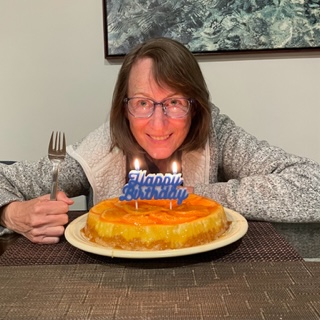
Birthday celebrations now are very different than they were when I was younger. I don’t want to open gifts or go out to a fancy dinner. I’d much rather spend the day exploring someplace interesting, enjoying a home-cooked meal, and, of course, consuming a piece of the delectable Caramelized Orange Cheesecake my husband makes me every year (happy wife, happy life).
Check, check, and check.
You may have read about all the rain California has been experiencing lately. Gosh knows we need it, but maybe not all at once. Here in the southern part of the state, the weather has been milder, but the king tides and stormy surf have brought big waves and some flooding to our coastal areas.
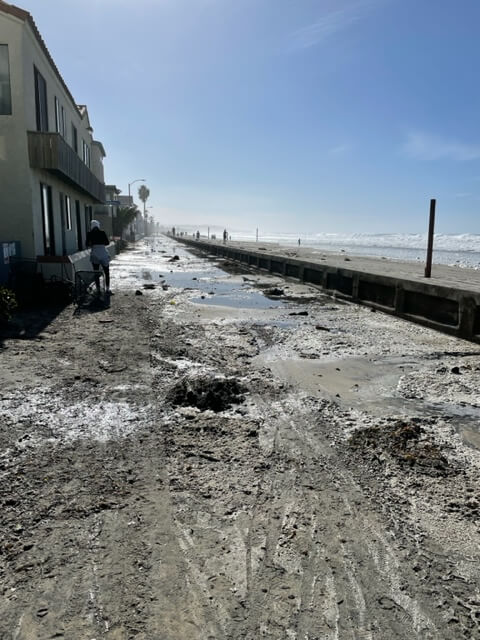
On my birthday, following a day of especially high tides, my husband and I drove to a local beach to watch the pounding surf and see the aftermath of surging water, seaweed, and sand.
This boardwalk is usually filled with walkers, skateboarders, and bicyclists. It will probably be a few days before all the sand is back on the beach… where it’s suppose to be.
Although we missed all the excitement, we heard tales of waves plunging over the seawall, leaving a thick layer of sand that will have to be shoveled back onto the beach.
Our walk also took us to Belmont Park, a beachfront amusement park built in 1925.
Although the interior has been modernized, I’m glad they maintained the Spanish Renaissance style façade.
When I was very young, our parents often took my brothers and me swimming at The Plunge, a huge indoor pool located in the park. The building and pool have recently been renovated, but the sound of kids playing, and the smell of chlorine still brought back many happy memories.
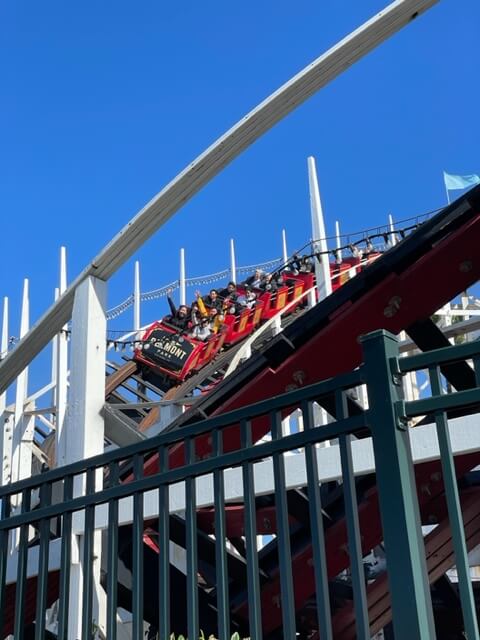
After visiting the pool, we walked around the arcade and midway area for a bit of people watching. That’s when I decided I had to ride the Giant Dipper—the historical wooden roller coaster that was also a part of my childhood—again. Although the roller coaster has been refurbished since I last rode it, it still had the bone-rattling twists, turns and downhill plunges I remembered from my youth.
There is something about a roller coaster that brings out the kid in us.
Topping off the first day of my latest journey around the sun, I dug into a yummy husband-cooked meal before plunging into my favorite birthday treat: Caramelized Orange Cheesecake.
It was the perfect ending to a perfect day.
This week’s Sunday Stills prompt is Plunge. Please visit Terri’s site to see how other bloggers took the challenge.
The final installment of our 1300+ mile road trip in our electric car (Part 1 & Part 2 & Part 3 here).
When we first planned our road trip, we weren’t quite sure which route we’d take back home. Because of the possibility of excessive heat and unpredictable wildfires, we left that decision open until it was time to head south. The coastal route is interesting and cooler, but we drove up that way. There are a couple of north/south freeways that offer the shortest and quickest drive, but they are mind-numbingly boring. If we drove further east before heading south, we could visit Mono Lake, something that I’ve always wanted to see.
When it was time to start home, the temperatures had dropped a bit and there weren’t any active fires, so we decided to head east, then south. This route required some additional planning because, unlike the state’s western corridor, the eastern areas aren’t as populated, and superchargers aren’t as available.
Fortunately, at this point in our trip, we had become comfortable with the apps that located the chargers and with our car’s ability to predict the level of charge we’d need at each one. As we headed east, we drove through mountain passes and pine forests – away from any population centers – but our car told us that we’d reach the next charging station with plenty of juice to spare. Although it can be anxiety-producing to watch the car’s range shrink when climbing hills, regenerative breaking adds most of that range back when driving downhill.
Mono Lake
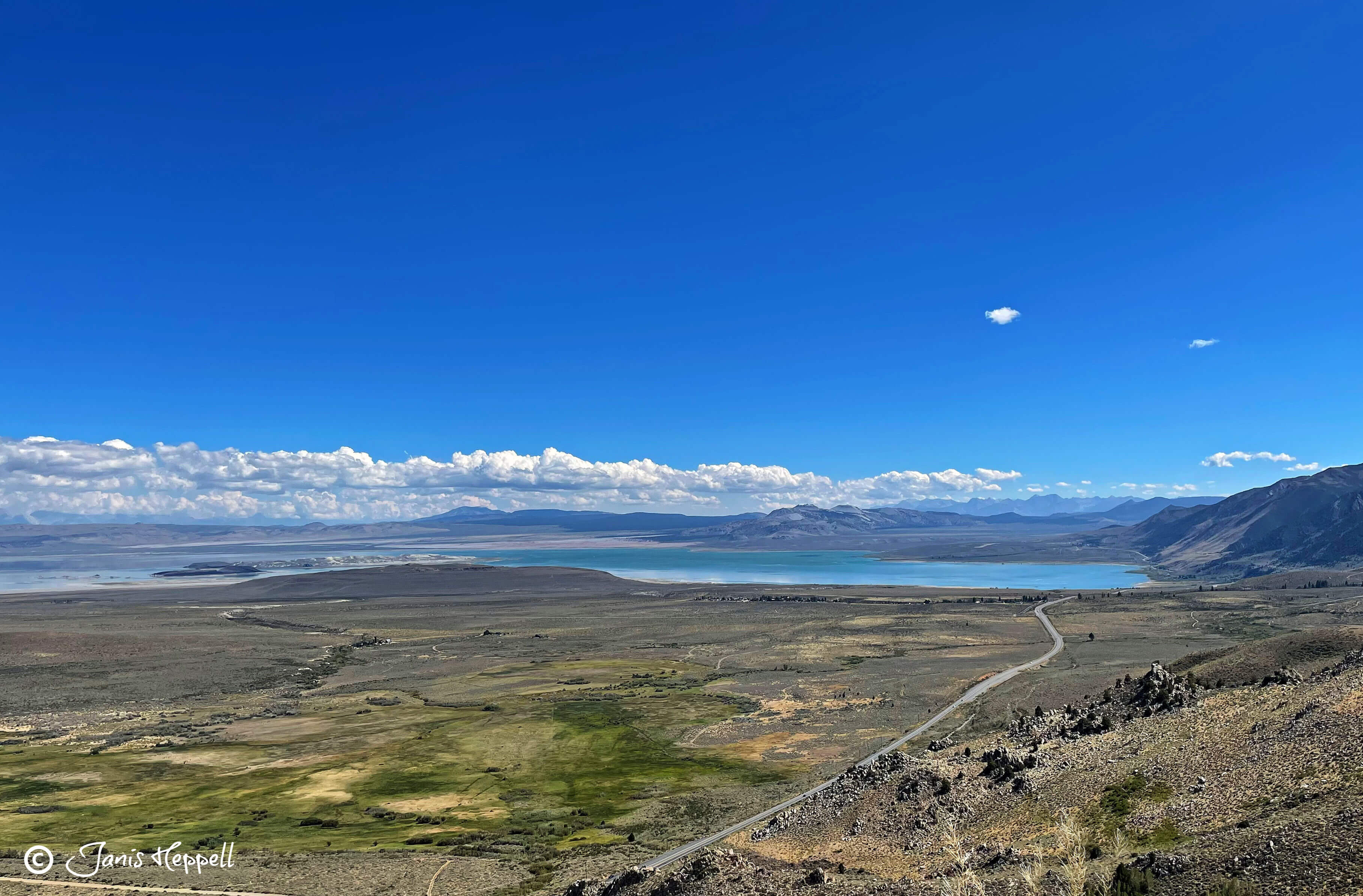
When we came around a bend in the road and first caught a glimpse of the lake from a view turnout, I was in awe. I had seen pictures of Mono Lake but was thrilled to now see it for myself.
Our first view of Mono Lake.
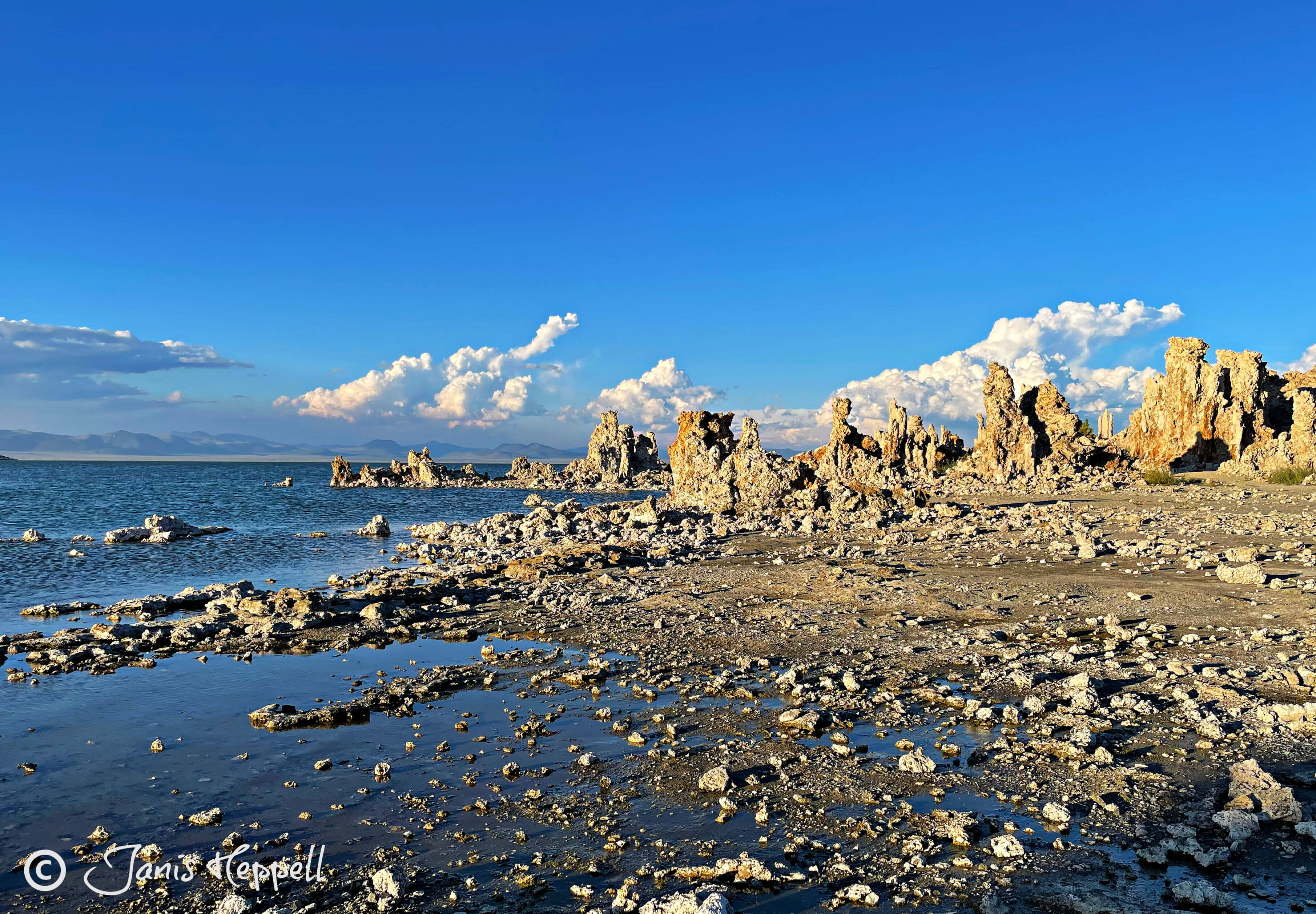
Mono Lake, an ancient saline lake located at the eastern edge of the California’s Sierra Nevada Mountains, is home to trillions of brine shrimp, millions of birds, and the world-famous tufa towers. The lake was nearly destroyed when, in 1941, water was diverted from the lake’s tributary streams and sent 350 miles south to meet the growing water demands of Los Angeles. Fortunately, because of the work of dedicated activists, this practice was stopped, and the lake’s water level is slowly being restored.
The clouds in the background mimicked the shape of the Tufas.The sun setting behind me lit up the clouds.
The Final Stretch Home
When we got on the road the next morning, our plan was to recharge twice along the way before stopping for the night about halfway home. During the drive, we continued to find charging stations available with no wait, as well as places to eat and “refresh” close by. As we approached the half-way point, we were feeling pretty good, so we decided to continue driving after charging.
This decision is not unusual for us; we often choose to power through the last stretch because we are anxious to get home and sleep in our own bed again. What was different was how good we felt after driving for over 7 hours. Stopping every couple of hours for a quick charge (charge time averaged 10 – 15 minutes each) made us get out of the car and stretch our legs. When we arrived home after 8 pm that night, we both felt good.
So, not to get too wonky on you, here’s our final thoughts about our 1300+ mile EV trip:
What we liked:
Charging more often but to lower levels not only makes the trip more enjoyable but the total charging time is actually less.
EV owners are nice and full of information so good conversations happen while charging.
Our car had plenty of power, the cabin comfort was outstanding, and we had more than enough storage space for our luggage.
Although it wasn’t our intention, we saved money. Gas prices are high but so are electricity rates at superchargers. Even so, we spent about half as much as we would have at the gas pump (and no stinky hands).
What could be improved:
Because charging stations aren’t as prevalent as gas stations, the trip took extra planning, and we had a bit of a learning curve on how to use the tools available. Next time, we’ll be better at it.
California has good charging infrastructure, so we had no trouble finding stations. Although more public chargers are being added all the time, for now, we might need to stick to the main freeways when traveling in certain states.
The biggest negative for us is the car’s single large screen located in the middle of the dashboard. Although this is a trend for a lot of cars – even gas-powered ones – we don’t like it. We prefer not to have to take our eyes off the road to perform some of the car’s functions or to see how fast we are driving vs. the speed limit. Without a co-pilot, I’m not sure either of us could comfortably drive unfamiliar roads and read the tiny print on the screen, especially with our older eyes.
Safely home and ready for a good wash.
Now that we’ve been home for a while, we are already thinking about our next EV adventure.
Continuing the story of our 1300+ mile road trip in our electric car (Part 1 & Part 2 here).
Somewhere east of Sacramento – the city where the reunion was held – we passed the halfway point of our trip, miles-wise. So far, we were pleased with the EV’s performance, comfort, and the availability of superchargers.
Amador County, California
We were looking forward to spending the next several days with my brother and sister-in-law exploring Amador County – an area famous for gold mining in the 1800s, and now known for producing wine. The fact that we would also be celebrating both our anniversary and my brother’s birthday while there, was a bonus. Besides visiting a few wineries, our plans included taking a tour of an abandoned gold mine operation, exploring a deep cave, and wandering around several gold rush-era towns and historical cemeteries.
Like many retirees, we prefer to travel in the off-season. After Labor Day, the summer crowds have dispersed, and reservations often aren’t necessary. That’s the good news. Traveling after Labor Day, especially mid-week to smaller towns, can also mean facing “Sorry, we are closed” signs in shop and restaurant windows. More about that later.
Kennedy Gold Mine
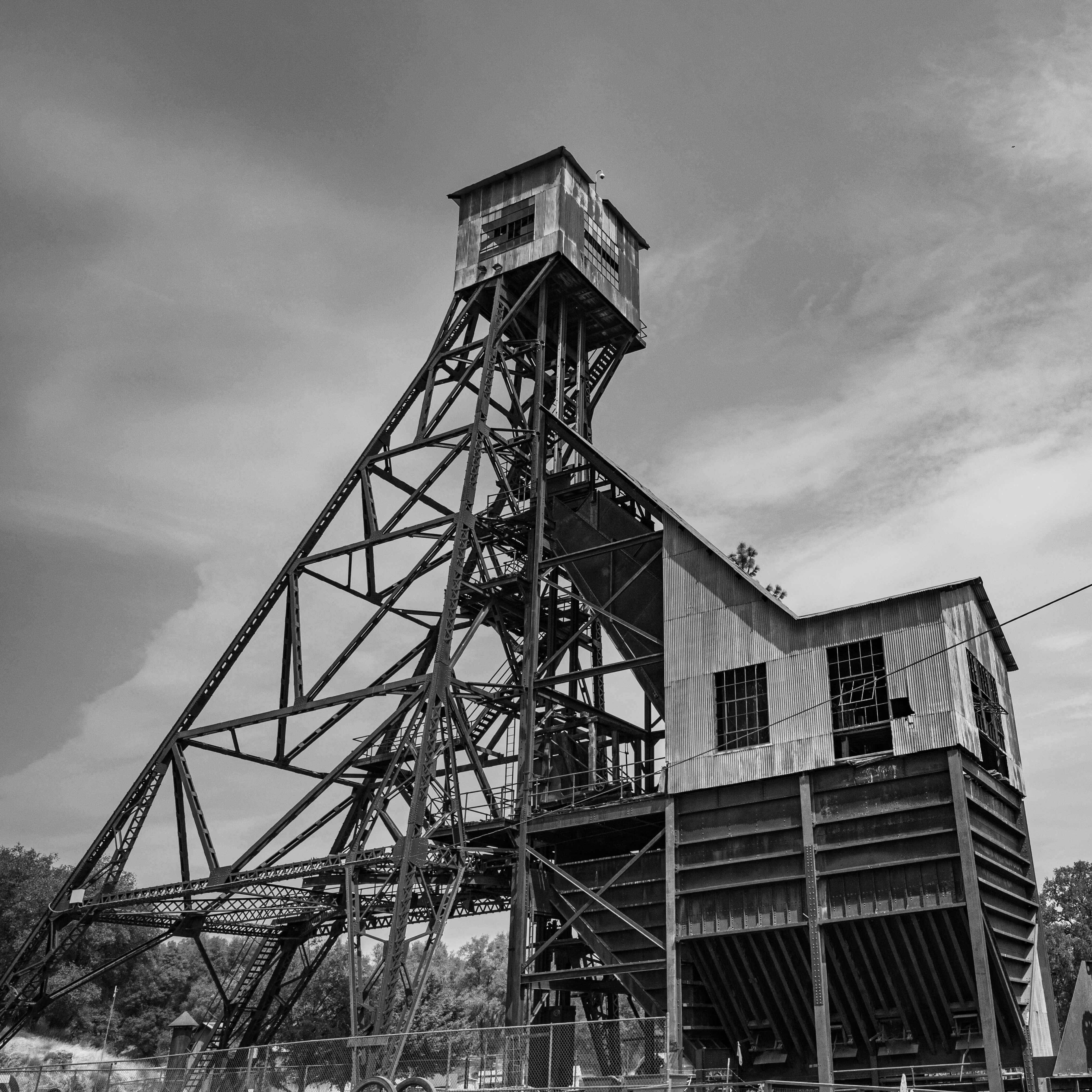
Kennedy Gold Mine headframe, where the miners were lowered into the mine shaft. Photo credit: my brother, Gary.
On our first day in Amador County, we took a tour of the Kennedy Gold Mine, one of the deepest mines in the world. Part of the tour included viewing old black and white films that showed the mine in operation. The mostly immigrant labor worked long hours in dangerous conditions. Despite the mine producing over $34 million (not adjusted for current prices) until it was closed in 1942, there was little indication that much of the wealth trickled down into the pockets of the laborers.
Although the actual mine was closed to visitors, we would have the opportunity to explore beneath the Earth’s surface the next day.
Black Chasm Cavern
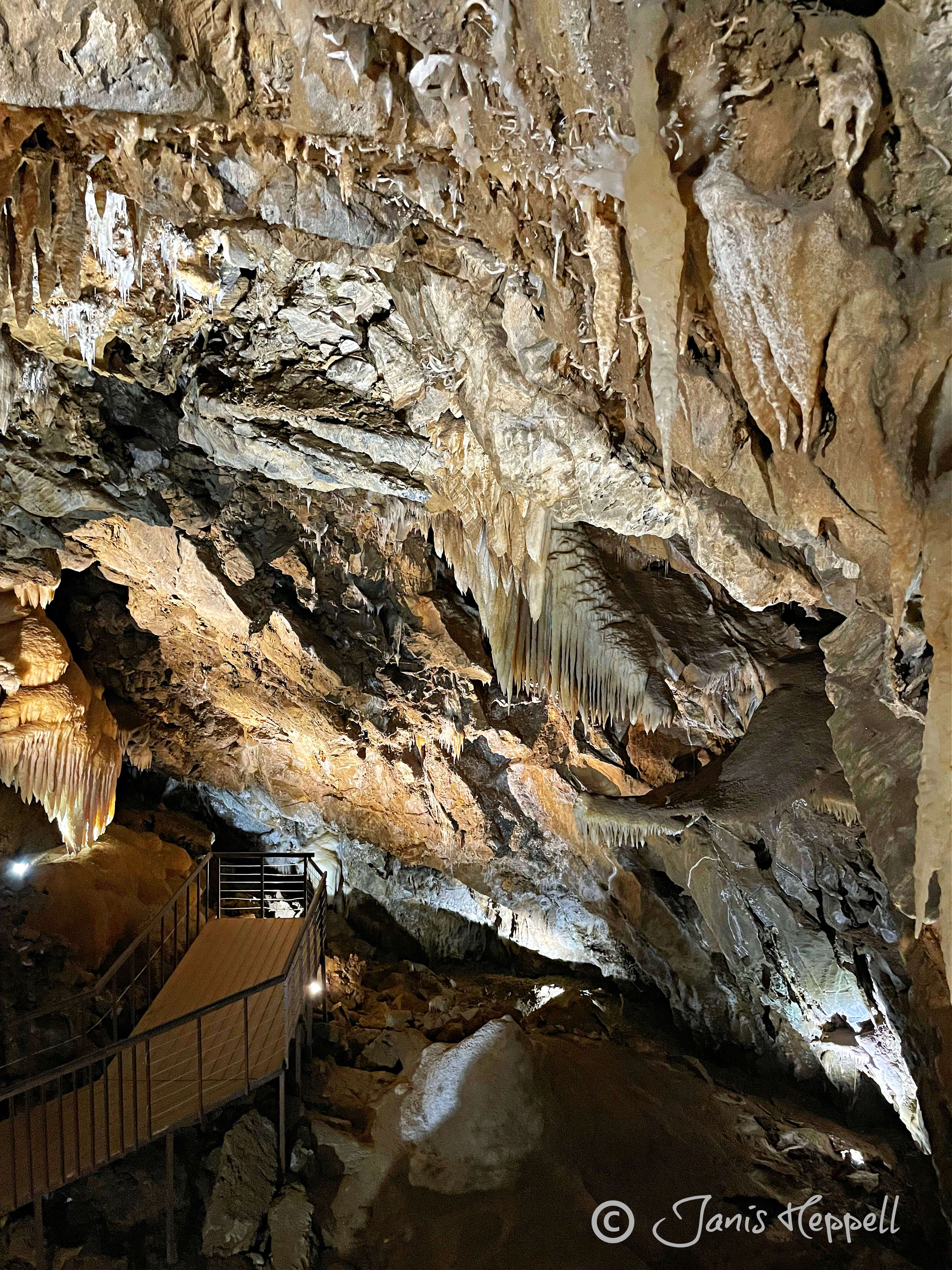
Waiting to enter the cave with the naturalist. Stairs leading down into the cavern.Just one of the beautiful formations we saw in the cave.
Not for those who are prone to claustrophobia or who have a fear of heights, the Black Chasm Cavern was a dazzling experience. The deep, cool cave, with its stalactites, stalagmites, and rare crystal formations called helicites, was the perfect place to spend an afternoon away from the sun.
Historical Towns – charming… and closed
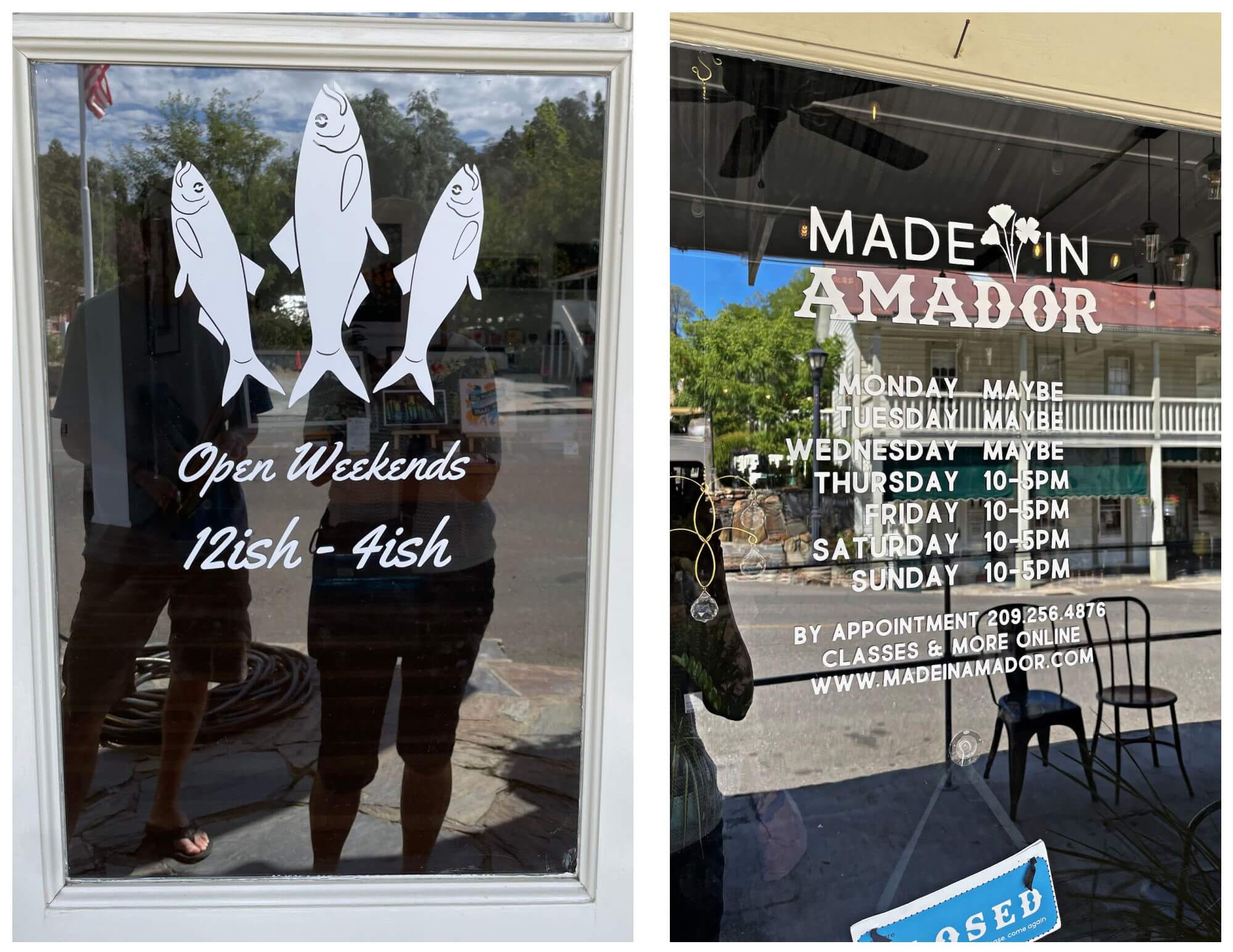
When we weren’t exploring mines, caverns, cemeteries, or wineries, we spent time wandering around several small towns whose founding dated back to the gold rush days. The main streets were quaint and lined with enticing shops and tempting restaurants. Sadly, because we were there at the beginning of the week, most of them were closed. Living in a big city, when everything is always open, this hadn’t occurred to us as a possibility.
Hours of operation were very iffy… and, sadly, closed when we were there.
Fortunately, we were able to find a nice(ish) restaurant that was open on my brother’s birthday. The next night, though, when it was our anniversary and their turn to treat, the only thing open was the restaurant attached to our hotel:
Not exactly elegant, but it’s the thought that counts, right?
I have to admit, although I have no recollection of what we ordered – most likely it was off their 55+ Special Savings menu – it was an anniversary celebration dinner that we won’t forget. Ever.
Continuing the story of our 1300+ mile road trip in our electric car (Part 1 here).
Before we started the trip, we knew that we’d be traveling during an especially severe heatwave here in California. Normally we might adjust our travel dates because of this, but since we were going for my husband’s high school reunion, that wasn’t possible.
What we could adjust was the first portion of our route, which is why we ended up in Morro Bay. When we were planning our trip, we saw that the expected temperature of our usual mid-way stop was over 100 degrees. Morro Bay’s high was in the 70s. That made it an easy choice. The cool, coastal temperatures allowed us to park our car at the hotel and comfortably walk everywhere, including to the pride of Morro Bay: Morro Rock.
Our hotel was just up the street from the waterfront and Morro Rock.
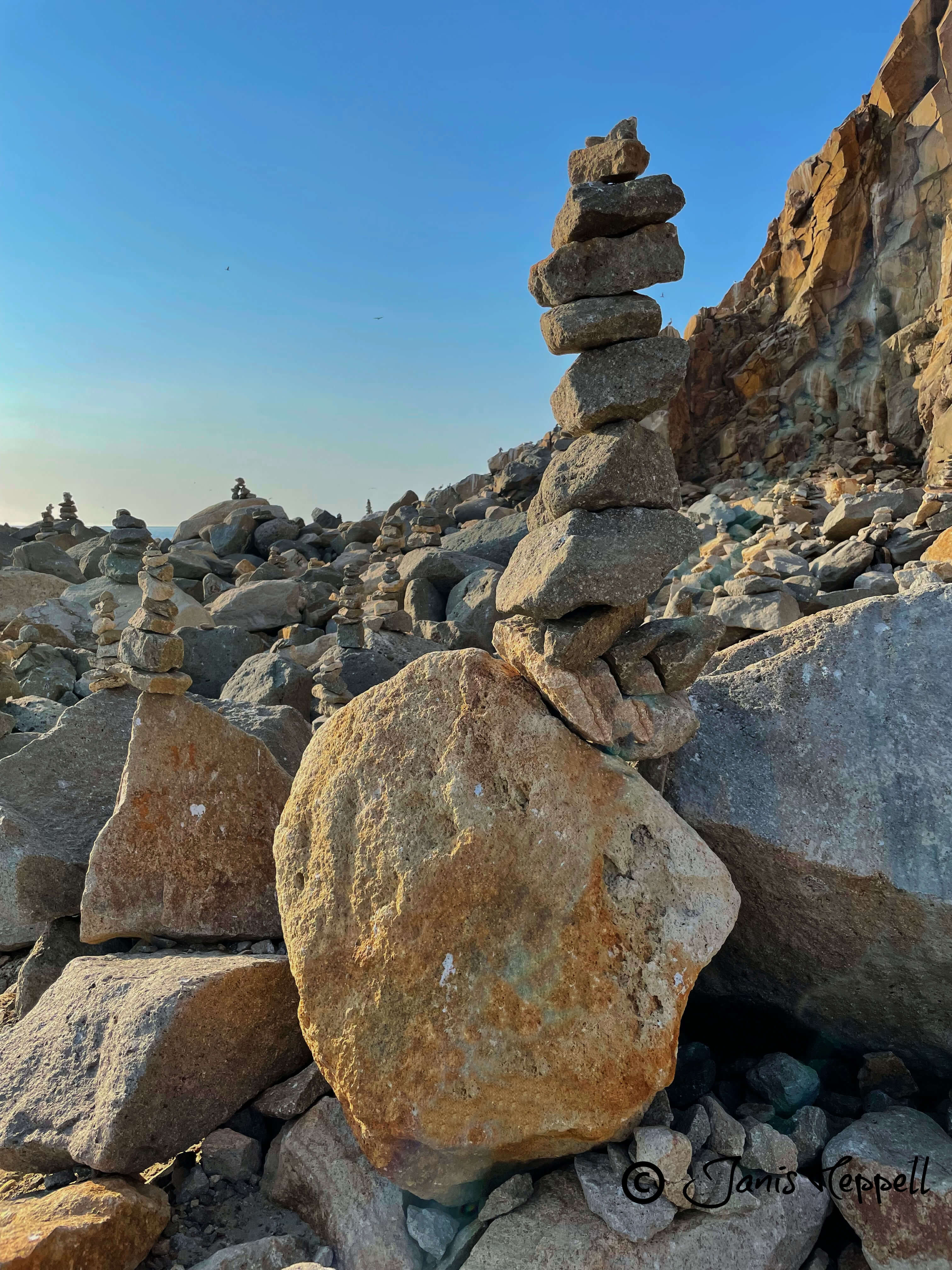
Morro Rock was formed about 23 million years ago from a long-extinct volcano. At approximately 576 feet, it is the tallest of the nine “sister” volcanic plugs that form a chain between San Luis Obispo and Morro Bay. The state historic landmark is a sanctuary for the peregrine falcon and other bird species. It is also the site of the largest field of rock carins I’ve ever seen. Not everyone appreciates these balanced piles of rocks, and I can understand their objection, but seeing so many in one place was pretty impressive.
A field of carins at the base of Morro Rock.Some were quite a balancing act.
The next morning was cool and foggy, and we reluctantly loaded up the car for our drive north towards the heat. Almost immediately, we began to see these digital freeway signs:
The temps where we were headed looked brutal and we knew we’d be giving our car’s AC a workout. Fortunately, while very cold temperatures can lower an EV’s mileage, studies have shown that using the AC doesn’t impact it much more than it does in a gas car. Happily, our car’s impressive onboard computer considers AC use when figuring range, so we never had to sacrifice our comfort to eke out more mileage.
We were also careful to avoid charging between the high-demand period of 4 pm and 9 pm. Only once did we have to plug in during that timeframe when a traffic backup due to an accident delayed our arrival at a supercharger until 4:09 pm (oops). We felt a bit guilty, but we were able to get a quick charge and be on our way in a few minutes.
That charge got us to my brother and sister-in-law’s home located east of San Francisco. We were planning to meet up with them later in the trip but we always enjoy staying for free in their guest roomdrinking good wine from their extensive collection their generous hospitality.
The next day, after another quick charge, we drove to the hotel where the reunion was being held that evening. Since this was not my reunion, I got to be more of an observer. As I looked around the room, it was clear that the past 50 years had been gentler to some than others. Most appeared happy, healthy, and engaged but others seemed fragile. On one table the reunion committee had set out pictures and candles in memory of classmates who had passed away. Many of us commented on the number of pictures and how it was a sobering reminder to enjoy life while we can because there are no guarantees.
Before I end Part 2 of our electrified journey, I would like to touch on luggage storage space. There is a common misconception that EVs are small and tight on trunk space, but, since the batteries are located under the chassis, our car has plenty of room. Not only is our trunk generous, but we also have a decent-sized “frunk” under the front hood where a gas car’s engine would be. Although we aspire to be light packers, this trip required both play clothes and dress-up clothes. One large and one small suitcase, a garment bag, and several additional bags fit with room to spare.
When my husband and I first talked about taking our electric car on our upcoming road trip, I was a bit hesitant. A gathering for a high school reunion prompted the trip, but we wanted to take advantage of the location to visit family and do some exploring. My concern was that driving our EV might make us adjust our route too much. I’m a big fan of electric vehicles, but I didn’t want to miss an opportunity to go somewhere because we wouldn’t be able to charge our car.
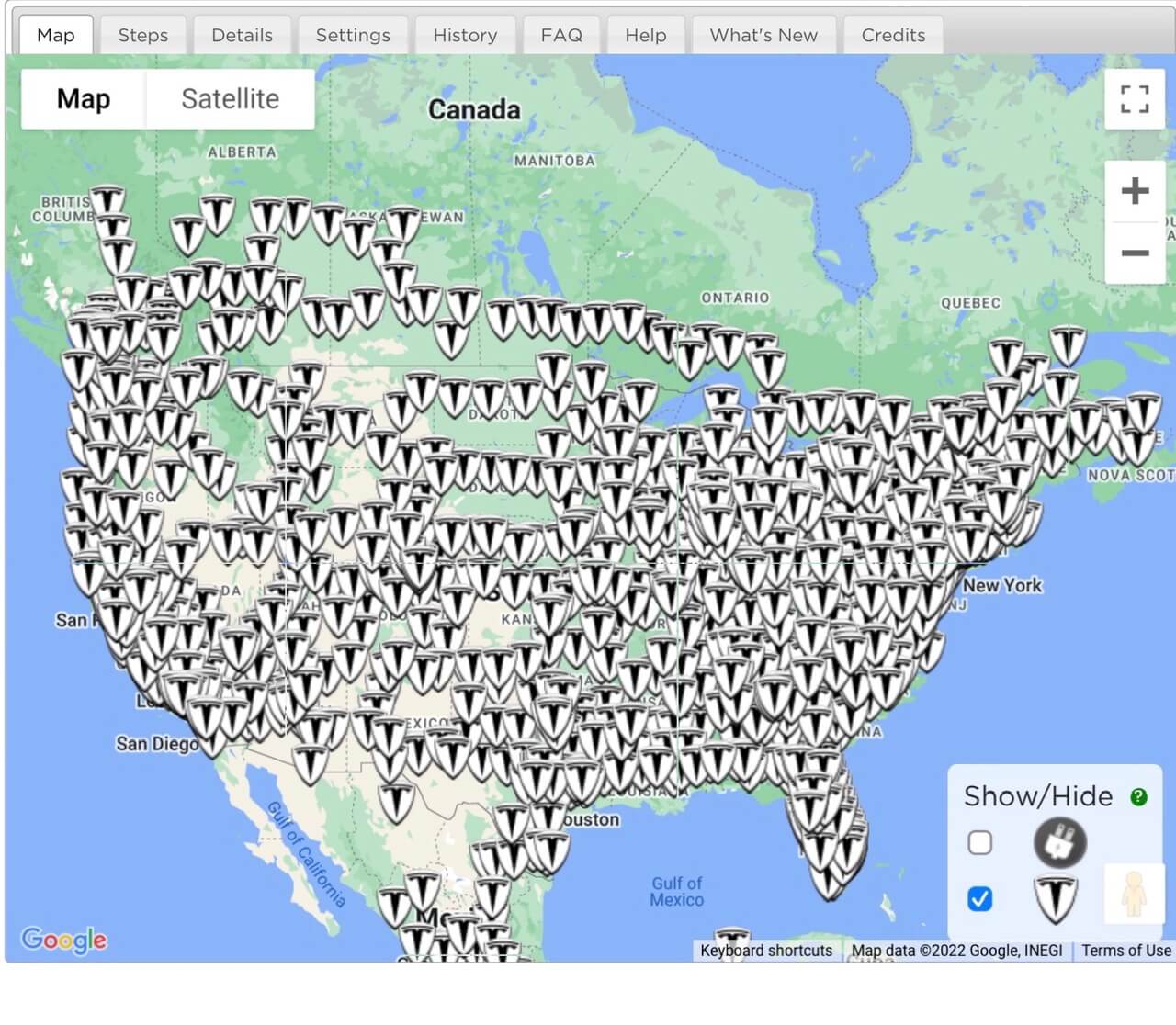
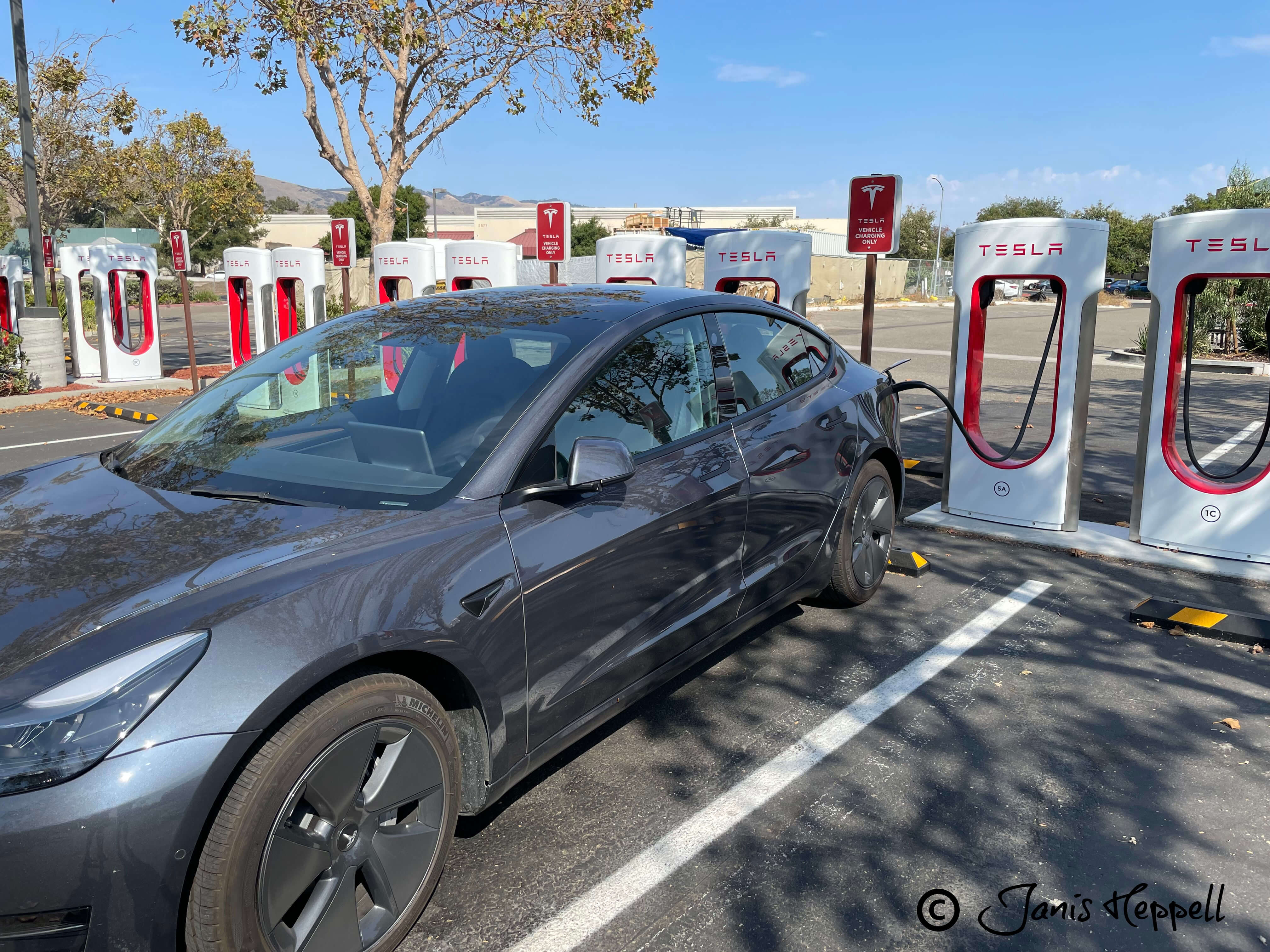
Normally, charging isn’t a problem. We plug our car in at home, charge overnight, and it’s ready to go in the morning. The car has plenty of range to last us at least a week with our usual daily driving needs. We had recently taken a couple of short trips that required some charging away from home, and they had gone well. Now that we were about to embark on a 1,300+ mile road trip, we knew that pre-planning would be important because of the multiple charging stops we’d need to make. Even with California’s relatively robust infrastructure of charging stations – especially Tesla-branded superchargers – they aren’t as ubiquitous as gas stations.
EVTripPlanner.com was a great help with planning our trip.
There seems to be (at least) two philosophies about road trip charging: A) Make fewer stops and charge to 100% each time, or B) Make more stops, but charge to lower levels (60 – 70%) each time. After some research, we like option B best for several reasons:
Each charging stop takes less time. When charging past 60-70%, charging slows way down as it tries to “stuff” more juice into the battery (this is not a scientific explanation, but you get the point).
More stops mean more opportunities to stretch our legs… something we’ve come to appreciate on longer road trips.
Lower stress. By not waiting until the car’s charge level was low before we re-charged, we would have a comfortable range cushion each time we reached a station (sort of like not waiting until your gas level indicator turns red before re-fueling).
The route we planned had us driving about 2 hours between charges and charging to no more than 70% each time. Of course, we could adjust this along the way, but that felt like a comfortable pace.
We only had to wait for a charging station once our whole trip. Usually, we’d find plenty of stations available.
Between our home and our first night’s stay, we stopped at three supercharger stations. While our car charged – a process that took about 10-15 minutes – we entered our next destination into the car’s computer. After some calculations, it told us where the next supercharger was located, how much remaining charge we’d have when we got there, how many stations they had, and how many were available for use (updated real-time).
Morro Rock at sunset.
As we strolled along the waterfront in Morro Bay, California, we congratulated ourselves on completing the first leg of our journey without any issues. Our pre-planning had paid off. We were becoming more comfortable with the car’s systems and confident that we had made the right decision to drive our EV.
The theme for Terri’s Sunday Stills challenge this week is “Under Construction. It seems as good an excuse as any to dip my toes back into blogging after taking much of the summer off. Part of my absence was construction-related, but lazy summer days and lack of inspiration are mostly to blame. Although I have continued to enjoy reading other blogs, I couldn’t manage more than three posts of my own since mid-May.
Deck Construction
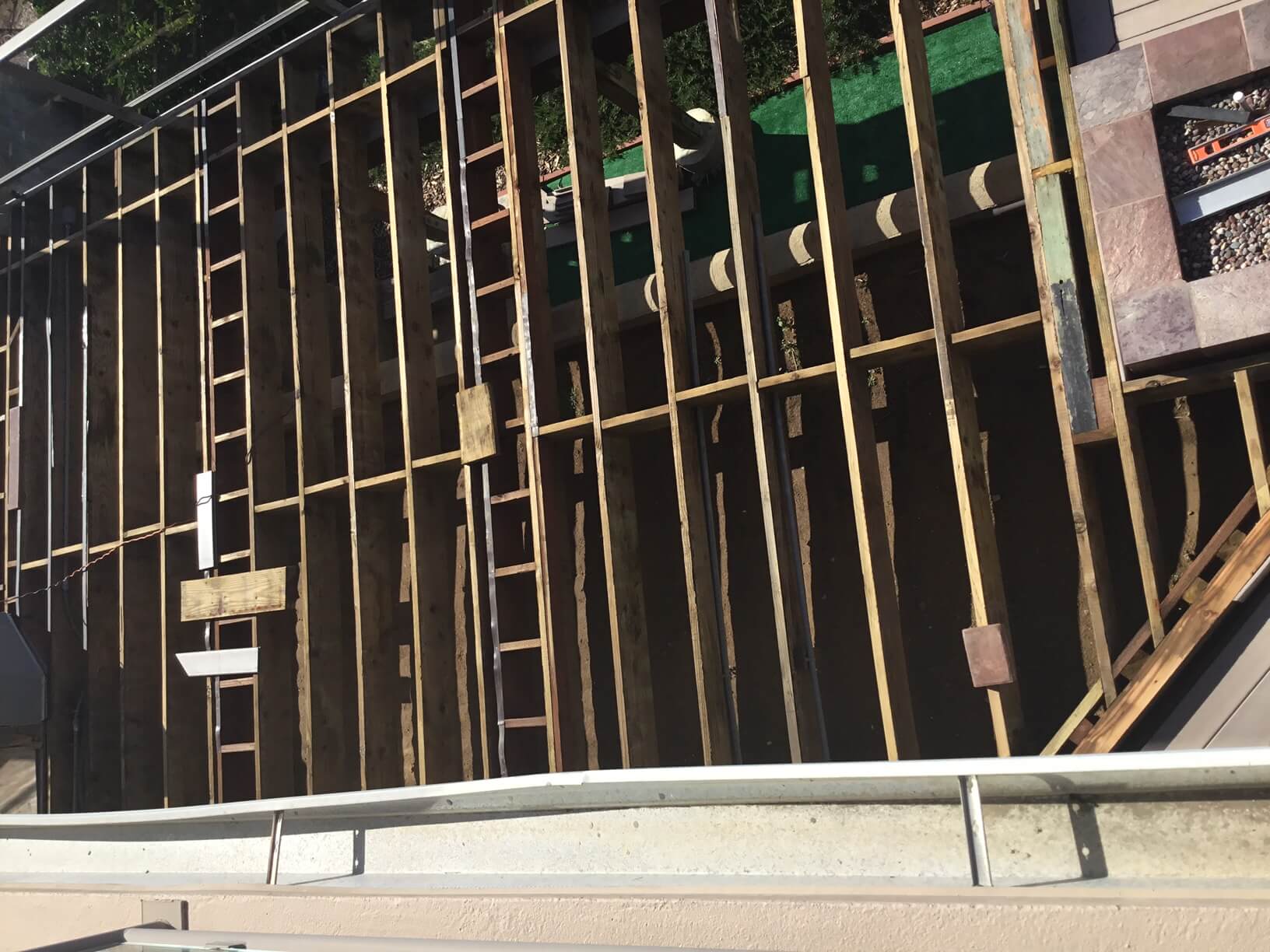
We actually did have a rather large construction project this summer, which took a lot of my time (full disclosure: it took much more of my husband’s time). Our 20-year-old deck was starting to show its age, so we decided—just when costs ramped up, and supply chains broke down—it was time to repair and re-surface it. The good news is that we found a nice young couple who wanted the old material, so we avoided sending it to the landfill. The bad news (besides cost and availability) is that the project was more work than expected (more full disclosure: it’s still not 100% done).
During and (almost) After deck construction
We are happy with the way it turned out, though, and hope it will last at least another 20 years (seeing as we’d be in our 80s then, I imagine that we will decide to ignore any flaws and grow old with it). In the meantime, we are enjoying our new deck and slowly forgetting the effort it took to build it.
Blog Construction
Even though I haven’t been writing many posts lately, I have made a few minor adjustments to my blog.
One that I should have done a while ago: after reading a head’s up on Hugh’s News and Views, I added some copyright verbiage at the end of my posts and made it a recurring block. I also plan to routinely watermark certain photos. I doubt if this will stop anyone determined to steal my words or images, but I hope it will stop some. I am not happy when I find what I’ve shared on my blog appearing elsewhere.
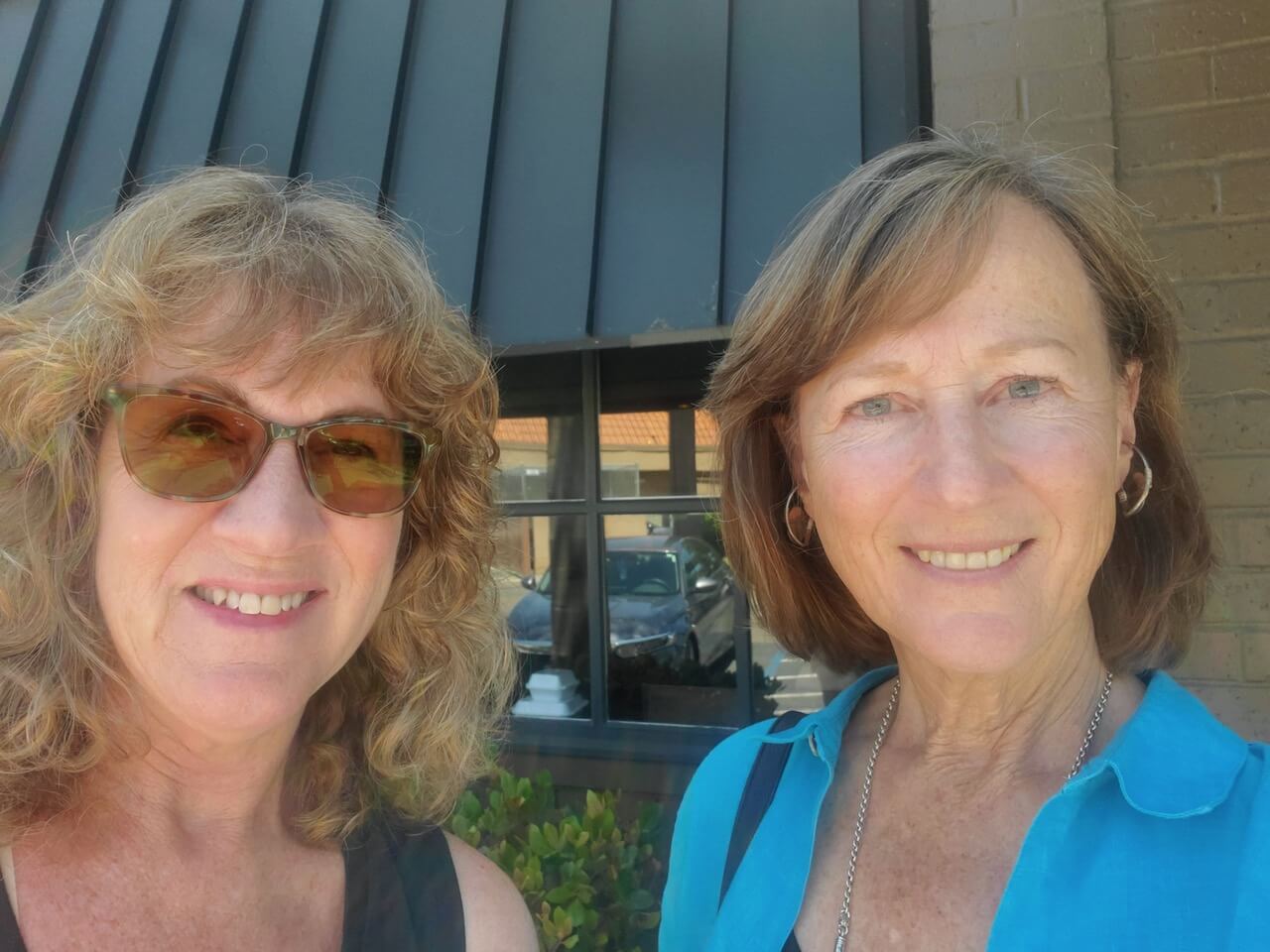
It was great to see Terri in June
Another change was suggested by Terri when we had a blogger meet-up a few months ago. I believe that I “may” have been whining about all the spam comments my blog was getting. WordPress does a good job filtering them out, but I still look at each one before deleting to assure that a diamond hasn’t gotten swept up with the dregs. Her suggestion of turning off comments after a post is over 120 days old has helped immensely (thank you, Terri).
Travel Plan Construction
My husband and I are planning a road trip later this year and we are looking forward to getting away for more than a few days. Although our itinerary won’t take us anywhere we haven’t been before, what will be different is that we are driving our electric car. We’ve driven the EV on some mini-trips that have required one mid-point stop for re-charging, but this will be the first trip where charging will be part of the planning process.
We love our electric car, and it is perfect for our day-to-day driving needs, but its 260-mile range won’t get us to our destination on a single charge. Driving an EV on an extended trip will take a bit of planning but there are a lot of online tools and fast charging stations available, so we see it as adding to our adventure. Since there is an increase interest in electric cars—including, unfortunately, a lot of misinformation—I plan to share our experience after we return.
Thanks for the inspiration, Terri, it’s good to be posting again.
If you live in the United States, I’m sure you are aware of the high cost of medical care in this country. Although not all of us will need to see a doctor or go to the hospital this year, many – especially those of us who are older – regularly take one or more prescription drugs. For those with chronic illnesses, the cost of these medications can be quite high. Tragically, some people on limited incomes have found themselves having to choose between paying for their medications, paying rent, or buying food.
One of the major reasons for high prescription drug prices is the lack of price transparency. As consumers, we are at the end of a bloated, complicated, and opaque supply chain. Even when drug prices are reduced, the original price before the discount is often set artificially high.
Enter Mark Cuban and his new company CostPlus Drugs. Cuban, entrepreneur billionaire and owner of the Houston Mavericks, decided to approach the high cost of drugs as a business problem with a straightforward solution: total price transparency. His website, costplusdrugs.com, which debuted this January, has over 700 generic drugs listed, with more, including branded drugs, to come.
The pricing is as follows: cost of drug + 15% + $3 pharmacy fee + $5 shipping. It’s really that simple.
I am lucky to have good health insurance with manageable deductibles. I take two generic medications daily and, although I have never struggled to pay for these prescriptions, I was curious to see if I’d save anything by ordering them through CostPlus Drug Co.
I had recently ordered a 90-day supply of both medications from my usual online pharmacy and was billed $36.81, which included free shipping. If I had used CostPlus Drug Co., my cost would have been $25.90 (this includes $10 shipping, $5 for each drug).
Although these aren’t life-altering savings, if I didn’t have insurance or my insurance wasn’t as robust, the savings would have been greater. If you or a loved one take prescription medications – either regularly or for a temporary condition – you might want to check it out. The website is very user-friendly and full of information.
I realize that CostPlus Drugs isn’t the only company trying to bring down the high cost of drugs, but I like its ease of use and transparent pricing. And, because I support its mission, I will order my prescription drugs through them from now on.
Whatever you are paying, it makes sense to shop around first. And, if you like what you see, spread the word. If more people take control of the cost of their medications, Big Pharma might take notice.
One of the first trees we planted in our yard when we purchased our house almost 30 years ago was a lemon tree. Although we’ve enjoyed its bounty since then, this was the first year I decided to try my hand at making the sweet, golden elixir called Limoncello.
Just about anything made with lemons gets a “yes, please” from me, but usually they are an ingredient of a savory dish or a dessert. In fact, one of my favorite dinners we’ve made included baked lemon chicken, a green salad with a lemon vinaigrette, and lemon pudding cakes baked in individual ramekins.
YUM!
So, where was I?
Oh, yes, Limoncello.
I have had commercially made Limoncello before, but I never thought to make it myself until a friend gave us a bottle of her home-made brew. Not only was it tasty, but I was excited to learn that it is easy to make. In fact, the hardest part is allowing the lemon peels and vodka enough time to mingle and do their magic before decanting.
Just four ingredients: lemons, vodka, sugar, and water.Peel just the yellow part of the lemons.Soak the lemon peels in vodka… watch it turn a lovely yellow.
If you’ve never tried it, Limoncello is a classic Italian liqueur with a refreshing lemon flavor. It is traditionally served after dinner as it is thought to aid digestion (and, who am I to argue with sound medical advice?). It is typically kept in the freezer and served cold so it’s perfect for summer. It can also be used in dessert recipes, including a delicious-sounding Limoncello and Ricotta Almond Cake (thanks, Widow Badass) I plan to try.
You can find a lot of recipes for Limoncello online, but they are all pretty much the same: organic lemons, vodka, sugar, and water. Recommended vodka proofs vary (most recipes suggest higher proofs), as does the time to infuse the lemon peels in the vodka (as little as four days to as much as three weeks) before mixing with the syrup. The only recommendation I have after making my first batch is: don’t buy the Costco-sized bottle of vodka (1.75 liters vs. the more normal size of 1 liter). I now have so much limoncello that not only will we be enjoying it all summer, but we’ll giving a few bottles away to friends. Not a bad problem to have.
Bottles ordered from Amazon… label designed by moi. Cheers!
So, What’s on Your Plate (or, in this case, your glass)? Join Donna and Deb for their monthly blog challenge. Link your own food-related post or just read what others have shared.
No, I’m not talking about those cute, bushy-tailed critters that are currently making a mess under our orange tree. I mean those distractions that keep me from finishing tasks, including blog posts.
Don’t let their cute little come hither looks fool you.
I’d love to tell you that my computer desk is neat and tidy, but that would be a lie. It’s covered in squirrels. Every time I sit down to write a post, at least one of them starts nipping at my arm. As soon as I turn my focus away from my keyboard to attend to that squirrel’s needs, more squirrels begin clamoring for attention.
The same thing happens in other areas of our house. Recently I started going through my closet to purge clothes I no longer need only to be distracted by squirrels on my dresser, next to the bed, and even hiding in the linen closet. It is impossible to complete a chore while being bombarded with their incessant chatter.
The squirrels in my living room and kitchen are in competition with each other. If I’m in the living room, the kitchen squirrels start to make a ruckus. If I’m in the kitchen, the commotion the living room squirrels make is hard to ignore. (Of course, the kitchen squirrels have a distinct advantage since they can tempt me with food. The refrigerator squirrels are particularly good at vying for my attention.)
My squirrels have been especially active lately. There are multiple partially finished tasks that I really need to get done. I have sewing projects, writing projects, arts and crafts projects, and house projects, as well as organizing, gardening, and trip planning to complete. Unfortunately, once I finish my morning coffee and the daily Wordle (the newest squirrel to take up residence in our house) all the other squirrels start demanding equal attention.
I obviously can’t please them all, so I’m trying to be more selective in responding to their seductive cries. In fact, as soon as I tidy up my desk squirrels, I will finish this blog post.
If you are reading this, you know that I was successful… at least this time.
One of my favorite times to scroll through the photos on my phone is at the end of each year. I find that it’s a great way to remind myself of things that I’ve done, the fun I’ve had, and what I’ve accomplished (and, if taking a lot of pictures is an accomplishment, I’m a rockstar) over the past year.
For this week’s Sunday Stills theme, Rear-View Mirror, I chose one picture from each month in 2021 to remember what brought me joy – and there was a lot – during this very strange year.
January
Our first vaccinations! It felt monumental… like we were really, really going to beat this thing.
February
Despite some activities being curtailed, we still enjoyed getting out to explore our beautiful city.
March
Less actual grocery shopping and more experimentation with kit meals shipped to our home.
April
Good times and interesting conversations when friends Kathy (SMART Living 365) and her husband Thom came for a visit.
May
Our blueberries begin to ripen.
June
More good times and interesting conversations when we visited Kathy and Thom at their mountain get-a-way.
July
Sunflowers and bees with pollen booties… is there anything better?
August
We crossed the Canadian border the first day it opened. A month of blogger buddy meet-ups, hiking, and experiencing the beauty of Vancouver Island commenced.
September
After our stay on the Island, we ferried over to the city of Vancouver for more exploration and fun.
October
Our local Dia de los Muertos celebration. Maybe not as elaborate as in Oaxaca, but very colorful and no plane trip required.