What would you Grab if you had to Go?

My husband and I were relaxing on our deck a few days ago when we noticed several planes circling to the east of us. All three were mostly white with red markings and lettering. When one of the planes flew close enough to our house, we could clearly read the words CAL FIRE on the underbelly. That’s when we noticed the brown smoke in the distance.

The fire, I soon learned from checking social media, had started in a canyon a couple of miles from our home. A small brush fire when it was first reported, quickly grew to an estimated five acres. We live a reasonably safe distance away but those whose homes were close to the canyon’s rims, received evacuation notices.

The great news is that the fire was brought under control within a couple of hours. No homes were damaged and everyone who evacuated was able to return home safely. With the memory of January’s devastating Southern California wildfires fresh in our minds, I imagine everyone living within a few miles of the canyon fire heaved a huge sigh of relief. We know how a small brush fire can spread quickly, consuming tens of thousands of acres, destroying thousands of homes, and threatening lives.

After the smoke cleared and the planes were gone, my husband and I talked about what we would take if we had to evacuate our home. Whether we had the luxury of time or just minutes, what would we grab first? I mentioned family photos, a few items of personal or monetary value, my laptop, and important paperwork. A change of clothes would probably be helpful too. As I looked around our house, I didn’t see many items that I either couldn’t do without or that couldn’t be easily replaced. The possibility of losing everything really focuses you on what is important.

Old family photos are often at the top of people’s grab first list.

This conversation has encouraged me to give a lot more thought to the question: What would I take? What’s important? What is irreplaceable? What would we need to sustain us if we couldn’t return to our home – assuming we still had one – for a while? What would we need to help us recover any losses?

Where we live, wildfires and earthquakes are the biggest threat. For others, it might be floods, tornados, or hurricanes. I am not aware of any location that is completely safe from a natural disaster. Although we don’t dwell on threats, being prepared for what ifs can help give us peace of mind.

Creating a Grab and Go evacuation plan wasn’t on my original Organize My Life to-do list but in the wake of recent events, I have added it and moved it to the top.

I don’t have a final list yet, but here is my initial outline:

  • List of items that will be needed if away from home for any length of time, or that are valuable and/or irreplaceable. Don’t forget medications.
  • List of personal records that may be needed (insurance, financial, medical, etc.).
  • List of passwords, PINs, and codes that may be needed.
  • Make a separate list of items to take if there is more time to pack before evacuation.

On both lists, indicate where the items are located. If anything needs to be gathered quickly, ensure those items and records are easily accessible (if your precious photos or family heirlooms are buried in a storage closet, you may not have time or the ability to grab them before you have to leave).

This is a list that I hope to never need, but I will feel better when it’s completed. Better to consider what to take now rather than when feeling worried and stressed.   

Do you have a Grab and Go list for your home? Can you think of anything I should add to my list?

Copyright © 2025 RetirementallyChallenged.com – All rights reserved.

Hoping for the best…

… but preparing for the worst.

I’ve lived in Southern California just about my whole life. Although the threat of earthquakes has always been “out there,” I doubt if many Californians have bothered to put together even a basic earthquake preparedness kit. Even though natural disasters occur in all parts of the world, they are easy to ignore in our day-to-day lives. We don’t deny the reality of earthquakes, hurricanes, tornados, tsunamis, or giant wildfires, we just would rather not think about them.

Now, with the latest threat to our health and safety – the Coronavirus – all over the news, a lot of people are starting to pay attention. Maybe it does makes sense to collect some important items just in case we find ourselves quarantined in our homes for several weeks. Californians have long been encouraged to make personal preparations for “The Big One,” but this virus has prompted many people to finally act.

There are already reports of shortages of canned food, disinfecting products, toilet paper, and water storage containers as more and more people realize that, in fact, it can happen here. As the news reports more people being infected – and dying – even greater panic buying will ensue. Those who wait until the last minute could face empty shelves, back orders and, sadly, price gouging.

Looking for hand wipes? Sorry, many stores are already out.

Recently, on the front page of our local newspaper, among articles about election results and the latest CONVID-19 reports, was another earthquake warning. A large fault, which is located very close to where we live, could produce a quake of 6.9 or greater. An earthquake that large could not only damage or destroy thousands of structures, but also cut gas and water service and cause widespread road and bridge failures.

We are not worriers by nature, and we don’t consume media that peddle wall-to-wall, end-of-days, scary “news,” but we also think that taking some precautions is warranted. We have taken seriously the admonitions to wash our hands frequently, avoid touching our faces, and dodge crowds and anyone who shows signs of a cold. Fortunately, since we are retired, we don’t have to worry about ill co-workers. We think our chances of avoiding the virus are pretty good. That being said, we’ve purchased a few things “just in case” and I feel that we are better prepared than we were.

Sometimes it takes something actual – as opposed to just possible – to prompt action. After many years of “meaning to” put together a disaster preparedness kit, we finally have.

GratiTuesday: Those who rush towards

I don’t know if we’ve had more disasters – both natural and made-made – this year or not, but it certainly feels like it. Wildfires have eaten up acres of beauty and hundreds of homes and businesses, hurricanes and storm surges have created destructive winds and deadly floods, and the sudden shifting of the Earth’s tectonic plates have toppled buildings and collapsed bridges. Then, there are the disasters created by the mentally ill, the morally repugnant, and the fanatically delusional.

It can be difficult to feel gratitude in the face of all of this. I don’t live in a hurricane zone, I haven’t been touched by a catastrophic wildfire, the earthquakes I’ve experienced have been mild and caused little damage, and I haven’t had a loved one’s life cut short by a bullet or a bomb, but I certainly don’t feel immune. Neither planning nor luck – and certainly not “thoughts and prayers” – will ensure my safety. Those who have recently been impacted likely once felt sorrow and empathy for past victims, and maybe some relief that they, and their families, were untouched.

As I’ve witnessed these disasters from afar and have worried about the fate of those affected, I see something over and over again that fills me with awe and appreciation: not just the first responders, but the everyday people who put themselves in harm’s way to help others.

x-school-collapse
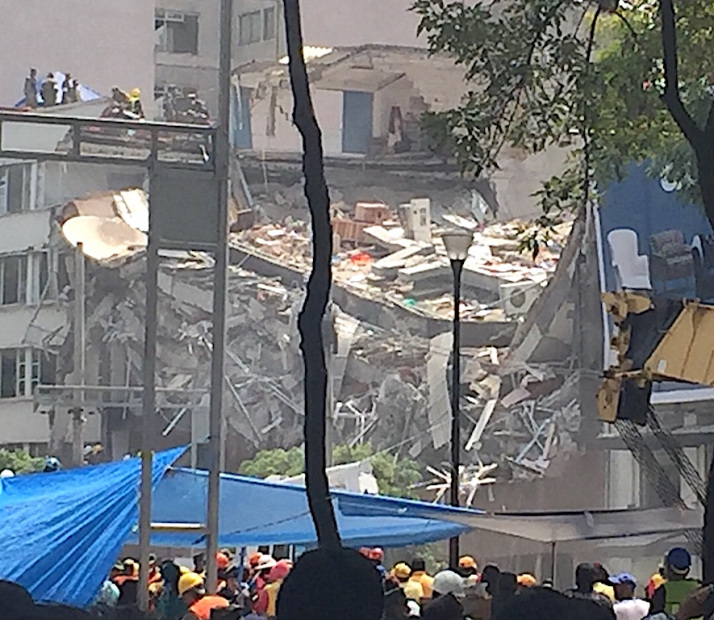
Aftermath of the earthquake in Mexico City. Picture credit: Joe, Month at a Time Travel blog


I’m so very grateful for those who fight the flames and rescue others from the path of a wildfire. I am grateful for those who brave floodwaters to carry trapped homeowners to safety. I am grateful for those who climb on top of precarious rubble in a desperate attempt to locate and save those buried below. I am grateful for all who keep the peace, attend to the wounded, and comfort the frightened. I am grateful for those who rush towards danger while others are running away.

Resiliency

Even those who deny climate change (or, at least the impact we humans have had) must have a hard time ignoring the wild swings of weather conditions the United States—and the world—has experienced over the last several years.

Those of us on the West Coast are in a severe, multi-year drought while those in other areas of the country have endured record cold temperatures. Now, I’m reading news stories about torrential rain and flooding on the East Coast.

Here in San Diego, fire crews are just finishing battling nearly a dozen individual wild fires that burned around 26,000 acres and required over 125,000 people to evacuate. Although California has had wild fires throughout the state’s history, this mix of low humidity, triple-digit temperatures, and hot, dry Santa Ana winds in May is most unusual… and troubling. No one is naive enough to think that we’ve seen the worst of it. This is just the earliest start of our fire season in decades. What we used to brace ourselves for in September and October could now be a threat year-round.

Our home was well away from the fires, but, along with so many others, we watched the scenes of the firestorms on the TV; cheering the heroics of the fire fighters as they battled the blazes in their attempt to save homes and lives. Because of their efforts, “only” around 70 homes were destroyed and no lives were lost (contrast that to 2003, when 2,232 homes were destroyed and 15 people died, and 2007 when 1,500 homes were lost and 9 died).

Now that most of the fires are fully contained the focus has switched from fighting the fires to mopping up and surveying the damage. It is heartbreaking to see the bewildered faces of people standing in front of what once were their homes. It is the same look seen after the devastating hurricanes, super storms, tornados, earthquakes, and so many other recent disasters we’ve witnessed.

As I look at photos of the fires’ destruction, I wonder how the people who have lost their homes will be able to bounce back after such devastation. Most of them say—and it’s true—that it’s only “things” and they are lucky to be alive, but I know how much all of the “things” that are in a home can make us feel safe, connect us to our past, and help us define who we are.

A word that I am hearing more and more in the aftermath of these disasters is “resilience” as it relates to systems, nature, and people. Andrew Zolli, the author of Resilience: Why Things Bounce Back described resilient systems as being able to “sense and respond to their own state and to the state of the world around them, compensate or dynamically reorganize themselves in the face of novel shocks, decouple themselves from other fragile systems when necessary, fail gracefully, and have a strong local self-sufficiency.” I think much the same thing could be said of people who are resilient.

I don’t believe that we either are or are not resilient. Some who are perceived as fragile by others can exhibit great resilience when faced with a personal challenge or devastating loss. Others, who may appear to be strong and stoic on the outside, might not be able to bounce back as well. Not everyone reacts in the same way to traumatic and stressful life events, but there are steps we can take to become more resilient in the face of adversity. A resilient person will still experience difficulty or distress, but their resilience can influence their ability to recover, persist, or even thrive amid disruption.

We all experience traumas in some form, whether because of a natural disaster, the loss of a loved one, the ending of a relationship or a job, or because of health challenges. What is important is to develop the tools—behaviors, thoughts and actions—now that will help us when we are faced with adversity. According to the American Psychological Association (APA), these attributes can be learned and developed by anyone. In order to increase our ability to be resilient, the APA suggests that we foster these important personal foundations*:

• Cultivate caring and supportive relationships, both inside and outside the family
• Nurture relationships that create love and trust, provide role models, and offer encouragement and reassurance
• Develop the capacity to make realistic plans and take steps to carry them out
• Maintain a positive view of one’s self and confidence in our strengths and abilities
• Develop skills in communication and problem solving
• Learn to manage feelings and impulses

We all will face increased challenges as we age; the death of loved ones, decreased physical capacity, perhaps a serious illness or even a natural disaster. Building our resilience now will help us better respond and adapt.

“If your heart is broken, make art with the pieces”

– Shane Koyczan

* This list paraphrases a list from the APA’s brochure The Road to Resilience.