GratiTuesday: Making Connections

A couple of years ago, when my husband and I had a vague idea of traveling to Oaxaca one day, we happened to meet a charming couple at a charity luncheon who told us about…

… a friend of theirs who was an expat living in Oaxaca.  They offered to ask him if he’d be willing to be a contact for us and answer any questions we might have. Their friend, David, very generously said “yes,” and he and I emailed back and forth over the next year. He was a great resource and always promptly and patiently answered our many questions. He also got us connected to…
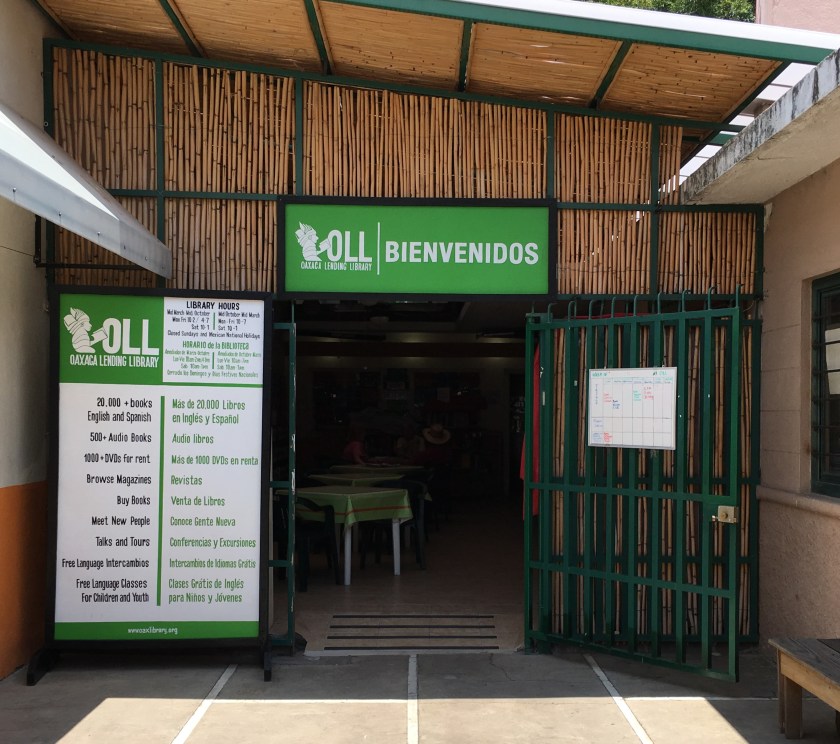
 

Oaxaca Lending Library… Bienvenidos!

…The Oaxaca Lending Library (OLL), which is the social hub for the expat community in Oaxaca. In addition to an extensive collection of books, they offer resources, programs, events, lectures, and other valuable services. English-speaking travelers visiting Oaxaca for any length of time should make OLL one of their first stops. My husband and I enjoyed meeting several members of this welcoming, interesting, and vibrant community, including…

Marga: 91 years old and full of energy

… Marga, a 91-year-old expat who is full of energy and enthusiasm. She has traveled around the world, but loves coming back to her home in Oaxaca.

When we asked David for a recommendation of a guide/driver to hire, he told us about…

The dashing duo… Jose and Robert

… Robert and Jose, who drove us to beautiful villages and spectacular archeological sites and made our experience very personal and special. Not only did we visit some fascinating locations but, after we were finished touring, they invited us into their home.

A big part of the joy of travel is the people we meet along the way. We have been fortunate to add many new friends to our contact lists, and we’ve received – and extended – plenty of, “if you’re ever in…” invitations over the years.

I am so grateful for the connections we make and the friendships we develop as we travel about. I am also very much looking forward to connecting with friends we have yet to meet.

Grave Discoveries

I’m not sure why I find old cemeteries so intriguing. I do know that I share this interest with many others, including more than a few bloggers. When I did a Google search on this particular fascination, I discovered that there is actually a name for those of us who consider a visit to an old – and the older the better – graveyard an essential stop on any trip: Tombstone Tourists (also, “cemetery enthusiasts,” “grave hunters,” “gravers,” or “taphophiles”).

Over the years, I have had the opportunity to visit many memorable cemeteries.  Some, like the Pere Lachaise Cemetery in Paris, are known for their famous inhabitants. Most, though, are populated by those known and loved only by a relatively small circle of family and friends. And, since the graveyards I love to visit are so old, probably that small circle of people is mostly gone too.

After visiting the Colon Cemetery in Havana, Cuba a couple of years ago, I thought it would be hard to match it for size, history, and architecture. So, you can imagine my excitement (OK, maybe if you don’t share this particular passion, it may be hard to imagine my excitement) when I discovered a city cemetery while looking at a map of Oaxaca. Even better, by the looks of the area indicated on the map with little crosses, it was a big one. Yippee!

This slideshow requires JavaScript.

Oaxaca’s San Miguel Cemetery was established in 1829 because of the city’s urgent need to bury large numbers of citizens killed by a smallpox epidemic. In 1833, it again was used to bury victims of cholera. Construction of a chapel in the middle of the cemetery was started in 1839, but was suspended due to, according to a plaque, “constant rebellions that were held in that time in the city.” Suspended, and never finished (an old crumbling building… yippee, again!).

This slideshow requires JavaScript.

The cemetery is surrounded by tall stone walls and an interior walkway that features 100 arches and over 2000 burial niches. The gravesites, tombstones, and alters tell a rich history of religious traditions, cultural heritage, and even geology, as many of the graves show the effects of the multiple earthquakes that have occurred over the years.

During the Oaxaca’s Day of the Dead celebrations, October 31st – November 2nd, San Miguel Cemetery is blanketed with flowers, candles and alters decorate the graves, and each of the burial niches are illuminated. It is supposed to be a spectacular sight; one that I hope we will experience for ourselves in the next few years.

Hearts and Crafts of Oaxaca

Oaxaca is known for the variety and beauty of its handicrafts. Exquisite pottery, woodcarving, weaving, basketry, embroidery, and many other crafts attract collectors from all over the world. Many of the small towns and villages surrounding Oaxaca City specialize in one particular type of craft. The skills have been passed down through the generations and often the whole family takes part in the various stages of producing the art, each adding their unique creative touch.

My husband and I visited several of the artists’ villages and, in some cases, even their private homes. We found that by hiring a private driver to take us around, we were able to tailor our experience to our interests and benefit from the guide’s personal knowledge. The “one-size-fits-all” packaged tours only visit the more touristy shops (never the private homes), often spend just a short time at each stop, and (we were told) steer purchases to locations that offered the tour operators a commission.

This slideshow requires JavaScript.

In addition to viewing the displays of finished products ready for sale, several of the studios we visited demonstrated how the items were made, including how dyes were created from natural sources. When we visited a shop in the village of Teotitlan del Valle, famous for their hand-woven rugs and tapestries, we were shown how a tiny insect gathered from the prickly pear cactus created the intense reds used to dye wool for weaving. Other dye sources include the indigo plant, wild marigold, pecan leaves and shells, pomegranates, and tree moss.

This slideshow requires JavaScript.

Another fascinating visit was to the village of San Martín Tilcajete, which is famous for the fantastical carved wooden animals called alebrijes (al-ah-bree-hays) created there. San Martin’s – and Oaxaca’s – most famous alebrijes artists are the husband and wife team, Jacobo and Maria Angeles. Not only do they produce bright and exquisitely detailed artwork themselves, they have converted their studio into a model of community development. They employ many talented artists from their village and offer tours and demonstrations. Although the alebrijes made by Jacobo and Marie were out of our price range, they also featured beautiful – and much more affordable – carvings made by their apprentices.

This slideshow requires JavaScript.

Making our tours to the outside villages even more special was having the opportunity to visit the private homes of a few of the artists. We met Conception Aguilar, whose family helps her create beautifully crafted and whimsically painted clay sculptures in their small home, and Jose Garcia Antonio, also known as “The Blind Potter,” whose large and wonderfully messy compound is a jumble of his primitive – but exquisite – ceramic art.

My husband and I aren’t big souvenir purchasers, but we did come home with a few items we fell in love with. Not only are they mementos of our travels, but we feel that buying pieces directly from those who make them is the best way to support the artisans and their families, and helps them to keep their heritage alive.

Oaxacan Celebrations

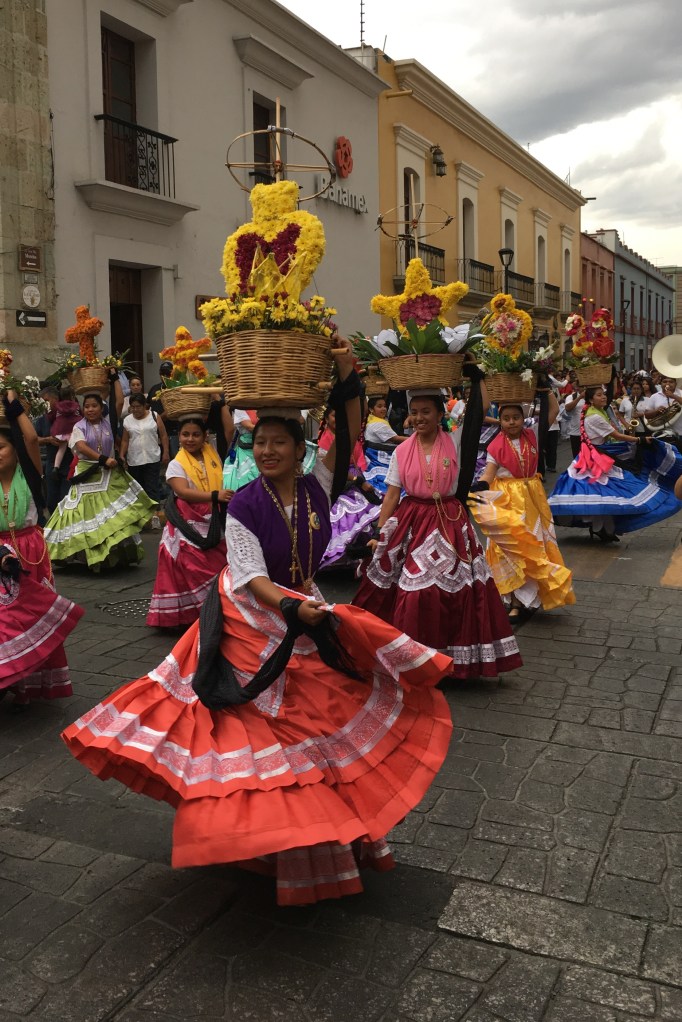
Although the timing of our recent stay in Oaxaca didn’t coincide with any of the large festivals that city is famous for, there was no lack of celebratory events. And, lucky for us, many of these festivities took place in public so we could experience the magic, color, music, and joy of an Oaxacan celebration.

We had no idea what this parade was for, but we were happy to join in!

Whether it was a wedding, graduation, quinceanera, or a religious celebration of unknown (to us) origin, the cobblestone streets were often filled with revelry and processions. What I especially liked about these celebrations is that they weren’t arranged by the chamber of commerce or designed to entertain tourists. Instead, they were authentic and steeped in ritual. That we were there to witness the festivities was fine, but the celebration was for the invited guests, the citizens of Oaxaca, and for those who roots run deep in its culture and traditions.

Many of Oaxaca’s festivals trace their origin to indigenous rituals that were later combined with Catholicism, brought to the region by Spanish conquistadores. One such holiday, Dia de los Muertos (Day of the Dead), is celebrated on the same day as All Saints Day (November 1st) and All Souls Day (November 2nd). Unlike the solemn rituals surrounding these Catholic holidays, Dia de los Muertos is marked with festivals, parades, and celebrations. The holiday and its rituals recognize death as a natural part of the human experience. The departed are seen as part of the community and on these days, they are awakened from their eternal sleep to share celebrations with their loved ones.

During the Day of the Dead celebrations, this cemetery will be filled with people and flowers.

Other festivals that are tempting us for a return visit include the huge Fiesta Guelaguetza, held in July, and the many festivals surrounding the Christmas season including Noche de Rabanos (Night of the Radishes), which brings people from all over the valley into the city center to display their homegrown radishes that have been carved into imaginative sculptures .

Whether they are remembering their departed loved ones, marking a religious holiday, or observing part of their ancient culture, the people of Oaxaca are creative and artistic, exuberant and friendly. They know how to celebrate and, best of all, we are all welcome to join in.

GratiTuesday: Building bridges, not walls

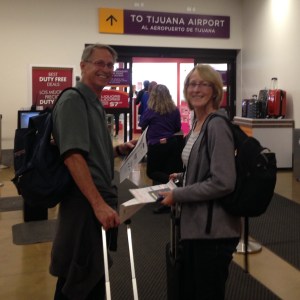
We had several choices of airlines and flights when we booked our travel to Oaxaca. Several of the major U.S. airlines offer flights, but all of them required stops in between and planes changes along the way. Fortunately for us, we were able to book our flight on a Mexican airline that offered a non-stop flight from the Tijuana International Airport to Oaxaca. By flying out of Tijuana rather than our city’s airport, our flight was quicker, cheaper, and only required a 5-minute walk across the border over a 390-foot-long bridge to reach the airport.

The picture is a little blurry, but so were we as we set off to board our 1:10 am flight to Oaxaca.

The Cross Border Xpress (CBX) terminal and bridge was financed by private U.S. and Mexican investors. Since its opening in 2015, an average of 4,800 passengers walk over the enclosed pedestrian skywalk each day to catch flights originating in Tijuana or return from trips to Mexico. It is believed to be to only such cross-border facility in the world.

This was the second time we have taken advantage of the CBX Bridge to fly domestically from Tijuana to another city in Mexico. Our first experience, when we flew to La Paz a year ago, went so smoothly – even with our limited Spanish language skills – that we did not hesitate to travel that way again.

I am so grateful to those with the vision – and the finances – to imagine bridges across borders rather than envision walls. Although I understand that countries have to protect their borders, by working together and extending a hand of friendship and support, mutually beneficial outcomes can be realized. The CBX Bridge is an example of collaborative thinking and long-term planning. Just what we need more of these days.

Oaxaca’s Street Markets

The tianguis, or open-air street market, is much more than a place to buy and sell merchandise. Throughout Mexico – and maybe especially in Oaxaca – markets are a fundamental element of the cultural structure. They are where people meet and catch up on news and gossip, new babies are shown off, and young romances are kindled. Market day is a ritual that has been celebrated every week – virtually unchanged – for thousands of years. These markets are not set up for the tourists (although tourists certainly can be found there – often with their cameras, like me), they are an important component in the day-to-day lives of many of the citizens.

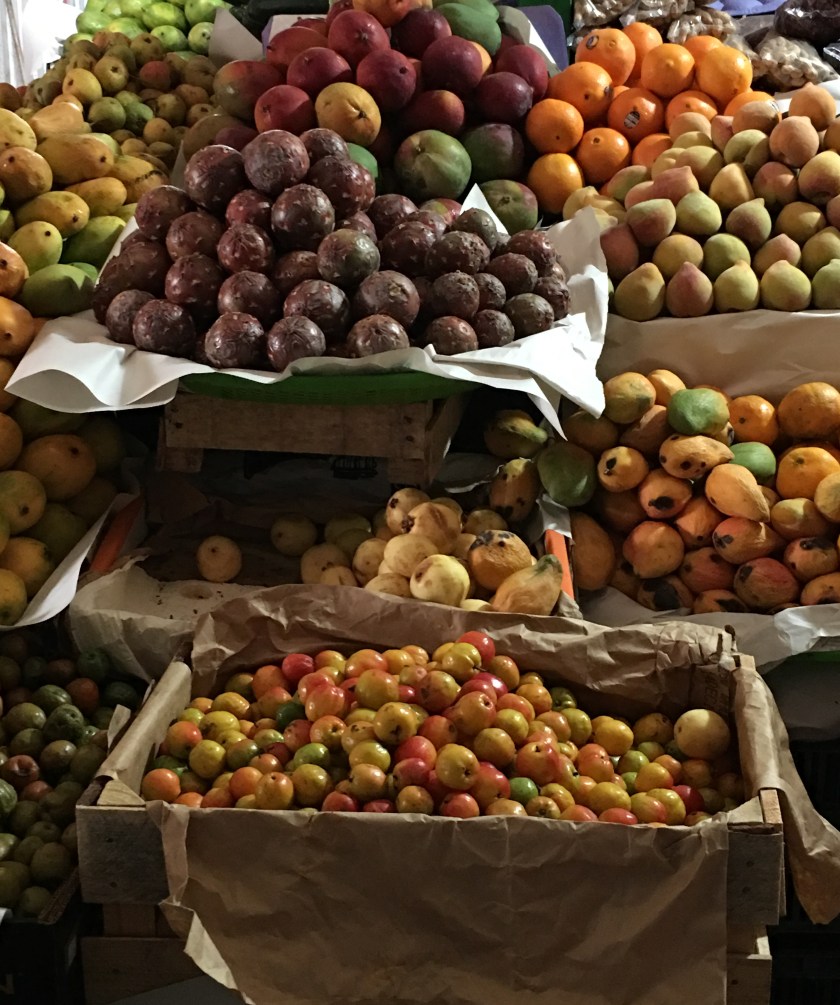
We were able to enjoy amazing fruit every day.

The city of Oaxaca has several tianguis that are open each day. Mercado Sanchez Pasqua, located very close to our house, was our go-to source for fruits and vegetables, as well as freshly made tamales. Just about every day, we stopped by on our way home to purchase delicious, just-picked avocados, mangos, and bananas.

Oaxaca’s original and best known market, Mercado Juarez, is housed in a huge, warehouse-like building. The energy and chaotic mix of sounds, colors, smells, textures, and shapes is an experience not to be missed. Among the multitude of stalls selling merchandise, one can find fruits, vegetables, herbs, flowers, mezcal, sauces, beef, chicken, and seafood. Other stalls tempt buyers with displays of brightly colored clothing, crafts, woven bags, shoes, and blankets.


In addition to the markets in the city center, the Valley of Oaxaca is famous for the tianguis that each of the surrounding villages set up one day a week (each village has its designated day). These local markets not only sell the usual food, flowers, and clothing, but they also feature items that their particular village is known for, such as weavings, cheese, or wooden furniture.

Don’t forget to pick up your Chapulines (fried grasshoppers). And, yes, I tried them.

As unique and exciting as these markets are, there is some worry that they might eventually become a victim of our global society. Oaxaca now has two Walmarts and several large grocery/department stores called Chedraui (all, mercifully, outside the city center). Amazon deliveries are also available. While I understand the ease and time-savings of going to a single location for all ones needs, I fear this convenience will someday lead to the demise of the traditional street markets. A ritual that has been around for thousands of years could be made irrelevant in a few years by big box stores and the internet. That would be an unimaginatively sad and irretrievable loss.

Slow Travel

Since we both retired, my husband and I have done quite a bit of traveling. Sometimes we take a quick drive somewhere close, other times we are away for several weeks or even a month.

Two years ago, a month-long road trip took us through several western and midwestern states, and included a journey along a good portion of Route 66. Last year, we flew to Montreal, rented a car, and traveled through parts of south eastern Canada, and the north eastern United States.

Although we thoroughly enjoyed these trips and relished visiting a lot of different places, each time we moved on we regretted not being able to stay longer and experience all that a specific location had to offer.

This time, we decided to travel in a different way, one that allowed us to slow down, breathe, and relax into life in a foreign country. For a little over five weeks, we rented a private home in Oaxaca, Mexico and enjoyed the luxury of unpacking our bags just once. The house was within walking distance to the central area: close to activity, shops, and restaurants, but far enough away to provide us with a place to enjoy our own company and recharge our batteries.

Our oasis came with a private garden.

By staying in one location for an extended period, we found that our pace slowed and our appreciation for this beautiful city and its culture was allowed to deepen and grow.  Because we weren’t on a tight schedule, we started to match – at least somewhat – our rhythm to that of the city around us.

Santa Domingo at twilight.

This isn’t to say that we didn’t take a few tours or enjoy other “touristy” pursuits – we did. But, because we knew that we had a lot of time to engage and explore, we also could make discoveries that most short-term visitors would probably miss.

What type of travel do we enjoy more? Our answer is that it really depends: it depends on the location, it depends on our curiosity level, and it depends on the time we have to devote to a particular trip.

We just returned home yesterday and I have already found my pace quickening. I have hundreds of photos to go through and pages of notes to organize. Although I promise to not share everything, I do have enough post ideas, along with pictures of doors, murals, churches, architecture, archaeological sites, celebrations, and many other delights we found in this UNESCO World Heritage city, to keep me busy for a while.

Rockabilly Style Comes to Las Vegas

There aren’t many things that would prompt my husband and me to drive 320 miles – through boring scenery and across the desert – with the final destination being a town built on gambling, excessive partying, and staying out late (none of which we are fond of). But, the Viva Las Vegas Rockabilly Weekend event, the largest rockabilly festival in the world, is well worth the trip.

IMG_1672.JPG

People from all over the world gather for this annual event. Some come to the Rockabilly Weekend for the cars, others come for the tattoos, many come to see and be seen, or for the vintage and kitschy merchandise, or maybe the tiki pool parties, pin-up, and burlesque, but almost all come for the music.

IMG_1687.JPG

The car show was great (Over 1,000, pre-1963 vehicles were on display), tattoos were both colorful and plentiful (and you could add even more ink at the event), the people-watching was stellar, you could buy just about anything from parasols to pomades, and rockabilly style ranged from sweet to sexy, but it was the music and dancing that enticed my husband and me to return to Las Vegas for this year’s event.

Although this was only our second year, Viva Las Vegas was celebrating its 20th anniversary, and they – and the attendees – really put on a show. Over 60 bands played on six stages over the 3-day weekend and when they weren’t playing, the DJs kept everyone entertained. Typically, the music started around 3:00 pm and ended well after midnight (or so the schedule said, we were long asleep by then).


We enjoy swing dancing and, for the most part, the music gave us a lot of opportunities to get out on the dance floor. When we weren’t dancing, we were watching others far more talented than us. Although some of the dancers were older, most were young(ish) and it was nice to see the classic dance styles being preserved. Jive, Jitterbug, Balboa, Lindy, Cha-Cha, West Coast Swing, and even some Texas Two-Step and Polka: whatever dance the music inspired.

IMG_1685IMG_1696IMG_1697

Besides the great music and dancing opportunities, we enjoyed watching the young men and women who love the rockabilly style and dressed to impress. Many of them wore classic 1940s clothes and had their hair styled to match (although the colors were often not those found in nature). Some dressed that way just for the weekend, but others had clearly committed themselves to that look.

Whether we go next year or not, we haven’t decided. We have decided, though, to sign up for Lindy classes. It was a dance style that looked like a lot of fun and we want to be ready when the music moves us to get up and out on the floor.

GratiTuesday: Unexpected delights

A couple of weeks ago, my husband and I traveled to Las Vegas to attend the annual Viva Las Vegas Rockabilly Weekend event (more on that in another post). We don’t gamble and we don’t drink a lot (especially when we are dancing) so what Las Vegas is famous for doesn’t hold a great amount of appeal for us.

The weekend event is held at a hotel off The Strip so it’s easy for us to ignore the glitz and “glamor” (but, unfortunately not the cigarette smoke), and at least attempt to eat a fairly normal diet. We were happy to find a local supermarket to buy fruit, snacks, and other items we could keep in our room.

On our first visit to the market, while we were in the produce section, I was surprised and delighted to see Elvis checking out the apples. I’m not sure I would have recognized him had he not been wearing his white jumpsuit, but I’m sure that he was the real deal.

IMG_1581

I wish I could have gotten a better shot, but I was too shy to ask him to pose. Unfortunately, on subsequent visits, Elvis had left the building and was nowhere to be found.

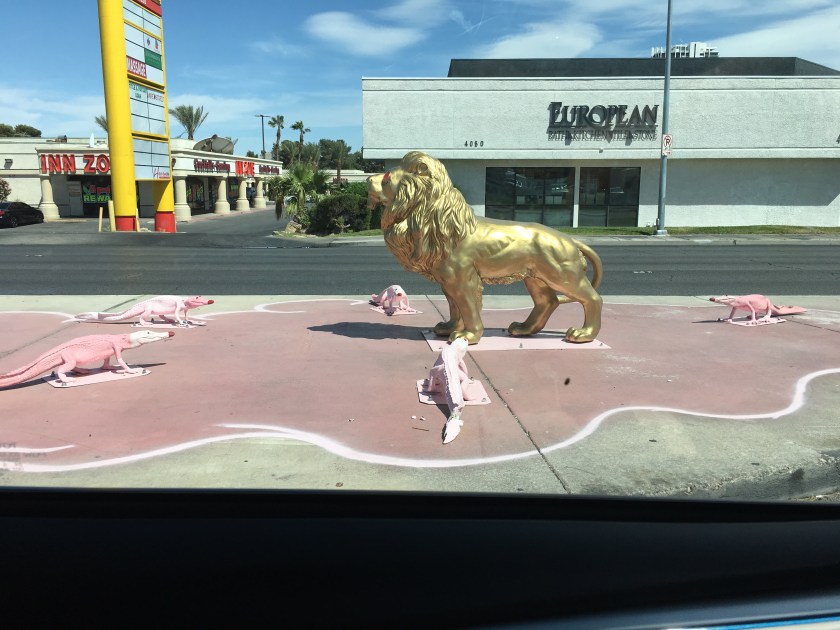
Then, on our drive back to the hotel, I came across a curious scene on the center island of the street we were on.

IMG_1694

I’m not sure what the back story is, but a golden lion with red eyes, surrounded by 5 pink crocodiles (or, whatever they were) has to have one… don’t you think?

Some people are wowed by the noisy crowds and flashing slot machines, others by the glitzy shows and other extravaganzas Las Vegas has to offer. Us, not so much. But I am grateful for the unexpected, silly, puzzling, delightful little encounters we often find when we travel and find ourselves off the well-beaten path.

Thursday Doors: Tears for Quebec

I had quite a different Thursday Doors planned for today… until I read Norm’s on his blog Norm 2.0. His post was a departure from his usual intriguing but lighthearted #ThursdayDoors posts. What he wrote today was thoughtful, emotionally powerful, and it hit me in the gut.

Go ahead, read it now if you haven’t already. I’ll be here when you get back.

My husband and visited Quebec City this past June, just days after the horrible massacre at the Pulse nightclub in Orlando, Florida. That shooter killed 49 people and wounded 53 others before being shot and killed by the police. His reason for the rampage: Hate.

U.S. Consulate General office in Old Quebec, 2016.

As we were touring Old Quebec, we came upon the United States Consulate General office located along one of the many lovely streets in this incredibly beautiful city. As awful as the news had been just a few days before, seeing a large rainbow flag flying at half-mast next to the U.S. Consulate door, made us proud of our country and our (then) government. The flag was a clear display of deep sorrow and a show of solidarity with a community that often finds itself maligned.

Now, we read about the massacre that happened in beautiful Quebec City. The gunman used a different religion to justify his action, his skin was of a different color, and his targets were a different “other.” But, his motivation was the same: Hate.

Evil feeds on evil. Rather than speaking words that lift us up and encourage our better selves, people in power – and those who seek power – are speaking words of hate and suspicion. They do it because it works, they do it because some people need to feel “better than” to feel good about themselves.

I’m not sure when this evil will stop, or if it ever will, but I know we need to speak out against it when we can. We need to defend the “others” who are victims of the hate and let them know that they are us and we are them; we are all in this together.

I wonder what flag is flying outside the United States Consulate General office today. I hope very much that it is one displaying deep sorrow and solidarity with a community that often finds itself maligned.