When my husband and I plan our trips, we usually act as our own travel agent. We select the accommodations, book the flights, and are fully in charge of our day-to-day itineraries. Since we are often away for a month or longer and appreciate having flexibility, this type of travel works well for us.
The task of researching and arranging our trips falls mostly on my shoulders, something that I’ve never enjoyed doing. Even though – so far – our trips have turned out great, I often find the planning process to be stressful.
We have several friends and family members who travel mostly on group tours. OAT, Road Scholar, and Viking are just three of the many organizations that offer attractive packages of pre-planned excursions.
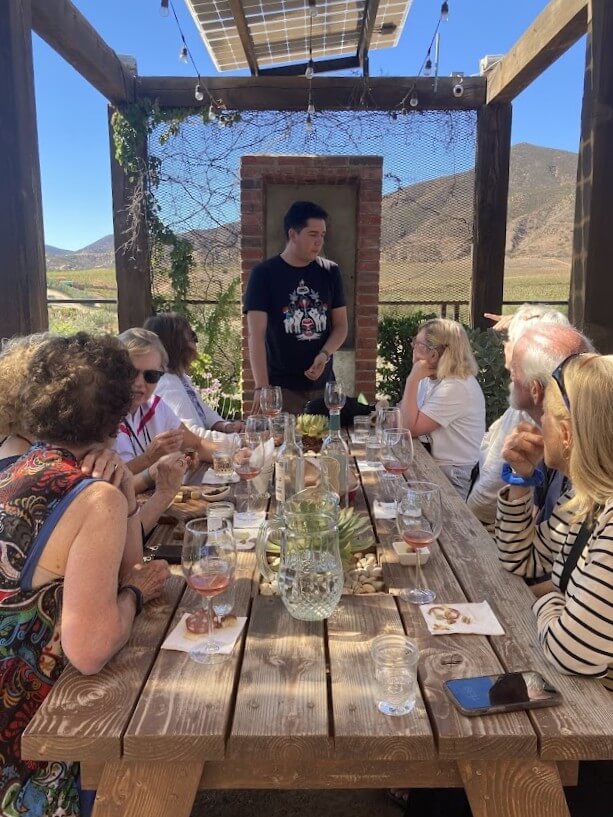
We recently had the opportunity to join a group tour of Valle de Guadalupe – the well-known winemaking region of northern Baja California, Mexico. It seemed like a great way to learn more about the area, indulge in culinary delights, sip excellent wines, and experience this type of travel. All we had to do was pay Road Scholar some money and show up at a hotel on the U.S. side of the border. The next morning, a dedicated bus took our group of 14 over the border and everywhere we went for the next six days.
After crossing the border, one of our first stops was for lunch at Caesar’s Hotel in Tijuana, where the Caesar’s Salad was first created in the 1920s. It was made tableside and it was yummy.
We know several people who have made this trip on their own. It is very doable, but we weren’t crazy about driving in a foreign country, and driving after drinking wine didn’t seem like a great idea in any country. I also would have had to do a lot of research to determine what hotel to stay at, and which wineries and restaurants to visit.
We learned that Mexico was the first country in the Americas (New Spain at the time) to start planting vines for commercial wine production. The growth of the wine industry has attracted internationally famous chefs to Guadalupe Valley.
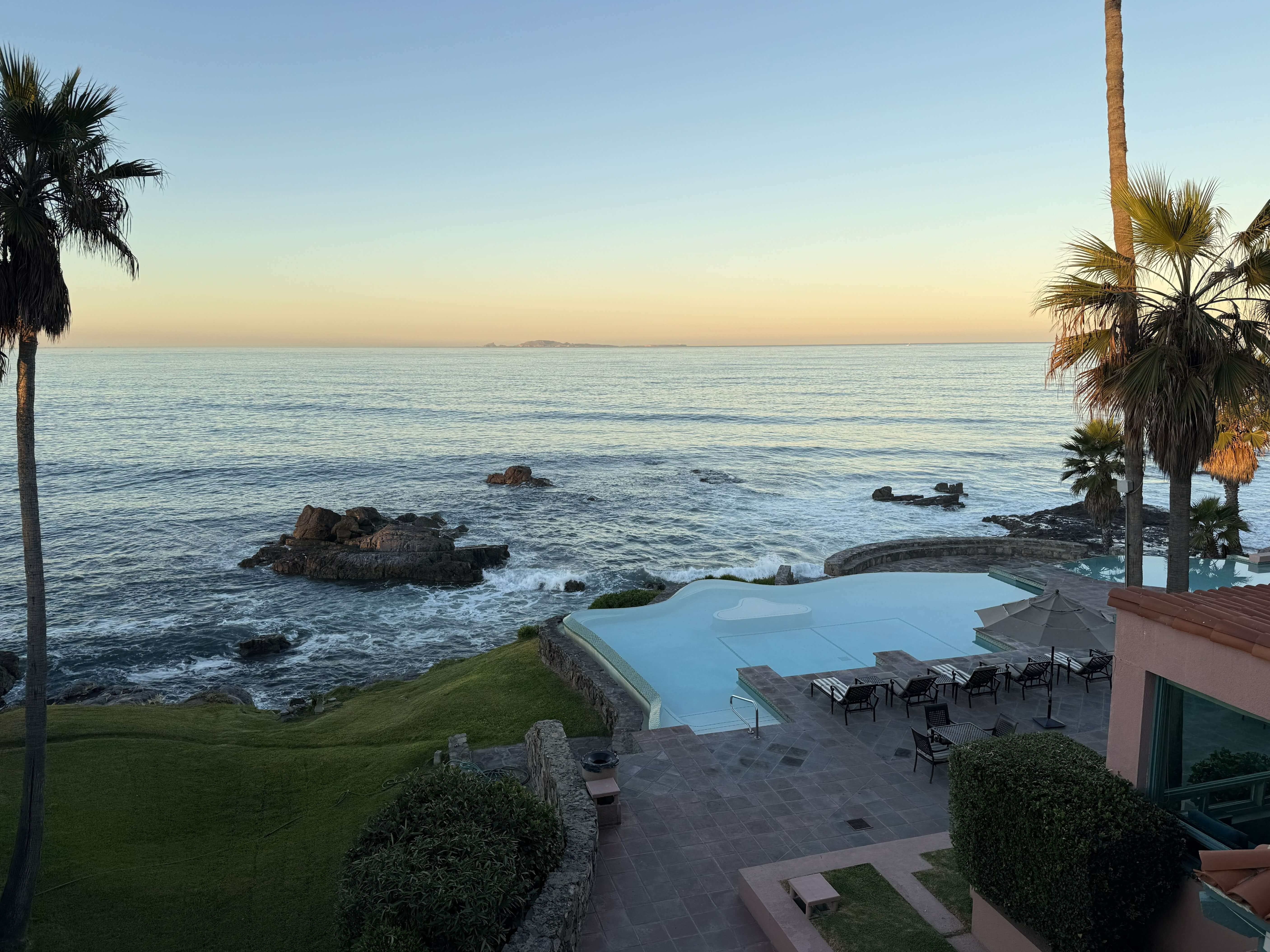
As it turned out, our tour guide was fabulous, our ocean-front hotel in Baja was lovely, and the food and wine were bountiful and so, so good.
The view from our hotel room was gorgeous.
I imagine my husband and I will continue to plan many of our trips, but our positive experience has opened our minds to small group tours. Depending on the destination, combining a group tour with time tacked on at the beginning or end – or both – could give us the deeper dive a group trip can provide, with the flexibility of solo travel that we love.
Do you prefer to create your own travel plans, or go with a group?
If you’ve gone on group tours, do you have a favorite provider?
I’m fairly sure my parents never used an Automated Teller Machine. Even though they were only in their 60s when ATMs became widely available, they continued to go into the bank to do their transactions. I remember thinking it was odd at the time. Why wouldn’t they prefer the ease and convenience the machines offered? Why add another 10 – 15 minutes to get a task done by standing in line and talking to a teller?
Fast forward 40 years. I’m now in my 60s and can better understand my parents’ reluctance. While I’ve embraced some of the digital cash conveniences, there are others I happily do without. If the system is safe, easy, and useful, great. But, if I don’t fully understand it, or I don’t see the benefit – especially if it involves downloading another app, I’ll stick with what I’m used to.
I’ve switched almost exclusively to using credit cards to purchase items and pay most of my bills electronically. I seldom use cash, and if not for haircuts and occasional pedicures, I could count the number of checks I write each year on one hand. Just today, the woman ahead of me at the grocery store wrote a check and I realized how rare that was. The checker told me that he gets only about five or so a day. The safety and convenience of credit cards and paying electronically has made a checkbook – something that was always in my mother’s purse – nearly obsolete.
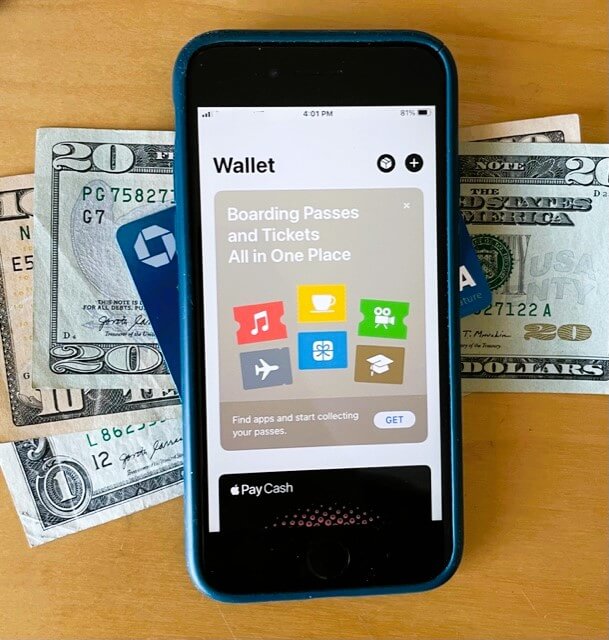
Digital wallets are appealing. I see lots of people using their smartphones to purchase a cup of coffee or board a plane. More and more items, including loyalty rewards cards, event tickets, metro passes, and gift cards, can now be stored in a digital wallet. Not having to carry cash, credit cards, or print out paper receipts seems worth the one-time task of setting it up.
On the other hand, peer-to-peer payment apps, like Venmo, Zelle, and Cash Ap, are of little interest to me. I vaguely know how they work but I haven’t found that I need that payment option. If I was much younger, and my friends were using it, I’d probably make a different decision.
Cryptocurrency falls firmly in the “I don’t understand it” category. Fun fact: a Bitcoin purchased for $10 in 2012, would have been worth over $60,000 in 2021. Since then, the value has decreased substantially (today’s value would “only” be about $32,800), but that $10 initial investment would still look pretty good. But you know what? I don’t care. Yes, I would have loved an extra $60,000, or even a piddly $32,800, but investing in a product that I don’t understand isn’t in my comfort zone. I will leave that type of investment to those who either understand it or those who love to gamble.
How about you? Do you still prefer to pay with cash or a check, or have you fully embraced electronic cash, or a little of both? Anyone purchased a Bitcoin for $10? (Yay, you!) How about a $60,000 one? (So sorry, but maybe it will be worth that – or more – again.)
Every once in a while, a book comes along that inspires me to sing its praises to anyone who will listen. It is so special that long after reading the last sentence and closing the cover, the story stays wrapped around my heart.
I recently discovered such a book by luck. After dropping items off at my favorite charity store, I stopped by their used book section. The book’s blue and yellow cover attracted my attention despite its rather awkward title. I pulled it out, read the blurbs on the cover, and decided that it was going home with me. Normally, I happily pay the few dollars for a book, read it, then return it to the shop so it can be resold. I’m afraid this book won’t be going back anytime soon.
This is How it Always Is, by Laurie Frankel is a book about family. It is also about secrets, fairy tales, and acceptance. It is about life not always turning out the way we envision, and how we deal with the challenges we face.
Frankel’s novel is often laugh out loud funny even as it deals with a very serious subject: raising a gender non-conforming child. I fell in love with the parents, Rosie and Penn, and their four older boys but, most of all, their fifth child, Claude/Poppy, stole my heart.
“He said he wanted to be a chef when he grew up. He also said he wanted to be a cat when he grew up. When he grew up, he said, he wanted to be a chef, a cat, a vet, a dinosaur, a train, a farmer, a recorder player, a scientist, an ice cream cone, a first baseman, or maybe the inventor of a new kind of food that tasted like chocolate ice cream but nourished like something his mother would say yes to for breakfast. When he grew up, he said, he wanted to be a girl.”
Frankel tells the story of this family with such warmth and honesty that it invites thoughtful discussion and consideration. I personally know two families who have a transgender child. These parents and their kids are real people who love each other and are doing well despite the challenges society throws at them. Rather than fearing or disparaging those that don’t conform to our “normal,” maybe this novel can help to open hearts.
Beyond the novel’s overarching theme, there are also lessons here for everyone about unconditional love and acceptance of those who are different. We don’t have to completely understand to treat others with empathy and compassion.
This is How it Always Is has won multiple awards since it was published in 2017, including Amazon’s Best Book of the Year, and the 2018 Washington State Book Award. If you read this book—and I hope you do—please don’t skip the Author’s Note; it made me love the novel even more.
This post is linked to the monthly #whatsonyourbookshelf challenge hosted by Donna, Deb, Jo, and Sue. Head on over to share what you are reading and see what others recommend.
Prior to my retirement, I dreamed about all the things I could do with my freed-up time. In addition to travel, creative pursuits, and enjoying friends and family, I was looking forward to vast amounts of time that I could fill up with anything I wanted. Reading, writing, gardening… whatever.
After being retired for a while, I started to explore the many emeritus programs and lifelong learning opportunities offered in our city. I always enjoyed school and learning new things, so this seemed like a great way to keep my mind engaged without the stress of grades.
So many classes to take, so little time to do everything I want.
The Oasis organization offers interesting lectures on a range of subjects and a variety of courses and workshops, all for a very reasonable price.
Our local Community College district has an Emeritus program that offers courses on an array of subjects as diverse as art, effective communication, writing, law, and music.
We also have robust Osher Lifelong Learning Institute (OLLI) programs at two local universities. Joining Osher is more expensive than the other programs, but the quality of the offerings is top-notch. Not only are most of the lectures presented by college professors, but membership also includes the ability to audit many of the regular university courses.
In addition, smaller organizations, clubs, and businesses offer art classes, craft lessons, photography workshops, writing groups, and other learning opportunities for just about any interest.
Pre-Covid most of these classes and lectures were held in-person but the pandemic moved them online. Now, some remain 100% virtual, some are 100% in-person, and others offer hybrid, in-person and virtual attendance.
Not only are there a tremendous number of quality offerings, but the ability to attend many of the courses and lectures from the comfort of home makes it so convenient.
So, what’s the problem? I have found that it is too easy to overschedule myself.
I’m the type of retiree that gets twitchy when I have too many commitments on my calendar in one week (too many being more than one or two). I prefer to space out doctor appointments, get-togethers with friends, and anything else that requires me to be at a specific place at a specific time. I like my calendar to have lots of blank days. Now, with so many interesting classes and lectures, I’m suddenly scheduled just about every day, Monday – Friday. Granted, most of the classes only last 2 – 3 hours but they are usually in the middle of the day, making it difficult to do anything else, like going for leisurely walks or enjoying relaxed lunches with my husband. I have found that I am starting to look forward to weekends again.
On one hand, I want to sign up for everything that sounds the least bit interesting (which is a lot). On the other, I want more unscheduled time to do other things, or do nothing. I’m not sure what the right balance is, but I’m trying to find it.
Although I was never worried that I wouldn’t have enough to do in retirement, I know it’s a concern to some. My advice: don’t stress. After being retired for a little over eight years, boredom is the least of my worries.
Continuing the story of our 1300+ mile road trip in our electric car (Part 1 here).
Before we started the trip, we knew that we’d be traveling during an especially severe heatwave here in California. Normally we might adjust our travel dates because of this, but since we were going for my husband’s high school reunion, that wasn’t possible.
What we could adjust was the first portion of our route, which is why we ended up in Morro Bay. When we were planning our trip, we saw that the expected temperature of our usual mid-way stop was over 100 degrees. Morro Bay’s high was in the 70s. That made it an easy choice. The cool, coastal temperatures allowed us to park our car at the hotel and comfortably walk everywhere, including to the pride of Morro Bay: Morro Rock.
Our hotel was just up the street from the waterfront and Morro Rock.
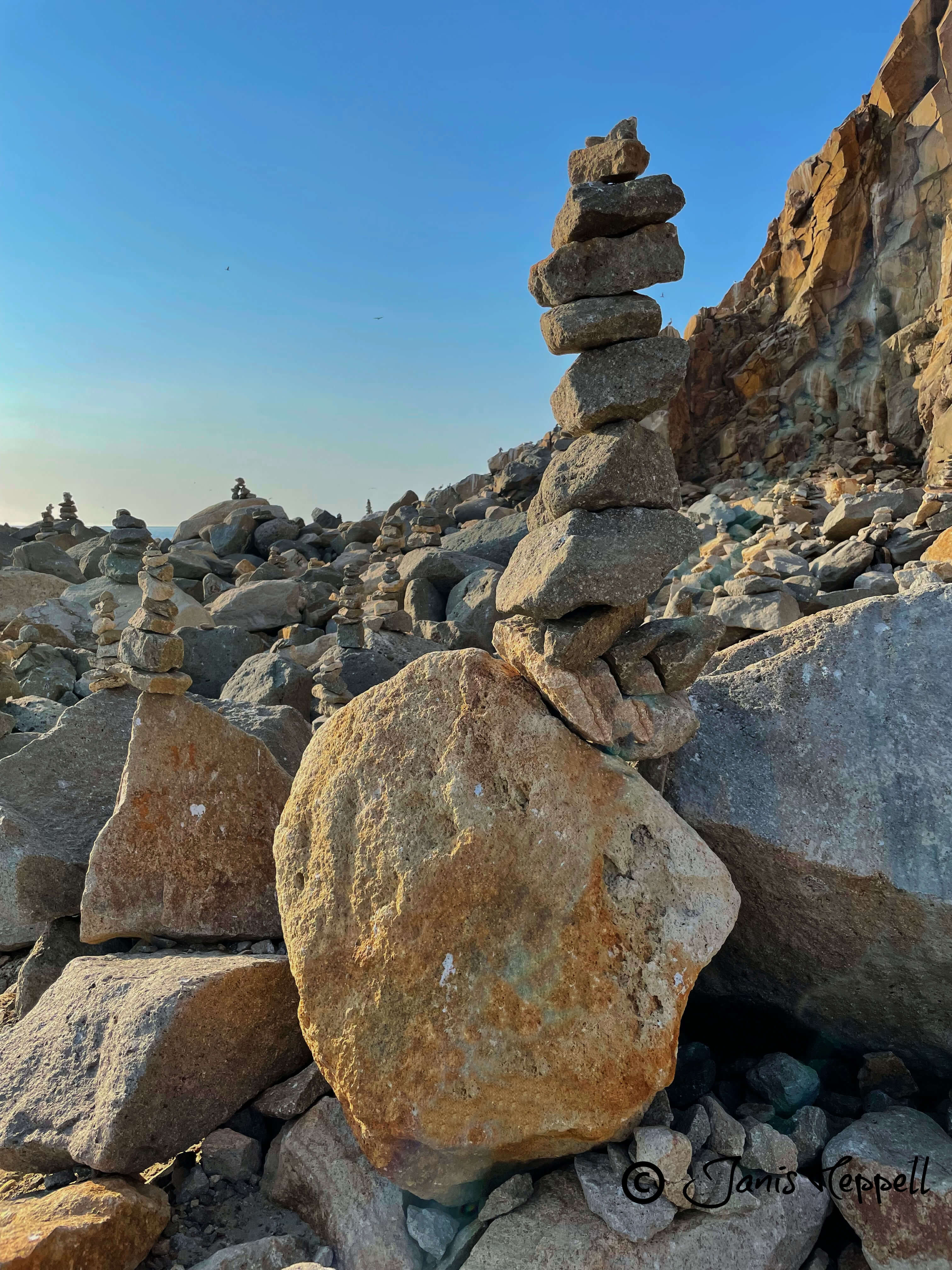
Morro Rock was formed about 23 million years ago from a long-extinct volcano. At approximately 576 feet, it is the tallest of the nine “sister” volcanic plugs that form a chain between San Luis Obispo and Morro Bay. The state historic landmark is a sanctuary for the peregrine falcon and other bird species. It is also the site of the largest field of rock carins I’ve ever seen. Not everyone appreciates these balanced piles of rocks, and I can understand their objection, but seeing so many in one place was pretty impressive.
A field of carins at the base of Morro Rock.Some were quite a balancing act.
The next morning was cool and foggy, and we reluctantly loaded up the car for our drive north towards the heat. Almost immediately, we began to see these digital freeway signs:
The temps where we were headed looked brutal and we knew we’d be giving our car’s AC a workout. Fortunately, while very cold temperatures can lower an EV’s mileage, studies have shown that using the AC doesn’t impact it much more than it does in a gas car. Happily, our car’s impressive onboard computer considers AC use when figuring range, so we never had to sacrifice our comfort to eke out more mileage.
We were also careful to avoid charging between the high-demand period of 4 pm and 9 pm. Only once did we have to plug in during that timeframe when a traffic backup due to an accident delayed our arrival at a supercharger until 4:09 pm (oops). We felt a bit guilty, but we were able to get a quick charge and be on our way in a few minutes.
That charge got us to my brother and sister-in-law’s home located east of San Francisco. We were planning to meet up with them later in the trip but we always enjoy staying for free in their guest roomdrinking good wine from their extensive collection their generous hospitality.
The next day, after another quick charge, we drove to the hotel where the reunion was being held that evening. Since this was not my reunion, I got to be more of an observer. As I looked around the room, it was clear that the past 50 years had been gentler to some than others. Most appeared happy, healthy, and engaged but others seemed fragile. On one table the reunion committee had set out pictures and candles in memory of classmates who had passed away. Many of us commented on the number of pictures and how it was a sobering reminder to enjoy life while we can because there are no guarantees.
Before I end Part 2 of our electrified journey, I would like to touch on luggage storage space. There is a common misconception that EVs are small and tight on trunk space, but, since the batteries are located under the chassis, our car has plenty of room. Not only is our trunk generous, but we also have a decent-sized “frunk” under the front hood where a gas car’s engine would be. Although we aspire to be light packers, this trip required both play clothes and dress-up clothes. One large and one small suitcase, a garment bag, and several additional bags fit with room to spare.
When my husband and I first talked about taking our electric car on our upcoming road trip, I was a bit hesitant. A gathering for a high school reunion prompted the trip, but we wanted to take advantage of the location to visit family and do some exploring. My concern was that driving our EV might make us adjust our route too much. I’m a big fan of electric vehicles, but I didn’t want to miss an opportunity to go somewhere because we wouldn’t be able to charge our car.
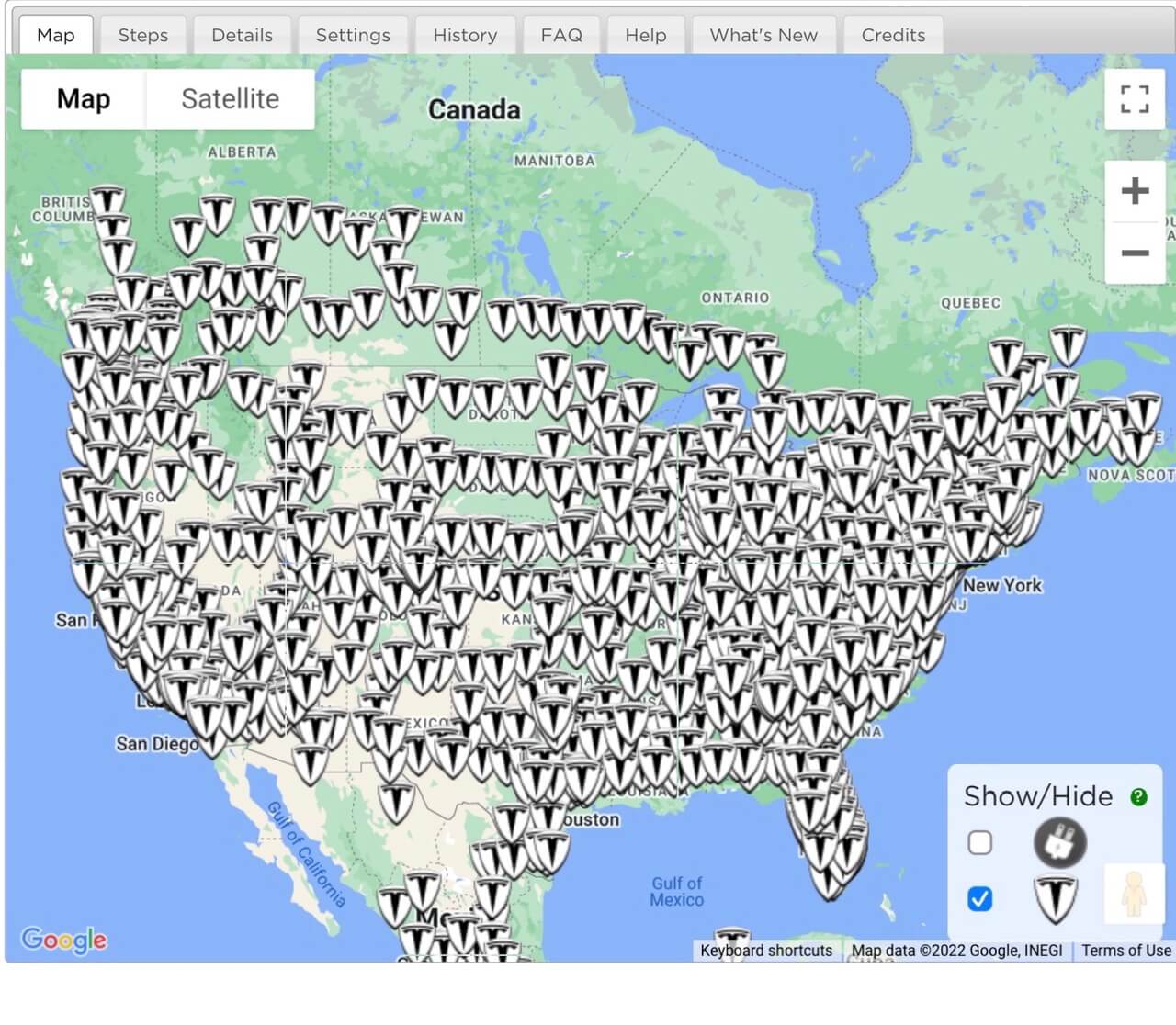
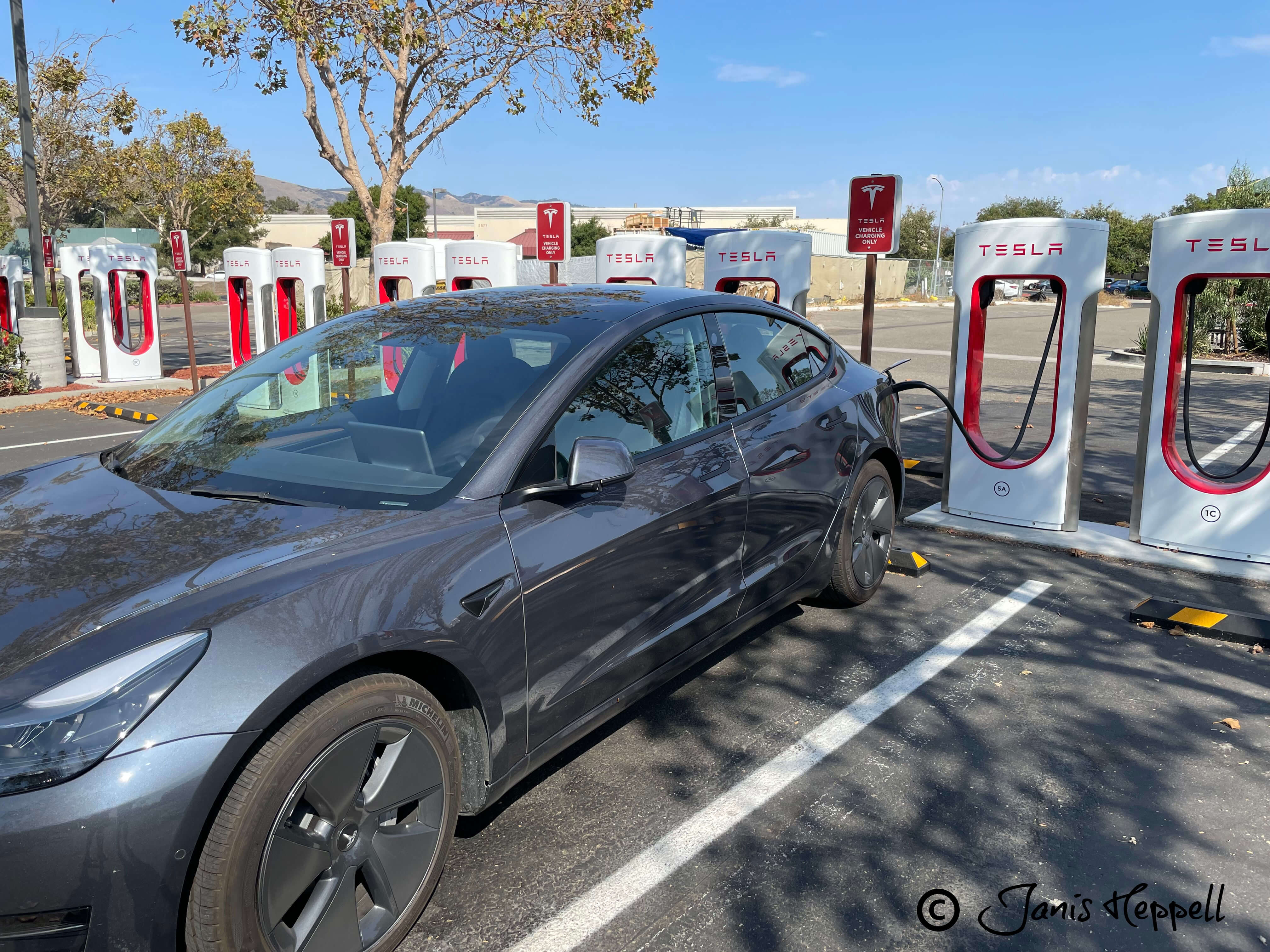
Normally, charging isn’t a problem. We plug our car in at home, charge overnight, and it’s ready to go in the morning. The car has plenty of range to last us at least a week with our usual daily driving needs. We had recently taken a couple of short trips that required some charging away from home, and they had gone well. Now that we were about to embark on a 1,300+ mile road trip, we knew that pre-planning would be important because of the multiple charging stops we’d need to make. Even with California’s relatively robust infrastructure of charging stations – especially Tesla-branded superchargers – they aren’t as ubiquitous as gas stations.
EVTripPlanner.com was a great help with planning our trip.
There seems to be (at least) two philosophies about road trip charging: A) Make fewer stops and charge to 100% each time, or B) Make more stops, but charge to lower levels (60 – 70%) each time. After some research, we like option B best for several reasons:
Each charging stop takes less time. When charging past 60-70%, charging slows way down as it tries to “stuff” more juice into the battery (this is not a scientific explanation, but you get the point).
More stops mean more opportunities to stretch our legs… something we’ve come to appreciate on longer road trips.
Lower stress. By not waiting until the car’s charge level was low before we re-charged, we would have a comfortable range cushion each time we reached a station (sort of like not waiting until your gas level indicator turns red before re-fueling).
The route we planned had us driving about 2 hours between charges and charging to no more than 70% each time. Of course, we could adjust this along the way, but that felt like a comfortable pace.
We only had to wait for a charging station once our whole trip. Usually, we’d find plenty of stations available.
Between our home and our first night’s stay, we stopped at three supercharger stations. While our car charged – a process that took about 10-15 minutes – we entered our next destination into the car’s computer. After some calculations, it told us where the next supercharger was located, how much remaining charge we’d have when we got there, how many stations they had, and how many were available for use (updated real-time).
Morro Rock at sunset.
As we strolled along the waterfront in Morro Bay, California, we congratulated ourselves on completing the first leg of our journey without any issues. Our pre-planning had paid off. We were becoming more comfortable with the car’s systems and confident that we had made the right decision to drive our EV.
First, let me apologize to my friends, Donna and Deb, the co-hosts of the monthly What’s On Your Plate? virtual potluck party. I am going to misappropriate their gathering shamelessly and use it as a way to generate meal ideas – specifically lunch ideas – for myself.
Breakfast is easy around our house… and usually not overly imaginative. My husband and I often fend for ourselves – pancakes, French toast, or cereal for him; oatmeal, a poached egg, or toast for me (and coffee… always coffee). Dinner is more involved and requires longer prep time, but we almost never seem to run out of inspiration (and, when we do, there is always pizza).
Ever since we retired, lunch has been a conundrum. Coming up with meals that are tasty, healthy, and relatively quick – the meal trifecta, as far as I’m concerned – hasn’t been easy. Too many times, we look at what is available in the fridge and/or pantry, find nothing inspiring, and decide to go out for lunch. As much as I enjoy a change of scenery with my meals, eating out can get expensive, and most menu choices tend to be calorie dense.
So, before the What’s On Your Plate? co-hosts notice that I’ve hijacked their topic, can you help me out? What do you typically make for lunch in your home? Do you put together a different lunch every day? Do you make a big bowl of something yummy and eat it throughout the week? Are there lunches that are tasty, healthy, and quick that you love to eat? Are there ingredients that you always have on hand so that lunch is never an issue? I would be very grateful if you shared some favorites.
And, to avoid Donna and Deb kicking me out when my ruse is discovered, here is a recipe for a lunch we have now and then when we are desperate:
Bread
Peanut Butter
Jelly
Please check out Deb’s (The Widow Badass) and Donna’s (Retirement Reflections) blogs for their What’s On Your Plate? monthly dinner – or breakfast, lunch, or midnight snack – party. Get inspired by the various dishes they and other bloggers feature and share one of your own (a lunch dish would be nice 😊).
Last year, when my husband and I realized that life as usual wasn’t going to be usual for a while, we started looking for alternatives to our normal foodie ways. Pre-pandemic, we made most of our meals at home but, soon, even simple trips to the grocery store became troublesome due to empty shelves and unwanted crowding. To help keep the trips infrequent, we signed up for a boxed meal delivery service.
One of the two meals we received for the week.
Several years ago, we subscribed to Blue Apron’s meal kit service (read my impressions here). This time, based on online reviews, we went with Hello Fresh. We started with their Veggie meal plan (they offer several different plans) to introduce more plant-based meals into our repertoire and expand our cooking experiences. After a few months, we switched to their Meat & Veggies plan for greater meal variety.
Our chosen two-recipe plan provided enough ingredients to make four meals a week, two for each recipe option. Every recipe comes with its own large, four-color instruction card and perfectly portioned ingredients. Most recipes require a few common pantry items that are not included; like cooking oils, butter, and salt and pepper. We received our first box last September and continued the weekly service until recently.
All the ingredients to make dinner for two.
What we liked
We were able to select meals in advance from a large variety of options. Our selections arrived on our porch in an insulated box every Monday. Each box contained food for two night’s worth of meals. This took a huge load off menu planning and shopping.
Meal prep was something we did together. There were always several components to the meals (protein, starch, vegetable), and a fair amount of prep, so we divided the duties to best assure everything was done on time.
The meals were, for the most part, interesting and varied, and not overly complicated. The flavors were good and the portions were reasonable. Hello Fresh provided some unfamiliar spice and sauce blends, which were fun to try.
Because the ingredients came in pre-measured portions, we weren’t left with partially-used jars of things that go to waste.
Several of the recipes were “keepers” that we will make again on our own. The recipe cards list the ingredients, amounts, and step-by-step instructions so they are easy to replicate. Hello Fresh even provides the ingredients for their special spice and sauce blends on their website.
What we didn’t like
Most of the recipes called for oven roasting. We don’t like heating the oven – and the house – unnecessarily. When we could – which was often – we used an alternative cooking method (e.g., rather than bake string beans for 15 minutes in a 450 degree oven, we just pan-roasted them).
We chose to pan-roast our string beans rather than heat up the oven.
Some of the recipes called for ingredients that we didn’t deem necessary. This is a personal preference but I, for example, chose not to add a tablespoon of butter – and the calories – to rice that will be covered with a sauce.
A few times, the supplied produce wasn’t very fresh and so we substituted our own.
Although Hello Fresh tries to be eco-friendly, it’s challenging when sending out thousands of boxes of individually packaged items. One scallion wrapped in plastic or two tablespoons of sour cream in a pouch seems wasteful.
We are big fans of leftovers and we didn’t like doing a lot of work for one night’s meal. Fortunately, we found that by supplementing the provided produce with some of our own, we could stretch many of the meals to cover two nights (or at least one dinner and a lunch).
Dinner is served.
Boxed meal services are becoming more and more popular and there are a lot of options to pick from. There are a host of websites that compare the different offerings to help you pick the right one, based on your budget and eating preferences. Because of the competition, most (all?) run promotional pricing on your initial order(s) to help entice you. Pro tip: if you know someone who subscribes to one of these services, ask them if it offers free boxes to friends they refer. I was able to pass on this offer to a few of my friends.
Although we have paused Hello Fresh for a while, we are likely to start it up again in the future, or maybe try another service for comparison. It’s a convenient – although not cheap – way to add more variety to your meals.
0
Please click over to Deb’s (The Widow Badass) and Donna’s (Retirement Reflections) blogs for their new What’s on Your Plate? monthly dinner (or breakfast, lunch, or midnight snack) party. Check out the various meal inspirations found there and share one of your own.
My computer had been hinting at its eventual demise for a while. I chose to ignore it. Then, two days ago, it finally decided to give it up. I guess 9 years of service, which included a major operating system update, was about all I could expect.
The bad news (if the blue screen of death wasn’t bad enough) is that, nowadays, getting a replacement quickly isn’t going to happen. I’m not sure where all the components are coming from, but I’ve been told not to expect anything before the first of July. The good news is that I have a laptop that I can use in the interim. My document and photo files are (fingers crossed) backed up on an external hard dive and sprinkled around on various cloud services.
Although I like to think of myself as pretty flexible (I like to think of myself as much younger and fitter too), this new state of affairs is making me nervous. I was perfectly happy with my old desktop. It was set up in a – to me, anyway – logical fashion. When I get the replacement, I’ll have to find someone to transfer everything over and hope that any changes will be minor.
And, speaking of changes…
Another change that I haven’t embraced is WordPress’s new Gutenberg block editing system. Many bloggers have already made the switch. Not me. Just like the death rattles from my computer, I’ve chosen to ignore the multiple and increasingly less subtle urgings from WordPress. The Classic Editor has worked perfectly fine for years.
If it ain’t broke, don’t fix it.
Oh, wait…
So, here I am, on my laptop, trying out the new editor. If you aren’t a blogger or if you use a different blogging platform, this may not seem like a big deal. But think back to the 90s, when you may have made the transition from WordPerfect to Word. Both were word processing applications, but they were very different. Although I’m sure I struggled a bit when my company made the switch to Word, I worked through it and have never looked back. I’m hoping for a similar result.
If you are reading this, the change was a success!
This is a reblog of a post from back in 2015. In light of the current toilet paper shortages, I thought I’d rerun it as a public service. You are welcome.
Like many Americans, I was first introduced to bidets when I traveled through Europe. It took me awhile to gain the required coordination and I never felt completely comfortable using one. The challenge was, after using the “regular’ toilet, I had to, with pants still down around my ankles, shuffle over to the bidet to experience the cleansing wash of water focused on my nether-regions. I remember feeling rather silly but certainly fresher and cleaner. Once back home, I don’t think I gave bidets a second thought. I was 28, what did I know?
None of the bathrooms on my European travels 30 years ago were this nice, but you get the idea. Image from archiproducts.com
Over the years I would see them in higher-end homes, but, even if I was tempted, I certainly didn’t have a bathroom big enough to hold two toilet-sized fixtures. Besides, bidets really seemed like an extravagance that was unnecessary in my life.
Then, several things happened that helped to change my mind:
As I’ve gotten older there have been things other than just my skin that have, let’s just say, loosened up.
Unlike the bidets I found in Europe, there are now toilet seat-integrated bidets — sort of a “one-stop-shop” on which to plop. What used to require not only a bathroom large enough for two fixtures, but also extensive re-plumbing, now takes up no extra room and can be installed in a few hours by a handy homeowner.
A dear friend whose opinion I value greatly speaks of her integrated bidet in terms that can only be described as worshipful adulation.
And, well, Costco.
After doing some, um, product testing at my friend’s house and a bit of online research, my husband and I began to think that getting a bidet might not be a bad idea. When we saw the integrated seats for sale at Costco, we figured the time had come to shit or get off the pot buy one. Now, we are converts.
Do you still have a conventional toilet? I shake my head in pity for you.
Is your toilet seat as cold as ice when you first sit down? My naked bum is welcomed by a soothingly warmed seat (especially nice for those middle-of-the-night sojourns).
When you are finished doing the deed, do you reach for dry toilet paper that (let’s be honest here) doesn’t do the job very well? Then, you use more and more tissue (at the risk of clogging up your plumbing) trying to remove all evidence? My tush is treated to a cleansing warm-water spray that leaves me feeling fresh and clean.
Ah-ha, you say, at least I don’t end up with a wet end! Well, actually, neither do I: after my bidet completes the rinse cycle, it finishes up by gently blow-drying my derriere with warmed air.
Oh, did I mention that it has a remote control?
I admit that our bidet has totally ruined me for regular toilet seats. Although not a fan of using public restrooms anyway, I now have an even stronger incentive to keep it together until I get home. If these things were portable, we would take ours with us on our travels. Having to use conventional toilets for an extended period is almost too much for my tush to tolerate.
Sales in America are tiny compared to the rest of the world but these integrated bidet seats are slowly gaining acceptance. There are several manufacturers (Kohler, Toto and Brondell are just three) and a variety of features available in different price ranges. As consumers start to appreciate the advantages of bidets (including better hygiene care for the disabled and elderly), I’m confident that they will become mainstream here too.
In the meantime, to those of you who haven’t promoted your potty yet, what are you waiting for? Relieve yourself of that seat that just sits there and treat your gluteus to maximus luxury. I guarantee that your bum won’t be bummed.










 Retirementally Challenged