Life’s a Beech

This post, with a few tweaks and updates, first appeared on my blog in 2014.

Like many people our age have done, my husband and I drafted our living trust, wills, durable powers of attorney, and advance health care directives. Over the last few years, we have witnessed the rapid deterioration in the health of some family members and friends, so we wanted to get this done while we are both in good physical and mental health. We do what we can to stay healthy but we don’t fool ourselves into thinking it can’t happen to us. Even if we live to 90 or beyond, these documents will be necessary to assure that our wishes are carried out.

Creating these documents was serious and time-consuming. There were a lot of details to think about and financial decisions to be made. I found the most enjoyable part of the process was determining where our assets will go once we were both gone. Since we have no children, we happily specified a few charities that are near and dear to our hearts. One decision that I had difficulty with was deciding what I want done with my remains. Although cremation is a given, where do I want my ashes to go?

When my mother passed away in 2000, I was relieved to discover that she and my father had made funeral arrangements many years previously. Because of this, my brothers and I weren’t faced with the burden of trying to guess what she would have wanted. It was a generous and loving act that we appreciated again when my father died several years later. Their ashes now lay side-by-side in a columbarium overlooking the Pacific Ocean.

After doing some research, I found the answer to my dilemma: tree urns. Planting commemorative trees is a practice that has been around for a while, but I discovered that there is a way I can actually become part of a tree once I am gone.

There are several companies that sell these urns, which contain all the items necessary for the process (“just add ashes!”): Bios Urns, EterniTrees, Spirit Trees, Peotrees, are a few that I found. The prices vary, but the concept is pretty much the same: one’s ashes are mixed with planting soil, nutrients, and a tree seed. Since ashes contain phosphorous, they contribute to the healthy growth of the tree. How great is that?! I have always considered myself a tree-hugger, but now I can actually nourish the tree. Rather than becoming post-consumer (as in me, the consumer) waste, I can contribute healthy Co2 to the atmosphere for many years to come.

Most of the companies that sell tree urns offer a choice of seeds. Beech, maple, and oak are a few of the options listed on one website. Living – and most likely dying – in Southern California, I’d probably choose a tree that’s drought resistant. Or, maybe a citrus. A lime tree, perhaps, so my tree’s fruit could be blended into pitchers of margaritas or muddled to make a mojito.

Since we are pretty sure we can’t take it with us, my husband and I intend to spend most of our assets having fun in our retirement (sorry, designated charities), leaving just enough for a heck of a Celebration of Life party for our friends. Although I’d like to think we will leave the world a better place, most likely our names won’t be remembered by generations far into the future, nor will they be engraved on a plaque or noted in a text.

Maybe my ashes could be used to propagate a tree planted in our back yard. Becoming a tree – a symbol of eternal life in many cultures – will allow me to live on, providing some beauty, a little shade, and perhaps adding a refreshing zest to the drinks of future homeowners. I hope they will raise a toast to my memory.


GratiTuesday: BookBub

Have you heard about BookBub? If you have, I hope that you are happily downloading some great books at bargain prices. If you haven’t, read on…

A friend told me about BookBub a couple of years ago but it took me awhile to consider it further. Since I prefer actual, physical books, having a bunch of ebooks available for download wasn’t of much interest.

What changed my mind and prompted me to look at BookBub again was my purchase of a Kindle Paperwhite. I was tired of carrying books with me when I traveled and thought a single, light-weight device (that can hold more than a thousand books) made more sense.

BookBub is a free service that emails me several book suggestions every day. Most books cost about $1.99; some are a little more, and some are a little less… even free. If a book in the selection looks good, I click on the title and am taken to Amazon’s website, where I can read more about it, and, if I want, purchase it with one click. Easy peasy.

A sample of a recent email I received from BookBub

And, don’t assume that the books offered are the type that you might find on a remainder table in some dusty corner of a bookstore. Many are best sellers, or written by best-selling authors. Recent purchases include the critically acclaimed Hillbilly Elegy by J.D. Vance, Doris Kearns Goodwin’s biography of President Lyndon Johnson, and A Long Way Home, the fascinating memoir that the movie Lion was based on.

BookBub members can customize the selections to their taste. For instance, I particularly enjoy historical fiction and biographies so that’s the genre I see the most. I can update my settings at any time, and I can see everything BookBub is currently offering by going to their website.

I typically borrow my paper books from the library or purchase them from second-hand stores, so I am not about to buy a bunch of ebooks at full price. I am grateful that BookBub has allowed me to populate my virtual library with quality books for very little cost.

And, just in case you thought I might have been paid for this post, I have not. I love BookBub and wanted to spread the word. If you haven’t yet tried it, you might want to check it out.

Spectacles, testi…

When I travel – especially when it involves airplanes – I try to pack as light as possible. Over the last couple of years, I have slowly put together a travel capsule wardrobe that makes packing easier and gives me a number of mix-and-match outfit choices. My capsule is primarily made up of three colors that work well together and integrate with my clothing at home (most of these clothes are part of my everyday wardrobe, not ones that I only wear when I travel). My chosen travel colors are navy, gray, and purple/raspberry. Others might choose black, white, and red (or some other accent color). Pinterest and certain fashion blogs are a great resource for more information.

One thing I don’t usually carry when I travel is a big purse. I much prefer a small cross-body bag for my cash, a small notebook, and (minimal) personal items. I also carry a smaller cross-body pouch for my iPhone (which I like to keep handy for picture-taking).

Because these “accoutrements” – the two smaller bags in place of one larger purse (plus, whatever else I might have, like a map or my DSLR) – are not what I’m used to carrying, I have to be careful not to misplace anything along the way. After eating a meal in a restaurant or attending an event, I try to be extra-deliberate about gathering everything up before I leave.

I call this mental sweeping process I go through to assure I have everything: “Spectacles, testicles, wallet and watch.

For those of you who may be unfamiliar with this saying, here’s the background (hopefully no one is offended):

A priest and a rabbi are on a plane, when the captain makes an announcement: “We are experiencing engine trouble and have to make an emergency landing. This could be rough.” As they are landing, the turbulence is terrible and the priest notices the rabbi making the sign of the cross.

Fortunately, the plane lands safely and, as they are disembarking, the priest says to the rabbi, “so, when the chips are down, you acknowledge Jesus?” The rabbi looks confused, so the priest says that he saw him making the sign of the cross. “Oh that,” says the rabbi, “I’m just checking my inventory: spectacles, testicles, wallet, and watch.”

Apparently, the line is also found in at least two movies: Nuns on the Run and an Austin Powers film.

Although not anatomically correct for me (nor do I carry a watch), this little ditty runs through my head as I check to make sure I don’t leave any of my items behind.

So far, it has worked every time and has helped to remind me more than once to grab my sunglasses before leaving.

Whatever works.

GratiTuesday: Making Connections

A couple of years ago, when my husband and I had a vague idea of traveling to Oaxaca one day, we happened to meet a charming couple at a charity luncheon who told us about…

… a friend of theirs who was an expat living in Oaxaca.  They offered to ask him if he’d be willing to be a contact for us and answer any questions we might have. Their friend, David, very generously said “yes,” and he and I emailed back and forth over the next year. He was a great resource and always promptly and patiently answered our many questions. He also got us connected to…


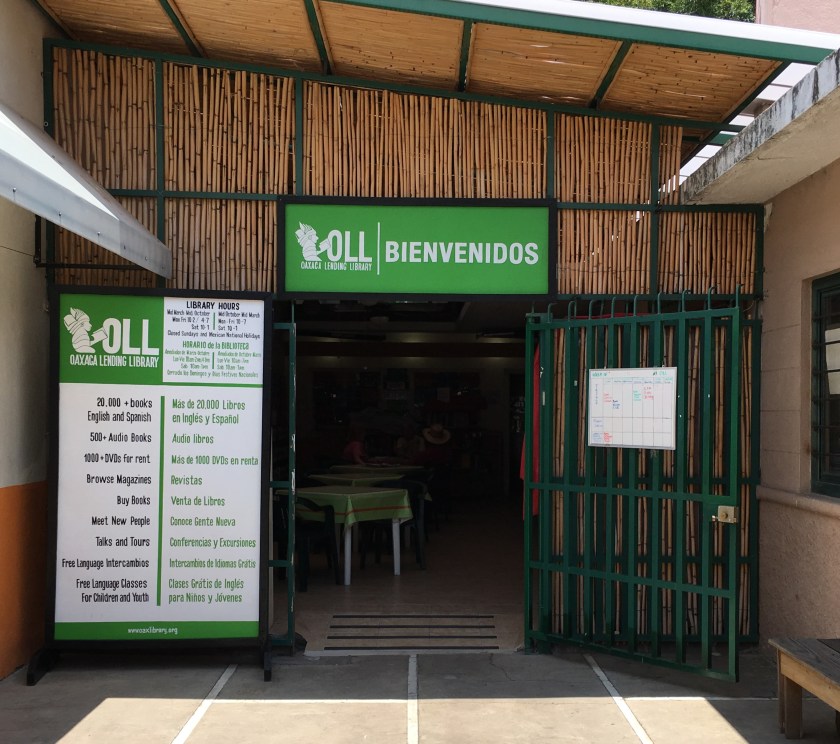
Oaxaca Lending Library… Bienvenidos!

…The Oaxaca Lending Library (OLL), which is the social hub for the expat community in Oaxaca. In addition to an extensive collection of books, they offer resources, programs, events, lectures, and other valuable services. English-speaking travelers visiting Oaxaca for any length of time should make OLL one of their first stops. My husband and I enjoyed meeting several members of this welcoming, interesting, and vibrant community, including…

Marga: 91 years old and full of energy

… Marga, a 91-year-old expat who is full of energy and enthusiasm. She has traveled around the world, but loves coming back to her home in Oaxaca.

When we asked David for a recommendation of a guide/driver to hire, he told us about…

The dashing duo… Jose and Robert

… Robert and Jose, who drove us to beautiful villages and spectacular archeological sites and made our experience very personal and special. Not only did we visit some fascinating locations but, after we were finished touring, they invited us into their home.

A big part of the joy of travel is the people we meet along the way. We have been fortunate to add many new friends to our contact lists, and we’ve received – and extended – plenty of, “if you’re ever in…” invitations over the years.

I am so grateful for the connections we make and the friendships we develop as we travel about. I am also very much looking forward to connecting with friends we have yet to meet.

Grave Discoveries

I’m not sure why I find old cemeteries so intriguing. I do know that I share this interest with many others, including more than a few bloggers. When I did a Google search on this particular fascination, I discovered that there is actually a name for those of us who consider a visit to an old – and the older the better – graveyard an essential stop on any trip: Tombstone Tourists (also, “cemetery enthusiasts,” “grave hunters,” “gravers,” or “taphophiles”).

Over the years, I have had the opportunity to visit many memorable cemeteries.  Some, like the Pere Lachaise Cemetery in Paris, are known for their famous inhabitants. Most, though, are populated by those known and loved only by a relatively small circle of family and friends. And, since the graveyards I love to visit are so old, probably that small circle of people is mostly gone too.

After visiting the Colon Cemetery in Havana, Cuba a couple of years ago, I thought it would be hard to match it for size, history, and architecture. So, you can imagine my excitement (OK, maybe if you don’t share this particular passion, it may be hard to imagine my excitement) when I discovered a city cemetery while looking at a map of Oaxaca. Even better, by the looks of the area indicated on the map with little crosses, it was a big one. Yippee!

This slideshow requires JavaScript.

Oaxaca’s San Miguel Cemetery was established in 1829 because of the city’s urgent need to bury large numbers of citizens killed by a smallpox epidemic. In 1833, it again was used to bury victims of cholera. Construction of a chapel in the middle of the cemetery was started in 1839, but was suspended due to, according to a plaque, “constant rebellions that were held in that time in the city.” Suspended, and never finished (an old crumbling building… yippee, again!).

This slideshow requires JavaScript.

The cemetery is surrounded by tall stone walls and an interior walkway that features 100 arches and over 2000 burial niches. The gravesites, tombstones, and alters tell a rich history of religious traditions, cultural heritage, and even geology, as many of the graves show the effects of the multiple earthquakes that have occurred over the years.

During the Oaxaca’s Day of the Dead celebrations, October 31st – November 2nd, San Miguel Cemetery is blanketed with flowers, candles and alters decorate the graves, and each of the burial niches are illuminated. It is supposed to be a spectacular sight; one that I hope we will experience for ourselves in the next few years.

GratiTuesday: Happy 241st Birthday!


“The second day of July, 1776, will be the most memorable epoch in the history of America. I am apt to believe that it will be celebrated by succeeding generations as the great anniversary festival…. with pomp and parade, with shows, games, sports, guns, bells, bonfires, and illuminations, from one end of this continent to the other, from this time forward forever more.”

            ~John Adams, in a letter to his wife, dated July 3rd, 1776


John Adams was right about the “pomp and parade,” but not about the date. The legal separation of the thirteen colonies from Great Britain occurred on July 2, 1776. The Declaration of Independence (the statement that explained this decision) was debated, revised, then approved two days later on July 4th (can anyone imagine anything like that happening so quickly these days?). From the beginning, our nation has commemorated the date shown on the Declaration of Independence, not the date the original resolution of independence was approved.

I am grateful to be able to join in the “great anniversary festival” of my country’s birthday. I’m also grateful that it is today, not the “2nd of July” we celebrate… it just doesn’t have the same ring to it.

Hearts and Crafts of Oaxaca

Oaxaca is known for the variety and beauty of its handicrafts. Exquisite pottery, woodcarving, weaving, basketry, embroidery, and many other crafts attract collectors from all over the world. Many of the small towns and villages surrounding Oaxaca City specialize in one particular type of craft. The skills have been passed down through the generations and often the whole family takes part in the various stages of producing the art, each adding their unique creative touch.

My husband and I visited several of the artists’ villages and, in some cases, even their private homes. We found that by hiring a private driver to take us around, we were able to tailor our experience to our interests and benefit from the guide’s personal knowledge. The “one-size-fits-all” packaged tours only visit the more touristy shops (never the private homes), often spend just a short time at each stop, and (we were told) steer purchases to locations that offered the tour operators a commission.

This slideshow requires JavaScript.

In addition to viewing the displays of finished products ready for sale, several of the studios we visited demonstrated how the items were made, including how dyes were created from natural sources. When we visited a shop in the village of Teotitlan del Valle, famous for their hand-woven rugs and tapestries, we were shown how a tiny insect gathered from the prickly pear cactus created the intense reds used to dye wool for weaving. Other dye sources include the indigo plant, wild marigold, pecan leaves and shells, pomegranates, and tree moss.

This slideshow requires JavaScript.

Another fascinating visit was to the village of San Martín Tilcajete, which is famous for the fantastical carved wooden animals called alebrijes (al-ah-bree-hays) created there. San Martin’s – and Oaxaca’s – most famous alebrijes artists are the husband and wife team, Jacobo and Maria Angeles. Not only do they produce bright and exquisitely detailed artwork themselves, they have converted their studio into a model of community development. They employ many talented artists from their village and offer tours and demonstrations. Although the alebrijes made by Jacobo and Marie were out of our price range, they also featured beautiful – and much more affordable – carvings made by their apprentices.

This slideshow requires JavaScript.

Making our tours to the outside villages even more special was having the opportunity to visit the private homes of a few of the artists. We met Conception Aguilar, whose family helps her create beautifully crafted and whimsically painted clay sculptures in their small home, and Jose Garcia Antonio, also known as “The Blind Potter,” whose large and wonderfully messy compound is a jumble of his primitive – but exquisite – ceramic art.

My husband and I aren’t big souvenir purchasers, but we did come home with a few items we fell in love with. Not only are they mementos of our travels, but we feel that buying pieces directly from those who make them is the best way to support the artisans and their families, and helps them to keep their heritage alive.

Oaxacan Celebrations

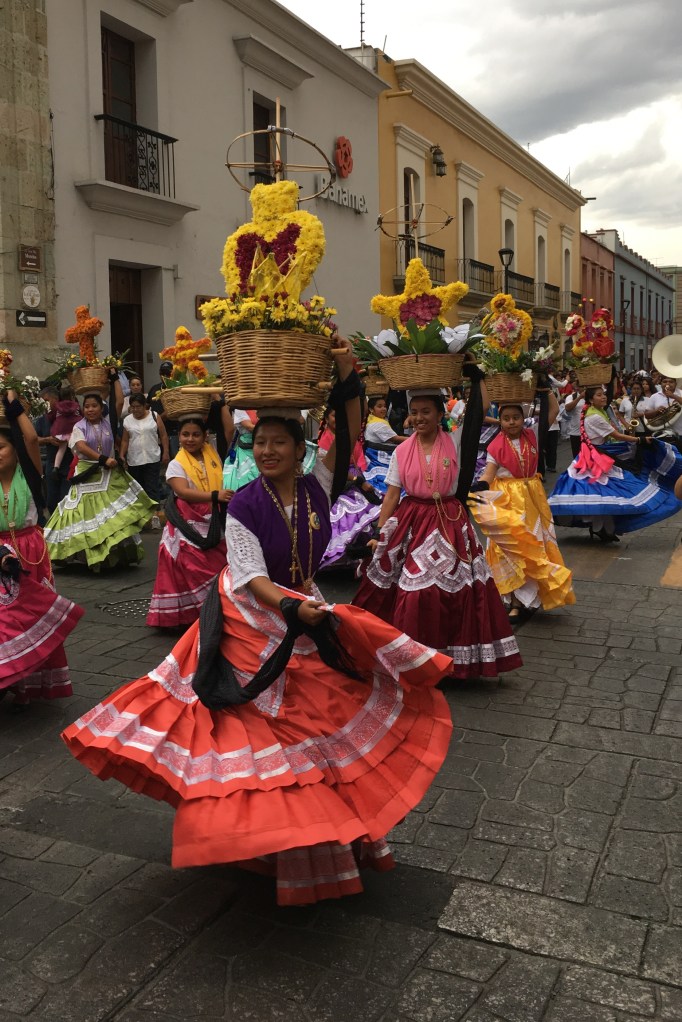
Although the timing of our recent stay in Oaxaca didn’t coincide with any of the large festivals that city is famous for, there was no lack of celebratory events. And, lucky for us, many of these festivities took place in public so we could experience the magic, color, music, and joy of an Oaxacan celebration.

We had no idea what this parade was for, but we were happy to join in!

Whether it was a wedding, graduation, quinceanera, or a religious celebration of unknown (to us) origin, the cobblestone streets were often filled with revelry and processions. What I especially liked about these celebrations is that they weren’t arranged by the chamber of commerce or designed to entertain tourists. Instead, they were authentic and steeped in ritual. That we were there to witness the festivities was fine, but the celebration was for the invited guests, the citizens of Oaxaca, and for those who roots run deep in its culture and traditions.

Many of Oaxaca’s festivals trace their origin to indigenous rituals that were later combined with Catholicism, brought to the region by Spanish conquistadores. One such holiday, Dia de los Muertos (Day of the Dead), is celebrated on the same day as All Saints Day (November 1st) and All Souls Day (November 2nd). Unlike the solemn rituals surrounding these Catholic holidays, Dia de los Muertos is marked with festivals, parades, and celebrations. The holiday and its rituals recognize death as a natural part of the human experience. The departed are seen as part of the community and on these days, they are awakened from their eternal sleep to share celebrations with their loved ones.

During the Day of the Dead celebrations, this cemetery will be filled with people and flowers.

Other festivals that are tempting us for a return visit include the huge Fiesta Guelaguetza, held in July, and the many festivals surrounding the Christmas season including Noche de Rabanos (Night of the Radishes), which brings people from all over the valley into the city center to display their homegrown radishes that have been carved into imaginative sculptures .

Whether they are remembering their departed loved ones, marking a religious holiday, or observing part of their ancient culture, the people of Oaxaca are creative and artistic, exuberant and friendly. They know how to celebrate and, best of all, we are all welcome to join in.

Oaxaca’s Street Markets

The tianguis, or open-air street market, is much more than a place to buy and sell merchandise. Throughout Mexico – and maybe especially in Oaxaca – markets are a fundamental element of the cultural structure. They are where people meet and catch up on news and gossip, new babies are shown off, and young romances are kindled. Market day is a ritual that has been celebrated every week – virtually unchanged – for thousands of years. These markets are not set up for the tourists (although tourists certainly can be found there – often with their cameras, like me), they are an important component in the day-to-day lives of many of the citizens.

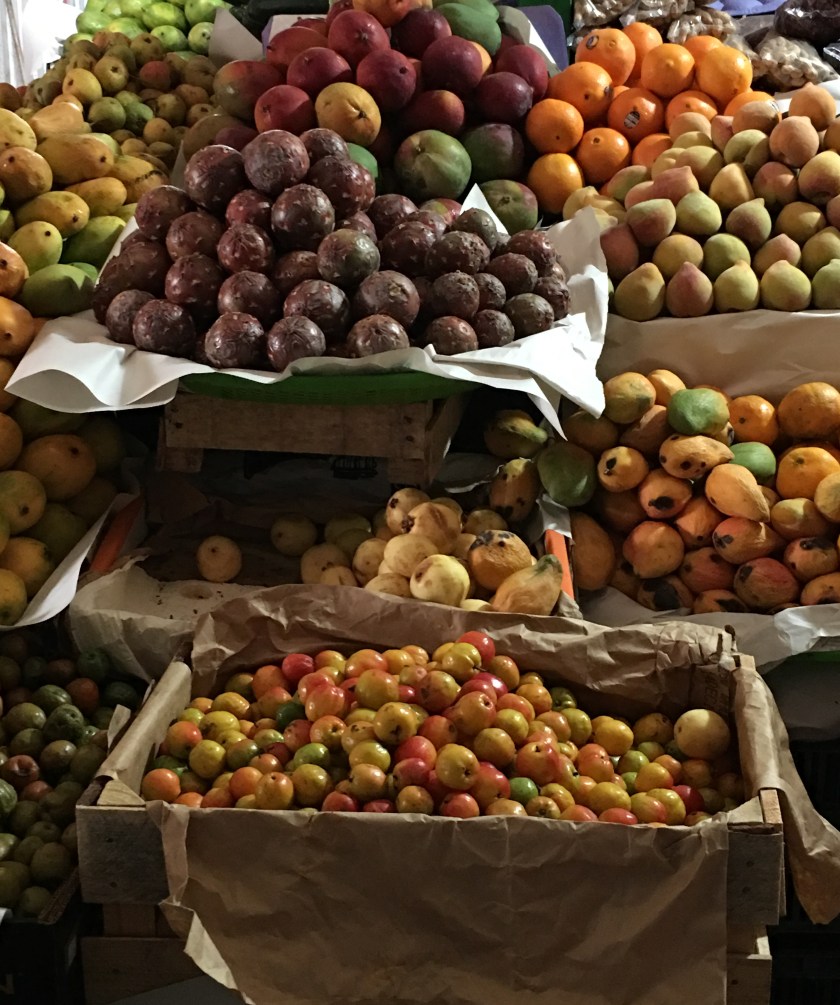
We were able to enjoy amazing fruit every day.

The city of Oaxaca has several tianguis that are open each day. Mercado Sanchez Pasqua, located very close to our house, was our go-to source for fruits and vegetables, as well as freshly made tamales. Just about every day, we stopped by on our way home to purchase delicious, just-picked avocados, mangos, and bananas.

Oaxaca’s original and best known market, Mercado Juarez, is housed in a huge, warehouse-like building. The energy and chaotic mix of sounds, colors, smells, textures, and shapes is an experience not to be missed. Among the multitude of stalls selling merchandise, one can find fruits, vegetables, herbs, flowers, mezcal, sauces, beef, chicken, and seafood. Other stalls tempt buyers with displays of brightly colored clothing, crafts, woven bags, shoes, and blankets.


In addition to the markets in the city center, the Valley of Oaxaca is famous for the tianguis that each of the surrounding villages set up one day a week (each village has its designated day). These local markets not only sell the usual food, flowers, and clothing, but they also feature items that their particular village is known for, such as weavings, cheese, or wooden furniture.

Don’t forget to pick up your Chapulines (fried grasshoppers). And, yes, I tried them.

As unique and exciting as these markets are, there is some worry that they might eventually become a victim of our global society. Oaxaca now has two Walmarts and several large grocery/department stores called Chedraui (all, mercifully, outside the city center). Amazon deliveries are also available. While I understand the ease and time-savings of going to a single location for all ones needs, I fear this convenience will someday lead to the demise of the traditional street markets. A ritual that has been around for thousands of years could be made irrelevant in a few years by big box stores and the internet. That would be an unimaginatively sad and irretrievable loss.

Slow Travel

Since we both retired, my husband and I have done quite a bit of traveling. Sometimes we take a quick drive somewhere close, other times we are away for several weeks or even a month.

Two years ago, a month-long road trip took us through several western and midwestern states, and included a journey along a good portion of Route 66. Last year, we flew to Montreal, rented a car, and traveled through parts of south eastern Canada, and the north eastern United States.

Although we thoroughly enjoyed these trips and relished visiting a lot of different places, each time we moved on we regretted not being able to stay longer and experience all that a specific location had to offer.

This time, we decided to travel in a different way, one that allowed us to slow down, breathe, and relax into life in a foreign country. For a little over five weeks, we rented a private home in Oaxaca, Mexico and enjoyed the luxury of unpacking our bags just once. The house was within walking distance to the central area: close to activity, shops, and restaurants, but far enough away to provide us with a place to enjoy our own company and recharge our batteries.

Our oasis came with a private garden.

By staying in one location for an extended period, we found that our pace slowed and our appreciation for this beautiful city and its culture was allowed to deepen and grow.  Because we weren’t on a tight schedule, we started to match – at least somewhat – our rhythm to that of the city around us.

Santa Domingo at twilight.

This isn’t to say that we didn’t take a few tours or enjoy other “touristy” pursuits – we did. But, because we knew that we had a lot of time to engage and explore, we also could make discoveries that most short-term visitors would probably miss.

What type of travel do we enjoy more? Our answer is that it really depends: it depends on the location, it depends on our curiosity level, and it depends on the time we have to devote to a particular trip.

We just returned home yesterday and I have already found my pace quickening. I have hundreds of photos to go through and pages of notes to organize. Although I promise to not share everything, I do have enough post ideas, along with pictures of doors, murals, churches, architecture, archaeological sites, celebrations, and many other delights we found in this UNESCO World Heritage city, to keep me busy for a while.