I find myself saying this out loud or to myself more and more lately. The aches and pains—minor at this point, thank goodness—and occasional loss of the exact word I’m looking for aside, being older definitely has its advantages. I am happy that I’ve successfully aged past the years of being a responsible, fully employed adult, and into blissful, often irresponsible, and less-than-productive retirement.
In no particular order, here are just a few reasons I celebrate being old:
I am grateful that I grew up without the scourge of social media. I didn’t have to worry about getting likes, the latest social media trend, or that something dumb I did would be captured on video and go viral.
Somehow we made it through high school without cell phones, social media, bots, or online influencers.
I’m not overly concerned about what others think of me. That doesn’t mean that I don’t consider others or don’t want to be liked; I just don’t lose sleep worrying about someone else’s opinion of me.
I am concerned about the state of my country and the world, including social justice and the impact of climate change. I do what I can to support the causes I believe in but, at my age, I’m somewhat insulated and will probably be gone before things get too bad. I hope the younger generations are smarter than we were.
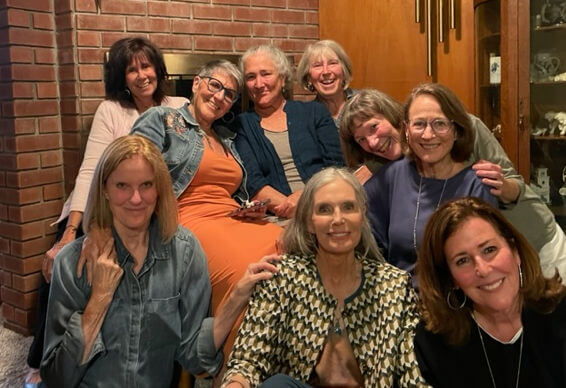
I’m happy with my tribe of peers. I find myself surrounded by thoughtful, intelligent, engaged, interesting friends. I’ve known some since I was very young, and others have been more recent additions. All are treasures.
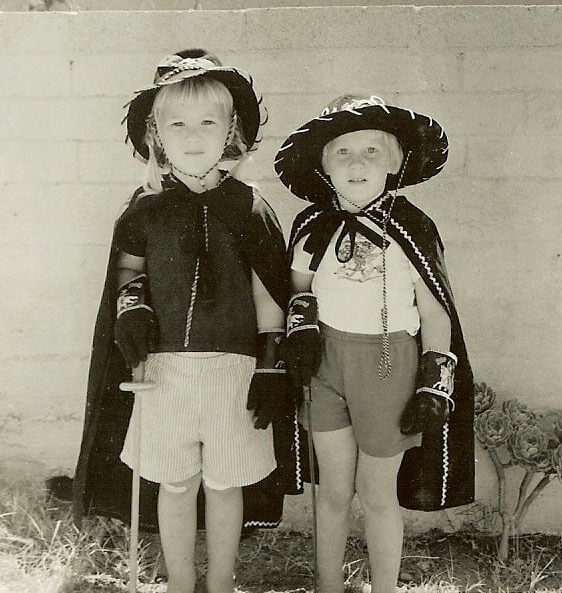
Friends since our diaper days.
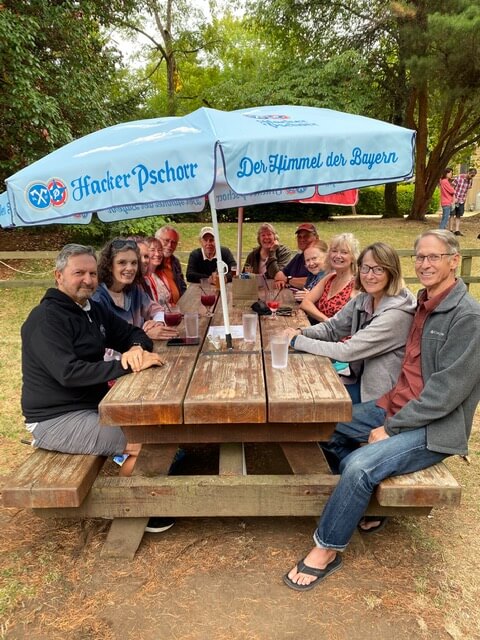
Cherished blogging friends.
AI wasn’t a thing when I was young. While I was working, most jobs were performed by actual human beings. At no time during my career was I concerned about being replaced by a computer program. I don’t think anyone really knows where AI will lead us, but I know several younger workers who are worried.
My husband and I recently got the latest COVID booster. Being over 65 means that we are “privileged” to be in the approved group. Also, because I grew up when I did, I received all the vaccines available as a child.
The elementary, junior high, and high schools I attended weren’t surrounded by barricades. I didn’t have to worry that my life was an acceptable cost of protecting the right of others to arm themselves with AK-47s.
Fencing recently added to a local elementary school.
Of course, the best part of growing old is the privilege of being old. Not everyone is so lucky. That I successfully dodged the consequences of more than a few stupid decisions, survived a couple of serious health challenges, and managed to make it this far is a bit of a miracle.
How about you? Are you happy to be the age you are, or would you like to time travel to a different age? If you are older like me, what benefits are you enjoying?
If you are like many of us who have reached a certain age, your focus is on acquiring less and purging more. Paring down, organizing, and decluttering has become the mantra of many retirees who are interested in de-stuffifying their homes. As you are off-loading what you don’t want, have you also considered organizing what is left so that someone can easily manage your affairs if/when you can’t?
My husband and I have had several wake-up calls recently that have prompted us to take action. Over the past year, several friends and family members have experienced major illnesses and other physical or mental declines. One recent death in particular, where the surviving partner was left with a mess of papers and little documentation, made us realize the importance of organizing our information now for when we are no longer around.
Before so much of our lives were online, gathering the necessary documents and financial data was a fairly simple task. Now, not only are many of these documents digitized somewhere in some cloud, but there are multiple passwords, PINs, secret codes, social media accounts, online subscriptions, etc. that need to be considered. Think about the family member or friend taking over for you; without a roadmap, they probably wouldn’t know where to start.
There are various tools available to help organize your information. I’ll cover a few of them in a future post.
I’ve been doing a lot of reading and online research to help create that roadmap. Since we established our Trust years ago (note to self: it’s time to get it updated), my main focus will be on organizing information not contained in that document. A project like this can be time-consuming and feel overwhelming so I’ve broken it down into doable chunks to be tackled over several months. Since others may have a similar project, I will share my progress from time-to-time as I work through my list:
Organize passwords and codes
Create an estate blueprint
Document Home Operating Systems
Make a list of important contacts
Update Trust and write Letter of Last Instructions
Document any debt, credit, and insurance
Create my Personal Medical Journal
Create a Digital Estate Plan
Document personal possessions to distribute
Write an Ethical Will
Plan for what happens next
I get that most people feel uncomfortable thinking about their mortality. I’m healthy and active now so I’d rather not think about it either. But, after seeing a loved one struggle with legal and logistical issues while dealing with her profound grief, I don’t want to put anyone through that experience. I expect, like decluttering my home, I will feel much better when I’m done. I also imagine that the person managing my estate will appreciate that I organized my life and left them a roadmap.
My husband and I don’t go out to dinner very often – our home cooked meals are often tastier and healthier – but we do enjoy going out for lunch. Sometimes it’s the sole reason for getting out at midday, sometimes it’s woven into a day’s errands. We don’t often frequent fancy restaurants, but we appreciate a decent sized table (we like to sit side-by side) and a quiet atmosphere. Being able to carry on a conversation is as important – maybe more so – than the food.
Over the last several years, we have gotten in the habit of splitting meals. Not every time, but often enough that we check with each other first to gauge our hunger level before ordering. This has nothing to do with the cost of the meals, and everything to do with the quantity of food. We just can’t eat as much as we used to.
At first, we didn’t think much about asking to share or split a plate. We only wanted one, so that’s what we ordered. Recently, though, we’ve noticed that our request has elicited a variety of responses. Some servers happily bring two plates separated into two even half portions. Some bring one entrée with an extra empty plate. Some just bring one entrée on one plate for us both to dig into. Other times, we are charged a “split plate fee” of a dollar or two. Restaurants that charge this fee usually split the entrée on two separate plates, but not always.
I often feel compelled to let the server know that we just can’t eat the amount of food we used to – I suppose implying, but not saying, that it isn’t because we are cheap. That completely useless piece of info makes me feel better, but I imagine the server is calculating his or her tip based on a check of half the usual amount. Since my husband and I are generous tippers, hopefully they are pleasantly surprised.
Tapas are the perfect size……to share.
One of the many things we loved about Spain were the tapas (small plates) available in many of the restaurants. We could order and few to start, then order more if we were still hungry. We could taste several different items without overindulging and overstuffing ourselves. A few small plates and a couple of glasses of wine and we were completely satisfied. None of those huge mounds of food that are served in many U.S. restaurants.
I don’t think we are unusual in our shared dining habit. Several of our friends say that they do the same. As we get older, many of us experience a decline in the amount of food we can comfortably eat. Long gone are the days when we could – and did – eat anything and everything and not gain an ounce. Even if our weight isn’t a concern, our older tummies just can’t hold what they used to.
How about you… do you share meals at restaurants? If so, have you experienced any push-back – maybe even eye rolls – from the server? If you live where tipping is the norm, do you add extra because you are sharing an entrée?
So, What’s on Your Plate? (#WOYP). Hop over to Donna’s and Deb’s blogs to see what’s on their plates… and to share your own.
Even though it’s my birth month, I’ve never been a big fan of January. When I was young, I envied those who had summer birthdays and could celebrate with a pool party, beach bash, or an outdoor BBQ. Because my birthday closely follows the holiday season, people are pretty much over it by then, and in no mood to celebrate. After the big run-up to Christmas (that now begins as early as October), January can feel like a bit of a letdown, a sad gray month with little to get excited about.
In the Northern Hemisphere, January is known for low temps and dreary weather, the winter doldrums. Even though it doesn’t snow where we live, January is often our coldest and wettest month. February can be cold and wet too, but at least it has the good sense to last only 28 days, as opposed to January’s 31.
Recently, an article in The New York Times by Steven Kurutz has me rethinking my dislike of January. Reading his homage to the month, I began to realize that it’s actually the lack of much going on that makes it wonderful. There are fewer crowds and even fewer social obligations. There is less traffic on the roads and not as many people in stores and restaurants.
Just last night, as we drove to meet friends for dinner, my husband remarked about how little traffic there was. When we got to the restaurant, we were seated right away in an outdoor courtyard near some space heaters. We were warm and cozy and enjoyed a nice leisurely dinner with our friends, not feeling the least bit rushed so the table could be turned for the next guests.
January has a slower rhythm that allows us to relax, reflect, and rejuvenate. The cold weather is often a great excuse to spend time indoors organizing, decluttering, making soup, or just cuddling up with a good book. It’s a month made for introverts.
I no longer wish I could have a beach party or BBQ on my birthday. As the days slowly lengthen – we gain about a half an hour of daylight over the course of the month – I know there will be plenty of opportunities for outdoor celebrations when the weather warms up. For now, I’m happy to enjoy the sense of calm that January brings, allowing me to breathe again.
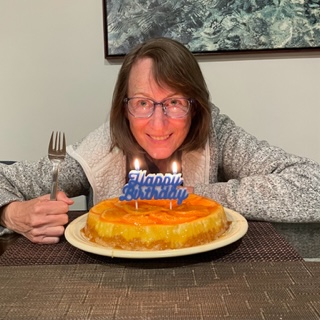
My husband’s caramelized orange cheesecake is the only birthday gift I need.
This post is linked to the monthly What’s Been on Your Calendar? linkup hosted by Donna, Deb, Jo, and Sue.
We all know that each of us comes with an expiration date. If we are lucky, and we remain in decent health, that date is well into the future. Others aren’t so fortunate. Since none of us are privy to the exact day we will take our last breath, hopefully we all live our best life until then.
In her debut novel, The Measure, Nikki Erlick asks: what if we could know how long we had to live? What would happen if a small box containing that information was mysteriously delivered to every person on Earth? Those whose boxes contained a short string learned that they had just a few days, months, or years left. Others found longer strings and, therefore, had lengthier timelines. The novel’s premise is fascinating, and Erlick does a great job exploring how this knowledge could impact individuals, relationships, and whole societies, including how different governments might react.
When my book club met last week to discuss The Measure, our hostess greeted us with an arrangement of small, unmarked boxes. We were told to pick one but not to open it until instructed. After a lively and stimulating discussion about the book (it received a solid 4 out of 5 stars from most of us), things got even more interesting. We went around the room and answered the question: Would you choose to open your box and why or why not?
Some of us, including me, opted to leave our boxes closed. A few said they might have opened it when they were young but not now (most of us are 60+). I chose to leave my box closed because I felt that knowing exactly when I will die could negatively impact my mental well-being. If I found out that I only had until next October, for instance, I’m afraid that I’d spend my last few months worrying rather than enjoying the time I had left.
Others said that they’d absolutely open their box. A few cited current health issues or having children and/or grandchildren as reasons for their decision. Some knew that their curiosity would get the better of them, although they’d probably have to have several stiff drinks before opening their box. Interestingly, even though we all knew these particular strings had no magical powers, as the boxes were opened, there was relief if the string was long, disappointment if it was short.
Image curtesy of Pixaby
So, I’m curious. What would you do? Would you choose to know when – although not how – you will die?
If you’d open the box, would having a short or a long string change anything about how you’d choose to spend the rest of your life? Would you take more risks if you had a long string? Would you be more cautious if it was short?
If you would choose to keep your box closed, why? Would you have made a different decision at another time in your life?
Full disclosure: At the end of the evening, before I drove home, I opened my box out of curiosity. My string was long… whew.
Linking up to What’s On Your Bookshelf? hosted every month by Donna, Debbie, Jo, and Sue.
… and, by “new year” I don’t mean 2023, I mean “new year” as in embarking on my latest year-long journey around the sun. I turned another year older a few days ago.
Birthday celebrations now are very different than they were when I was younger. I don’t want to open gifts or go out to a fancy dinner. I’d much rather spend the day exploring someplace interesting, enjoying a home-cooked meal, and, of course, consuming a piece of the delectable Caramelized Orange Cheesecake my husband makes me every year (happy wife, happy life).
Check, check, and check.
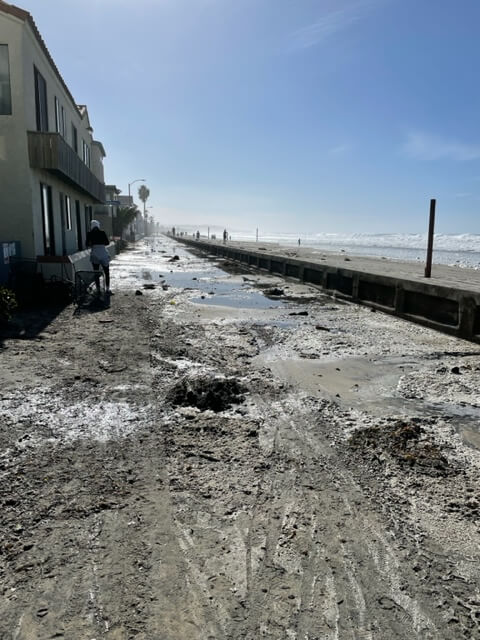
You may have read about all the rain California has been experiencing lately. Gosh knows we need it, but maybe not all at once. Here in the southern part of the state, the weather has been milder, but the king tides and stormy surf have brought big waves and some flooding to our coastal areas.
On my birthday, following a day of especially high tides, my husband and I drove to a local beach to watch the pounding surf and see the aftermath of surging water, seaweed, and sand.
This boardwalk is usually filled with walkers, skateboarders, and bicyclists. It will probably be a few days before all the sand is back on the beach… where it’s suppose to be.
Although we missed all the excitement, we heard tales of waves plunging over the seawall, leaving a thick layer of sand that will have to be shoveled back onto the beach.
Our walk also took us to Belmont Park, a beachfront amusement park built in 1925.
Although the interior has been modernized, I’m glad they maintained the Spanish Renaissance style façade.
When I was very young, our parents often took my brothers and me swimming at The Plunge, a huge indoor pool located in the park. The building and pool have recently been renovated, but the sound of kids playing, and the smell of chlorine still brought back many happy memories.
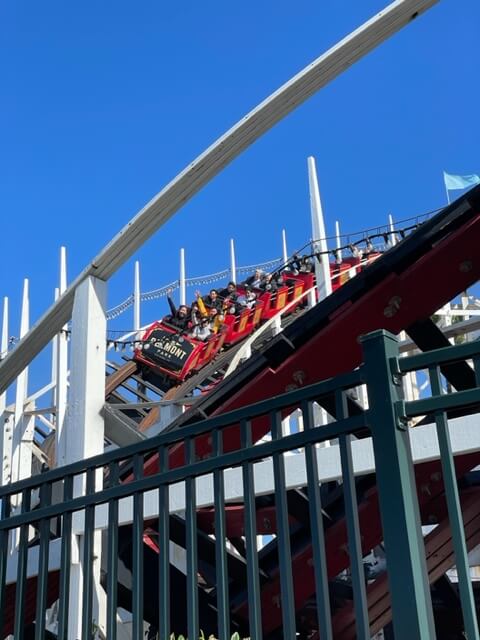
After visiting the pool, we walked around the arcade and midway area for a bit of people watching. That’s when I decided I had to ride the Giant Dipper—the historical wooden roller coaster that was also a part of my childhood—again. Although the roller coaster has been refurbished since I last rode it, it still had the bone-rattling twists, turns and downhill plunges I remembered from my youth.
There is something about a roller coaster that brings out the kid in us.
Topping off the first day of my latest journey around the sun, I dug into a yummy husband-cooked meal before plunging into my favorite birthday treat: Caramelized Orange Cheesecake.
It was the perfect ending to a perfect day.
This week’s Sunday Stills prompt is Plunge. Please visit Terri’s site to see how other bloggers took the challenge.
Like so many changes we experience as we age, this one occurred slowly, over time. I’ve worn corrective lenses for distance vision since I was in my twenties but was able to read even the tiniest fonts close-up, without glasses. Several years ago, I became aware that my corrected distance vision was becoming less clear. Driving at night, I saw starbursts from the lights of oncoming traffic and, even during the day, road signs were harder to read. I also started to have problems reading print. Type that had always been crisp and clear was now blurry. I tried cheaters but they just magnified the blurs.
A visit to my eye doctor confirmed my suspicions: like so many people of a certain age, I was developing cataracts. He said that there wasn’t much he could do by adjusting my prescription, but the cataracts weren’t quite bad enough to warrant surgery… yet.
Surgery isn’t normally something I look forward to—I’ve had a few and none have been voluntary or enjoyable—but I was anxious for my vision to get bad enough to have my cataracts removed. I knew several people who had the surgery, and they told me it was no big deal. Painless. Almost instant improvement.
Finally, earlier this year, my sight was deemed sufficiently deficient. In late October, I had surgery on my right eye and, two weeks later, my left. Just like I was told, the surgery was quick and easy, and the results were immediate. My foggy vision was gone.
Here’s what they didn’t tell me: as my eyesight had gradually gotten more and more blurry, cataracts also impacted my perception of colors. Over the years, so slowly I didn’t even notice it, my world had taken on a yellowish hue.
After my initial surgery, the colors I saw through my corrected eye were much brighter and more vivid than what I saw through my other eye. The blues were bluer, the greens, greener. The white walls of our living room no longer looked like they needed re-painting. When I looked at the view from our back deck, it sparkled, just like it used to. Suddenly, I was seeing things as they are, not as they appeared through a dingy lens.
During the two weeks in between surgeries, I kept shutting one eye, then the other, marveling at the difference in color perception. I felt a bit like Dorothy opening the door in her sepia world and entering a technicolor Oz (okay, maybe a bit of an exaggeration, but…wow!).
Prior to my second surgery, I thought it would be interesting to document the before and after as best as I could so I wouldn’t forget what my washed-out vision looked like:
Vancouver, Canada, before and after cataract surgery.
Thanks to the miracle of cataract surgery, my world is vivid again.
Check out other examples of Vivid at Terri’s weekly Sunday Stills challenge.
This story was inspired by a writing challenge hosted by D. Wallace Peach, who blogs at Myths of the Mirror. Her challenge: write a poem or story about a TBR (To Be Read) pile – those books many of us have accumulated but haven’t read yet.
I am also submitting my story to the What’s on Your Bookshelf? blog link-up hosted by Donna, Deb, Jo, and Sue. Hopefully fictional book collections qualify 😊.
To Be Read
It had taken nearly eight months, but Jane finally made it through the TBR pile that had been stacked by her bedside. As she picked up the remaining book from the floor, she could see the ring of dust her pile had created on the carpet like the chalk body outline in a crime novel. Her daughter would be pleased that she could finally vacuum the floor properly, but Jane couldn’t help feeling the loss of her friends.
She opened her book and started to read.
At first, when Anne invited her mother to come live with her, she had resisted. Jane valued her independence and knew that their individual daily habits could cause friction. But when Jane’s health deteriorated to a point that even she realized that she could no longer live alone, she consented. Within a few weeks, Jane’s home had been emptied and put on the market. Anne told her mother she could keep anything she wanted, but Jane knew her daughter’s house was small, and space was already at a premium. A few items of clothing, her favorite teacup, and her pile of books was all she brought with her.
A few weeks after Jane moved in, Anne realized the large stack of books by the side of her mother’s bed would be a permanent fixture. Clean, orderly spaces calmed Anne and gave her a sense of control. Books should be on shelves and floors kept clear of clutter. Knowing that her mother would bristle at her beloved books being referred to as clutter, Anne tried to appeal to her practical side.
“Would you like me to find space on my bookshelves for all of your books? That way, you can see each one easier.”
“No, thank you, dear. I love to see all my books out in the open, patiently waiting their turn. They give me something to look forward to.”
“But, what about your safety? Books on the floor could be a hazard. You could trip on the pile and break your neck.”
“What a novel way to die,” Jane replied.
“Very funny Mom, but I do worry about you.”
After several similar conversations, Jane finally agreed to read her way through the stack of books and not add any more. Anne assured her, after the pile was gone, she could check out all the books she wanted from the library or download them to her Kindle. Knowing that this was probably the best compromise she could hope for, Anne willed herself to stay silent despite her continued dismay at the pile. She vacuumed around it as well as she could and – when her mother wasn’t looking – she tried to neaten the stacks.
Over the next several months, Anne was happy to see that her mother was keeping her word. Slowly the TBR pile shrank in size and the floor around her bed started to clear. Anne was confident that, once the pile was gone, her mother would see the wisdom of keeping the area clear.
Before going to bed, Anne opened her mother’s bedroom door to say goodnight. She wasn’t surprised to see that Jane had fallen to sleep reading. She was still wearing her glasses and the bedside lamp was on, casting a ring of light around her. The book she was reading had tumbled out of her grasp onto the comforter. She looked so peaceful. Anne marveled at her mother’s joy of reading and was happy that, despite her poor health, she was still able to do what she loved.
As Anne crossed the room to her mother’s bed, she smiled when she noticed that there were no more books on the TBR pile. She made a quick mental note to make a trip to the library as promised. Anne reached for her mother’s glasses and was startled when her hands brushed Jane’s cold face. She quickly tried to find her pulse but felt none. Her mother was dead.
Anticipating this time would eventually come, Anne knew what she had to do. Holding firmly against her grief, she picked up her phone to call 911.
Anne sat down on her mother’s bed to wait for the paramedics and allowed herself to feel the full weight of her loss. Through her tears, she looked around the room and hoped that her mother had been happy living with her. Curious to see what her mother had been reading, she picked up the book from the bed.
She was surprised to see that it was the book by Mitch Albom she had given her mother when her dad died. Anne had hoped the messages found in The Five People You Meet in Heaven would provide her mother some peace after losing her husband.
“Oh Mom, you knew, didn’t you?” Anne cried. “You knew it was at the bottom of your stack, and you saved it for last.”
Anne saw a pink post-it note peeking out of the book and opened it to the marked page. A paragraph had been highlighted and her mother had drawn little hearts and stars around it.
“Lost love is still love, Eddie. It just takes a different form, that’s all. You can’t hold their hand… You can’t tousle their hair… But when those senses weaken another one comes to life… Memory… Memory becomes your partner. You hold it… you dance with it… Life has to end, Eddie… Love doesn’t.”
When Anne heard the knock on the door, she closed the book, kissed her mother’s forehead, and tousled her hair one last time. Before going to the front door, she walked into her bedroom and placed the book on the floor by her bed, to be read later.
This is the fourth short story I’ve written that has the current pandemic as an underlying theme. The other three: Lost and Found (in five parts), Be the Change, and Gathering Storm, can be found by clicking on the category Short Stories and Poems, above.
I hope you enjoy it.
Who Needs Who?
The quiet, tree-lined neighborhood of single-family homes was just what Jen was looking for. After spending most of her 20s and early 30s living in the beach area, she had been ready for a change. The traffic, noise, and loud weekend parties—things that she energized her when she was younger—had started to wear on her. Then, Covid hit, and it all became too much. Her friends acted as if they were immune and continued to gather, unmasked and in large groups. She grew tired of complaining, and she knew that her friends weren’t going to change, so she decided to move to an area where she felt more comfortable.
The cute, two-bedroom, one-bath, bungalow she found was perfect. The house was big enough to have a separate work-from-home office but small enough so she could afford the rent by herself. The days of dealing with roommate drama were over. Her move in November was more than just from one abode to another; she felt like she finally had transitioned from her unmoored youth into adulthood.
Jen knew that she was one of the lucky ones. Her job as a project manager was easy to do from home; in fact, she preferred working there. The windows in her office allowed soft light into the room and offered a relaxing view of her front yard and the street. Although she hadn’t had a chance to meet any of her neighbors face-to-face, she was starting to recognize a few familiar faces as they walked by or worked in their yards. She was relieved to see that they were careful to wear masks and keep their distance when interacting with each other.
Jen was especially intrigued by the woman who lived directly across the street. She reminded Jen of her grandmother who, at nearly 80, was a tiny ball of energy topped with a puff of gray hair. The woman even used a cane like Gram, although, from what she could see, her neighbor’s brightly-colored cane looked to be as much of a fashion accessory as a walking aid.
One Saturday morning in mid-January, as Jen was cleaning her office, she glanced out her window and saw her neighbor walking down her driveway to retrieve her newspaper. Jen’s thoughts turned to her Gram and how hard the Covid restrictions had been on her; how lonely and isolated she said she felt. Jen kept in touch as much as possible, but she lived several hours away and Gram’s facility still didn’t allow visitors. Despite their distance, Jen was happy to have been able to help her grandmother get her first vaccine appointment the prior week. As Jen navigated through the convoluted and frustrating process, she couldn’t help feeling sorry for anyone who wasn’t internet-savvy and didn’t have assistance.
As she watched her neighbor, it occurred to Jen that she might need help signing up for her Covid vaccine too. Offering assistance to her neighbor would give her a great excuse to introduce herself and, perhaps, do a good deed. Jen figured that her neighbor probably felt as unsure of the process as her grandmother had.
Later that morning, Jen put on her coat and walked across the street. She didn’t know why she felt anxious, but she put on a big smile to cover her nervousness and knocked.
After a few moments, her neighbor opened her door.
“Hi! I’m Jen. I moved into the house across the street a few months ago.” Jen smiled brightly, before putting on her mask. “I haven’t had the chance to meet any of my neighbors yet, but I’m really happy living here. This is the first time I’ve lived alone and, although I miss my roommates, I’m starting to appreciate the quiet.” Oh, gawd, I’m babbling like a nervous suiter, Jen thought to herself.
“Oh, hello, dear. I’ve been meaning to introduce myself and welcome you to the neighborhood but, well, you know, this virus makes those things so complicated. My name is Cora.”
Cora put on her mask, opened her screen door with her cane, and stepped onto her porch.
Jen’s confidence faltered a bit as Cora looked at her with questioning eyes. “Um, well, I was wondering if you might need some help setting up your vaccine appointment. The online process can be pretty confusing and there are a lot of forms to complete. I was able to help my grandmother, so I’m familiar with the procedure.”
“That’s so sweet of you. That would be lovely. I’m anxious to get vaccinated but I understand it can be difficult to get an appointment.”
Jen breathed a sigh of relief. “Great! I can either help you on your computer if you have one, or you can come over to my house and use mine. You can enter all of your personal information yourself, so you don’t need to worry about privacy.”
After some discussion, Cora agreed to meet later that day at Jen’s house. Jen assured Cora that they could do the work on her laptop outdoors in her small backyard. As Jen walked back across the street, she was filled with satisfaction. Not only was she helping someone who needed her assistance, Jen was also hopeful that she had just met her first friend in her new neighborhood.
That afternoon, sitting at a small table on Jen’s postage-stamp-sized patio, Cora and Jen worked together to find a vaccine appointment at a nearby facility. With Jen’s help, Cora filled out all the necessary information and, when they got to the screen that announced her success, they both spontaneously let out a cheer and clapped their hands. They both felt like they had won the lottery.
As Jen walked her new friend back across the street, she offered to drive Cora to her appointment the following Thursday. Although she knew Cora had a car, she figured her apparent leg injury might make driving difficult. Besides, if there was a long line or any other complications once she got there, Jen wanted to be able to help. Cora accepted her offer gratefully.
On Thursday morning, Jen sat in her tiny kitchen sipping her coffee. She had arranged to take the morning off from work and was looking forward to spending an hour or two with Cora. Jen knew that her Gram enjoyed their conversations and she imagined Cora would also appreciate having someone to talk to.
A half an hour before they were due to leave, Jen went out to her car to tidy it up. She tended to use the passenger seat as a desk and there often were notebooks and file folders strewn about. As she opened the passenger door to grab her stuff, she saw a neighbor walk towards her waving.
“Hi, there! I’m so happy to finally have a chance to meet you. I’m Lisa, I live in the blue house two doors down.”
“Nice to meet you,” Jen replied, smiling. “Sorry I don’t have my mask with me, but I was just getting a few things from my car. I’m driving Cora to her first vaccine appointment this morning.”
“That’s so nice of you! She is recovering well from her bike accident, but I know she still has trouble now and then.”
Bike accident? Suddenly Jen’s perception of her new friend shifted. As far as she knew, her Gram never cycled, and, even if she had, it would have been well before Jen was born.
“Um, yeah. I helped her get her appointment. It can be difficult if you aren’t comfortable with the internet… you know, dealing with the various websites and forms. I helped my grandmother too.”
Jen was surprised to hear Lisa laugh. “You helped Cora get an appointment?”
“Yeah?” Jen didn’t mean for that to come out as a question.
“Cora and her late husband used to own a computer consulting business before he became ill and they had to sell it. She knows Macs, PCs, and the internet better than anyone in this neighborhood. In fact, if any of us have an issue, she is the one we go to for help. We are lucky to have our very own Geek Squad on our block.”
Just then, Cora stepped out of her front door and waved. “Good morning! I’ve been looking forward to this day. I’ll be over in ten.”
“Well, you two have a nice time,” Lisa said. “I envy her. My appointment isn’t for a few weeks.”
Jen went back inside her house to dump her notebooks and grab her purse and mask. When she came out, Cora was standing by the car. Jen opened the passenger door and waited as Cora climbed in and settled her cane on the floor. After closing the door, Jen walked around to her side, got in, and turned towards Cora.
“Lisa tells me that you hurt your leg biking.” Jen cringed a bit at the accusatory tone of her voice.
Cora sighed. “I should probably give it up at my age. My grandkids and I love to ride in circles around their cul-de-sac. It was a way to spend time with them outside. I fell several weeks ago and got a bit banged up. My son tells me that I’m nuts, and he is probably right.”
“Lisa also says that you used to own a computer consulting company.” There was that tone again. “That you are always helping your neighbors with their technical problems.”
Jen could see Cora winch behind her mask. “Oops,” she said with a slight giggle. “I guess my secret’s out.”
“You probably didn’t need my help making your appointment.”
“No, I didn’t. But I was so touched by your offer, I couldn’t say no. You also seemed a little lonely and I thought you could use a friend.”
Jen turned back and started her car. Her face flushed with indignation. She felt foolish. How dare Cora take advantage of my generosity? And, then to make it sound like she was doing me a favor?
As Jen drove a few blocks further, she began to reconsider her initial reaction. She was the one who made the offer, after all. She had assumed Cora needed help because her Gram did. Besides, she thought, I am lonely, and I really could use a friend.
As she waited for the light to change so she could turn onto the main thoroughfare, Jen looked over at Cora and smiled. “How about after your appointment, we stop for coffee? I’d love to get to know you better.”
I, of course, had no idea that the hair and nail appointments I made one year ago would be the last ones for a long, long time. I imagine that, as I left each of these establishments, my parting words were something along the lines of “I’ll see you in six weeks” (or two, in the case of my nail tech). I was newly highlighted (hair) and gelled (nails) and had little reason to think that I was about to enter the twilight zone of…
I started lightening my hair in the 1970s, almost as soon as my naturally light blond tresses began to turn the dreaded “dirty blond.”
Proof that I come by my blond (and fine) hair naturally… also, apparently, my taste for cookies.
At first, I used Sun-In lightening spray that worked with the sun to produce dry, hay-like light golden locks. After several weeks of baking my skin and hair, I achieved the natural, surfer girl looks I was going for. Fortunately, my hair survived this assault but, unfortunately, my skin is still paying the price for my vanity.
As I got older and had more discretionary income, professional haircuts and highlights became part of my routine upkeep. At about the same time, I determined that my thin, perpetually-chipped nails didn’t support the professional look I was going for, so regular manicure appointments were added.
Before Covid, I hadn’t given serious thought to letting nature take its course. Despite all evidence to the contrary, I continued to think of myself as a blond. The highlights I was getting were merely augmenting my natural color (sure they were). My nails were a different story. I knew that, under the polish and gel coating, lurked a peeling, splitting mess. I had no desire to let my natural nails go free.
I remember canceling my first standing appointments after our state started to close things down. Like many, I assumed that this would be a short, temporary situation. I could certainly go a month – maybe even two – without my usual upkeep. After all, we’ve traveled out of the country for close to two months and somehow I survived—knowing, of course, that my appointments were set and waiting for me on my return.
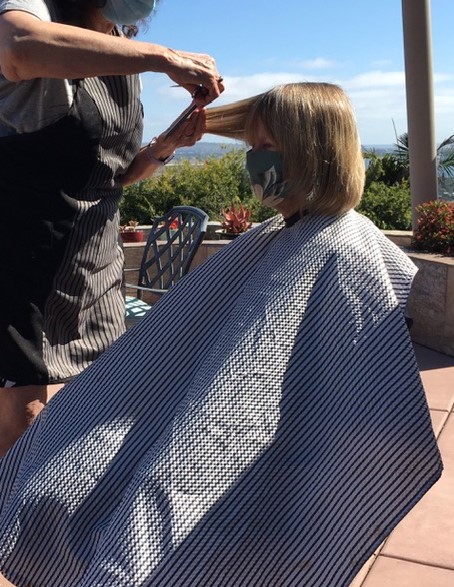
Then a funny thing happened. Four weeks turned to eight. Eight to twelve. Twelve to twenty. At week 21, I called my stylist and asked her if she made house calls. Since then she’s made three more, but only for trims.
Day 141.
My last color was one year ago and I’m okay with that. I don’t have a lot of gray in my mostly light brown hair but, what’s there looks amazingly like the highlights I used to pay the big bucks for.
Day 367.
My nails have also been a pleasant surprise. Once what had been damaged by the gel grew out, I have discovered that my natural nails aren’t bad at all. As long as I keep them fairly short, they look just fine.
I don’t know if my new natural look is here to stay or not. I doubt that I will go back to regular manicures, but I reserve my right to become an ash blond again if I decide that I prefer that look. Right now, though, I’m happy to embrace the real me. Oh, and my stylist no longer needs to make house calls… my husband and I have learned to cut each other’s hair.












 Retirementally Challenged