A New Year’s Resolution for EVERYONE

I wrote this post a year ago but apparently not everyone was paying attention because we still have issues… big issues. Here it is again with a few updates… I hope it works this time.

I gave up writing New Year’s resolutions for myself years ago. As a kid, it was kind of fun to put together a list every year but, as I got older, I came to realize that they really never amounted to much. In the end, and despite my good intensions, there were few pounds lost and no better habits gained. Yep, I was pretty much the same old me after a month or two into the new year.

This year, rather than come up with resolutions just for myself, I have decided to make one big resolution for EVERYONE to share. I figure that, with us all working together, supporting each other, and gently nudging those that falter back on track, maybe, just maybe, we can succeed.

My resolution for the masses:

Don’t be Stupid

The best thing about this resolution for you is, because I’m sure – like me – you aren’t stupid at all, your part will be easy. Just make sure that everyone else doesn’t mess up.

Here is list of 10 ways your fellow humans can avoid being stupid. It’s far from complete.

  1. Don’t text or talk on the phone while driving. Competent multi-tasking is a myth. Even if it wasn’t, the task of piloting a vehicle that weighs over 3,000 pounds requires complete attention. This level of stupid could end up killing someone.
  2. Same goes for drinking and driving.
  3. Don’t believe everything you read, hear, or see on the Internet – check things out. Develop a healthy skepticism. Believing that the Pope supported Donald Trump was stupid. Thinking that reposting a “Privacy Statement” on your Facebook wall will protect your privacy is stupid. Reposting these fake stories (even with the caveat “this could be a hoax, but I’m posting it just in case”) makes the poster’s stupidity evident to all 1,000 of their closest friends. Snopes.com and Factcheck.com are your friends. So are critical thinking skills.
  4. Don’t equate the accumulation of things with the building of happiness. We all like a certain amount of stuff, but chances are the good feeling we get from acquiring something new will not last. Think about acquiring experiences and accumulating memories instead. Travel, spend time with family and friends, learn a new skill.
  5. Don’t over-inflate. I’m not talking about weight here (although, it could be argued that not properly nourishing and caring for the only body we have is kind of stupid); I mean the tendency to take a small incident and inflate it into something much greater. The controversy over Starbuck’s plain red cups last year and their green cups this year comes to mind, as do many stories reported on cable news. Over-inflating creates cultural distortion and promotes misinformation.
  6. Don’t miss out on glorious vistas or the witnessing of actual events or because it seemed more important to take and post selfies. The magnificence of the Grand Canyon isn’t improved with duck-lipped faces in front of it.
  7. Don’t compare yourself physically to models and celebrities. Chances are that they don’t even really look like that. Photoshop and good lighting can do wonders.
  8. Don’t dig your own grave. You’ll get there soon enough as it is. Stop maintaining habits that are self-destructive, staying in relationships that are toxic, and dwelling on negative thoughts. If you like digging around in the dirt, better to plant a garden.
  9. Don’t ever pass up an opportunity to pay a sincere compliment or tell someone that you love them.
  10. Don’t forget to live your best life. Always. It’s the only one you’ll get.

Have a wonderful, safe New Year’s celebration! And, please watch out for stupid people (especially those mentioned in #1 and #2).

new-year

GratiTuesday: To You

thank-you

As any blogger knows, once a post is complete, it can be a little unnerving to hit “publish” and watch as our private words become public. Whether we’ve written something we hope will make people smile, or make them think, or we’ve shared an event or an adventure, we always pour at least a bit of ourselves into what we write. When we send a post off into the blogosphere, we never know for sure what will come of it. It’s the likes and comments we receive in return that help us know that our words are being read and appreciated.

Because of this, I want you to know how grateful I am to you for visiting, reading, liking, and (hopefully) following RetirementallyChallenged. I know that there are many, many millions of blogs to choose from, and I am beyond thankful that you have found and spent a moment with mine.

My deepest gratitude goes to those of you who take the time to leave such positive, insightful, and interesting comments – they are often the best part of each post. For the generosity of those who share their thoughts by commenting, I am more grateful than words can express.

I Blame Pinterest

Well, not really, but…

When did the holiday season – and especially Christmas – get so over-the-top stressful? My childhood memories of pre-Christmas preparations include buying and trimming a tree, placing decorations around the living room, and stringing lights in front of our house. Granted, most of these tasks fell to my parents, but I don’t recall a heightened sense of stress related to any of these activities.

The tree wasn’t decorated in an overall theme, nor were the trimmings color-coordinated. The ornaments were a mixture of well-loved heirlooms handed down through the generations, holiday crafts that my brothers and I made at school, and decorations that my mother bought over the years at after-Christmas sales.

xmas-tree

Our living room shelves and the credenza beneath it had various Santas, reindeer, and snowman decorations placed among the books and next to the TV. As Christmas cards arrived in the mail, they filled up any remaining spaces.

xmas-house

The outdoor lights – the large, tear-drop shaped, multi-colored bulbs that everyone had – were strung in a straight(ish) line from the far corner of our garage, across the front of our house, then down to a couple of the bushes below.

It was pretty much the same thing every year… and we wouldn’t have wanted it any other way.

Fast forward to the age of social media.

Friends on Facebook post pictures of perfectly decorated homes (inside and out) and lavishly prepared meals, Houzz offers a myriad of ways to accessorize our rooms for the holidays – in prices ranging from a lot to are you kidding me?, and Pinterest is bursting with photos of just the item, product, display, project, recipe, etc. that we need to purchase or create to assure our holiday is perfect.

Now, don’t misunderstand: I am not immune to the eye candy that is everywhere this season. I love to see what others have done to decorate or which appetizers, cocktails, or meals they have planned for their holiday celebrations. But, even as I admire their decorating talents (to say nothing about the off-season storage space they must have) or their creativity in the kitchen, I prefer the low-key way my husband and I choose to celebrate the holidays.

I realize that decorating every nook and cranny with just the right seasonal accessory or wowing family and guests by baking and serving a Chocolate Espresso Bûche de Noël fills some with joy. We’re just happier to eschew the tree (there really isn’t room for one anyway) and put out fewer, but well-loved, decorations. And, while we enjoy attending holiday parties given by friends who love to entertain lavishly, our get-togethers tend to be small and pretty casual.

img_1262

If I find myself grumbling about being stressed out or feeling like I don’t have enough time to do the things I “need” to do, I stop and consider how much unnecessary burden I’ve willingly put on my own shoulders. Am I doing what pleases me, or am I trying to emulate someone else’s version of the holiday? What works for one person, or one family, may not be a good fit for another.

And that’s OK.  This season isn’t about an exquisitely decorated home or perfectly prepared food, it’s about the people in our homes and those who share our food.

That’s where the memories are made.

GratiTuesday: Memories of Christmases Past

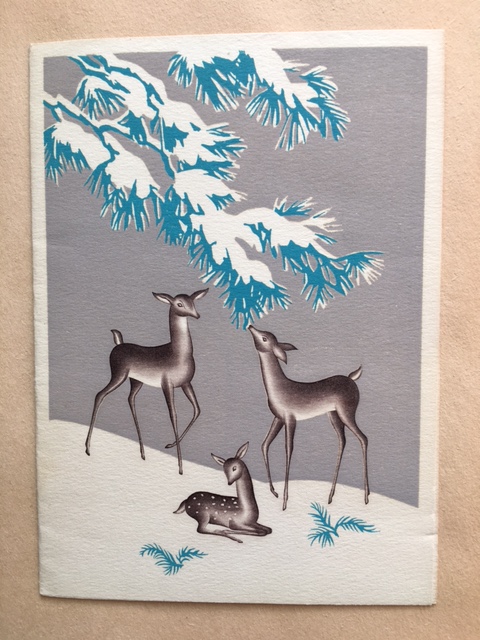
One of the holiday traditions in our family was the scrapbook my mother kept of Christmas cards. Beginning in 1945 – the second year my parents were married and the year my father returned from the war – she glued a sample of the card they sent out each year. She faithfully added cards up to 1998, just two years before she passed away. The following year, her health started to deteriorate, and by the next Christmas, there would be no more cards sent.

A few years later, as my brothers and I were clearing out the family home for its eventual sale, I came across the scrapbook and scooped it up. Although the anti-clutter side of me said not to, I knew that I couldn’t throw the book out. I am so grateful that I decided to keep it.

As a little girl, I remember looking through the scrapbook and marveling at all the pretty cards. Now as I look at the pages, I can see a clear timeline of my parents’ lives.

The first card in the scrapbook, dated 1945

The early cards were small and simple and had their names engraved under the greeting. Several years later, when my oldest brother was born, his name was added alongside theirs.

The next three years, including the year my other brother was added to the mix, my father was trying his hand at photography and printed the Christmas cards in his darkroom. The black and white cards are somewhat unusual, but his creativity shines through.

A beautiful desert landscape one year, three silly mice the next

Over the years, the cards they chose to send reflected different aspects of my parents’ personalities and interests. Their sense of humor, as well as their love of animals and travel was apparent in many of the cards. Several of the cards, instead of a traditional winter scene, depicted the desert or coastline more reminiscent of their Southern California home. And, because they supported many environmental and social causes, they often purchased their cards through such organizations as UNICEF, the Sierra Club, and the National Wildlife Federation.

The last card in the scrapbook is my favorite one of all. Its joyful message resonates with me, as it must have with my mother:

Sing the song to earth and sky. Sing of love, of peace, and joy!


And, written on the inside:

May all that brings you joy,

may all that sustains you and gives you peace,

be yours this holiday season.


I can’t imagine a better wish for us all.

Thursday Doors: Balboa Park (Part 2)

My Thursday Doors post last week highlighted some of the buildings and doors that were constructed for the 1915 Panama-California Exposition held in San Diego’s Balboa Park. This week’s post features a group of colorful structures that were added to the park close to 20 years later.

Hoping to mirror the success of the 1915 Exposition and promote the city during the Great Depression, San Diego civic leaders decided to hold a second large-scale event: the 1935 California Pacific International Exposition. To help accomplish this bold plan and create whole new areas of the park, San Diego was fortunate to receive the first funds allocated by the Works Progress Administration (WPA).

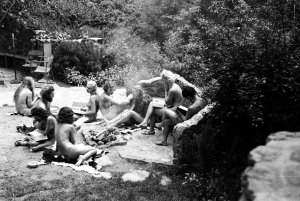
The second exposition, quite unlike the first, featured some controversial exhibits and unusual sideshow entertainment, including a nudist colony called Zoro Gardens, a Midget Village (yes, that’s what they called it), and Alpha, a 6’2”, 2,000 pound silver robot.

Even though this post isn’t about the nudist colony, I know you want to see it.
Even though this post isn’t about the nudist colony, I knew you would want to see it.
Robots and nudist colonies don't mix... or maybe they do?
Robots and nudist colonies don’t mix… or maybe they do?

San Diego architect Richard S. Requa oversaw the design and construction of many new buildings for the Exposition. Whereas the buildings from the 1915 fair were designed in the Spanish Colonial Revival style, Requa’s “California-Spanish” architectural designs pulled not only from Spain but also pre-Columbian Indian buildings and temples.

spanish-village

Included in the new construction was a group of quaint buildings and courtyards designed to depict a charming old Spanish village. The six buildings featured shops, restaurants, and a children’s theater.

In 1937, after the fair had ended, the Spanish village was reopened by a group of local artists as an artists’ colony. Although the colony was temporarily commissioned by the U.S. Army for barracks during World War II, after the war it was reclaimed and restored by the artists and has been a beloved local art destination ever since.

San Diego artists have continued to preserve and enhance this historical landmark by adding colorful plantings and unique entryways. Today, the Spanish Village Art Center continues to be a thriving community of over 200 independently juried local artisans. The Art Center features 37 working art studios and galleries that are open to the public.


Join the fun at Norm 2.0’s Thursday Door-a-palooza. If you have doors that you love (and who doesn’t love doors?) and want to share, click here for more info, to read other submissions, and to link up your post.

GratiTuesday: Pearl Harbor Memory Keepers

Tomorrow marks the 75th anniversary of the surprise attack on the U.S. naval base at Pearl Harbor by the Imperial Japanese Navy. On December 7, 1941, the residents of Pearl Harbor were just waking up to a quiet Sunday morning when, just before 8 a.m., the first wave of Japanese fighter planes and bombers began their quest to destroy the Pacific Fleet and cripple the U.S. military. The following day, December 8, the United States declared war on Japan.

The USS Arizona during the attack. Photographer unknown. This photograph is in the public domain.

Ninety minutes after it began, the attack was over. 2,008 members of the military and 68 civilians died and 1,178 were wounded. Eighteen ships were sunk or run aground, including five battleships. All of the Americans killed or wounded were non-combatants, given that there was no state of war when the attack occurred.

As we continue to lose members of the Greatest Generation, this special group – those who were witness to the attack – is also dwindling rapidly. Those who were there shared the rallying cry: “Remember Pearl Harbor!” Sadly, fewer and fewer people really do. In fact, the national organization of the Pearl Harbor Survivors Association disbanded five years ago after its membership, once close to 30,000, fell to less than 3,000.

Commemorations of the attack are held annually at the Pearl Harbor memorial site in Oahu. On this 75th anniversary, a key focus will be on our country’s relationship with Japan and a celebration of 71 years of peace between us. In fact, on Monday, Japanese Prime Minister Shinzo Abe announced that he would visit Pearl Harbor, becoming the first sitting Japanese leader to go to the site of the attack.

Yesterday’s unexpected announcement came six months after President Obama became the first sitting U.S. president to visit the memorial in Hiroshima for victims of the U.S. atomic bombing of that city. Prime Minister Abe, in a brief statement to reporters, said he would visit Hawaii on Dec. 26 and 27 to pray for the war dead at the naval base. “We must never repeat the tragedy of the war,” he said. “I would like to send this commitment. At the same time, I would like to send a message of reconciliation between Japan and the U.S.”

I am so grateful for those who are keeping the memory of Pearl Harbor alive. As we “Remember Pearl Harbor,” it’s also important to appreciate the power of reconciliation. For anyone witnessing the attack that day it would have been nearly impossible to believe that the United States and Japan – bitter adversaries – could now be close allies. I am grateful that we are.

Thursday Doors: Balboa Park (Part 1)

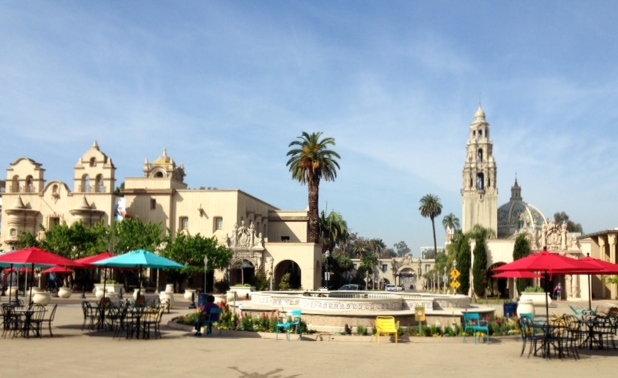
I recently posted about spending a gorgeous day with a dear friend in one of San Diego’s most beautiful and popular destinations, Balboa Park.  Since there are so many beautiful doors, arches, and entrances in the Park, I thought it would be a fitting submission for Norm 2.0 Thursday Doors link up.

balboa-park

I thought this gem in the middle of our city deserved a few more posts and pictures.

Balboa Park covers over 1,200 acres and is situated just minutes from downtown San Diego. It is home to 15 major museums, renowned performing arts venues, beautiful gardens, and the world famous San Diego Zoo. It is the nation’s largest urban cultural park and one of the oldest in the United States dedicated to public recreational use.


When the park (then named City Park) began in 1868 as land set aside by San Diego civic leaders, it was just a scrub-filled mesa without formal landscaping or development. That would change after the turn of the century when a master plan for improvements was formally introduced. San Diego was set to play host to the 1915 Panama-California Exposition and the city leaders wanted to put their best face forward as they welcomed visitors from around the world. San Diego would be the smallest city to ever hold a World’s Fair; its population at the time was less than 40,000.

The Exposition’s lead designer, Bertram Goodhue, wanted a regionally appropriate aesthetic for the architecture. To accomplish this, he and his design team combined the styles of highly ornamented Spanish Baroque with Spanish Colonial architecture to create the Spanish Colonial Revival Style used for the Exposition’s buildings. After attending the Exposition, President Theodore Roosevelt put his stamp of approval on the architectural style and recommended that the “buildings of rare phenomenal taste and beauty” be left as permanent additions.


Unfortunately, most of the expo buildings were only supposed to remain standing through 1916, and were not constructed with long-lasting materials. When the expo ended, several discussions were held to determine what to do with the buildings. Even the lead architect, Goodhue, recommended demolishing the buildings, saying “They are now crumbling, disintegrating and altogether unlovely structures, structures that lack any of the venerability of age and present only its pathos, and the space they occupy could readily be made into one of the most beautiful public gardens in the New World.”

Happily, cooler heads prevailed. A city-appointed committee hired an architect to review the buildings, and he determined that they could be restored by a slight margin over the costs to demolish the buildings. The necessary funds and materials for restoration were donated by San Diegans and the labor was financed by the federal government.


My next Thursday Doors post will cover another area of the Park, which was constructed for the 1935 California Pacific International Exposition.

GratiTuesday: Giving Tuesday

giving-2

Thank goodness we’ve all survived Black Friday, Small Business Saturday, (what, nothing for Sunday?), and Cyber Monday.  Today, as you may or may not know, is Giving Tuesday.

Since its launch in 2012, Giving Tuesday has been designated as a day when we can make up for the excesses of the past few days (and those coming up) by putting “our money where our hearts are.” It focuses on shifting the emphasis of the holiday season from receiving gifts to giving them to charity. In just a few years, Giving Tuesday has turned into a global movement which unites communities around the world. Last year, more than 700,000 people across 70 countries raised more than $116 million, more than double from the year before.

Although Giving Tuesday is about encouraging giving in general, the movement harnesses the power of social media (it even has its own hashtag, #GivingTuesday), to provide a platform for those interested in donating time, resources, and talent to address local challenges. Givers are encouraged to use the #GivingTuesday hashtag to share their efforts and spread the word about the day on their social media accounts.

The Giving Tuesday website provides more information about the movement and a directory to guide people to organizations, charities, events, and more in their own community. Through the website, Giving Tuesday “brings together the collective power of a unique blend of partners— nonprofits, civic organizations, businesses and corporations, as well as families and individuals—to encourage and amplify small acts of kindness.”

Whether you go through the website or give on your own, there are lots of ways to join in on this day of giving:

Donate to charity. If you have some extra money in your budget, make a donation to a charity of your choice. Or, think about rearranging your budget a bit: instead of buying that one extra Christmas present, devote those funds to a wider cause. You can stay local by giving to your community’s homeless shelter or food bank, or go national by contributing to well-known organizations, such as the American Diabetes Assn. or the Red Cross. (Be sure to check if your employer offers matching funds.)

Give a nonmonetary gift. If you don’t have room in your budget, you can give in other ways. Donate your time by volunteering at a nearby animal shelter or food kitchen. Sign up to become an organ donor. Give blood. The possibilities for good deeds are endless.

Go beyond charities. Remember that giving doesn’t have to be limited to charitable organizations. Give extra care and attention to your friends, family members and neighbors. Spend time reading to a younger relative. Volunteer to finish off a project around the house.

Most important of all, let this day of philanthropy inspire more days of giving back.

I am so grateful for individuals and organizations that offer support to those who are struggling or who need resources to serve others. Giving Tuesday is a great way to find opportunities to give locally and/or globally. And, once you’ve given whatever money, time or talent you can, don’t forget to use the #GivingTuesday hashtag and help spread the word!

Friendships beyond the bond of work

There are a few very special people I’ve met through work with whom I’ve maintained contact over the years. Some I met multiple jobs ago, and others I met at my last place of employment before I retired. Although it’s not unusual to have a variety of work friends while being employed under the same roof, continuing the relationships after the commonality of work is over can be difficult. Often you discover that work was the glue. Once the glue is gone, it is easy for the bonds to separate and disappear.

The workplace friends who are still in my life are there because work was the catalyst, not the glue.

One of these friends and I had been trying to arrange a get together for a while. She still works so doesn’t have the same flexibility as I do. Finally, we were able to arrange a time and date that worked for us both. It wasn’t until we met that day that she mentioned that it was her birthday.

This is a woman with lots of friends. She also has family close by. But, she chose to spend part of her birthday with me. How nice is that?

Overlooking Balboa Park, from the top of the California Tower

We chose to meet in one of our city’s most beautiful parks, on what turned out to be a gorgeous fall day. A perfect place and perfect weather in which to stroll, chat, laugh, observe, confide, and just be.

We rendezvoused at about 9 a.m. and we didn’t say good-bye until around 2 p.m. We spent the day enjoying each other’s company as we wondered around the park, visited a few museums, and had a lovely lunch on an outdoor patio. Our conversation easily flowed from one subject to another and we both mentioned how nice it was to spend the day without a schedule or an agenda. Other than encouraging her to retire at the first opportunity, very little of our conversation was about work.  It was a perfect day with a dear friend.

Happy birthday, my friend!

I am lucky that I still live in the community where I grew up and spent a majority of my working life because, like many people, I find it harder to make new friends as I get older. Children naturally gravitate to each other, school often brings kindred spirits together, and most working environments encourage engagement among colleagues. Now that I am retired, it can be difficult to build a new connection beyond superficial interactions. My blogger friend, Liesbet, recently wrote about the difficulties of making friends while living a less anchored lifestyle. If I were to move and start all over, I’m not sure how well I would do.

Fortunately, at least for now, I don’t need to worry.  I just need to get more of my friends to retire so we can get together during the middle of the week.

And not talk about work.

GratiThursday: What I don’t need

I postponed my weekly GratiTuesday post until today when we celebrate Thanksgiving in the United States. So, just for today, this is a GratiThursday post.

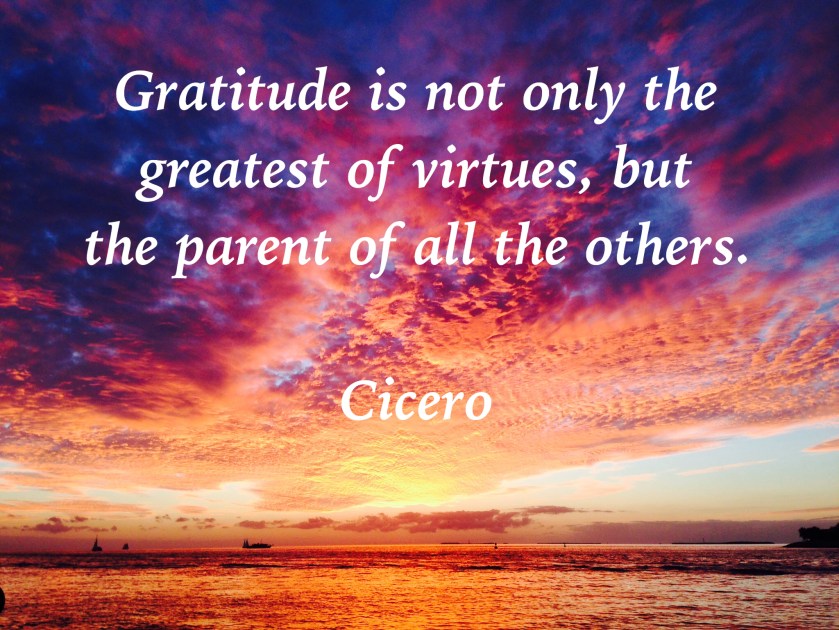
cicero

As I took apart our newspaper this morning, I was struck by how many Black Friday ads it contained. Dollars off this, a huge percentage off that. Best of all, you can take advantage of these tremendous offers TODAY! Get to the stores early… fire up your computer… shop!

As I dumped all of the advertising flyers into our recycling bin, I thought about how grateful I am that I don’t need any of what was being advertised. I didn’t even really want any of it either.

At this stage of my life, I choose quality over quantity and I do more with less. Just like an artist knows the worth of incorporating negative space in their paintings or photographs, I don’t need to fill up all of the open spaces of my world. I have fallen in love with my life just the way it is.

I am so very grateful for the abundance in my life.