GratiTuesday: Wild parrots thriving in Southern California

First we hear a frenzied screeching in the distance. As the noise gets closer, it is more distinguishable as the riotous squawking of birds. Then, we see them. Sometimes they fly in a small group of 6 or 8, but most of the time, they are in flocks of 30 or more. They often fly together in an unorganized mass, then split apart in a raucous burst of energy because… whatever. Whether they arrive in a small group or a large one, it’s hard to ignore when a flock of urbanized parrots invades our neighborhood.

There are several theories as to why these birds, whose natural habitat are the jungles of Mexico, and Central and South America, now call coastal Southern California their home. Some say that they—or their ancestors—were probably caged birds released into the wild either accidentally or on purpose. Some say that the changing climate and decimated tropical forests are the reason. Ironically parrot species that are threatened or endangered in their native environment are flourishing here because our ubiquitous palms and backyard fruit trees provide the food and nesting habitat they need.

These naturalized parrots include blue-crowned conures, lilac-crowned Amazons, cherry-headed conures, mitred conures, red-crowned Amazons, and yellow-headed Amazons. I’m not sure which of the dozen or so naturalized parrot species frequents our neighborhood, but they are wonderfully colorful, incredibly loud, and a delight to behold.

Not everyone is as charmed as I am with the urbanized parrots – they have been known to decimate the flowers or fruits growing on ornamental trees—but I am so grateful for their presence. They are exotic, unpredictable, exuberant, and, when I hear them coming, it’s almost impossible not smile at their unbridled joy.

Spanning seven urban bridges, 4 – 7

In my last Spanning seven urban bridges post, I wrote about a recent hike my husband and I took called the Seven Bridge Walk. The 5.5 mile hike traverses through several older neighborhoods in our city and crosses over a mix of historic and newer bridges. That post featured the first three bridges we crossed; the four remaining bridges are just ahead…

Quince Street

The Quince Street walking bridge is a wooden-trestle bridge that was built in 1905. It is 236 feet long and rises 60 feet over Maple Canyon. Although the cost for the original construction was less than $1,000, the cost to repair the bridge in 1988/1989 was closer to $250,000. Even though I knew the bridge was in good repair, it was a little unnerving to look over the sides and see what looked like a hodge-podge of wooden planks holding it up.

Spruce1

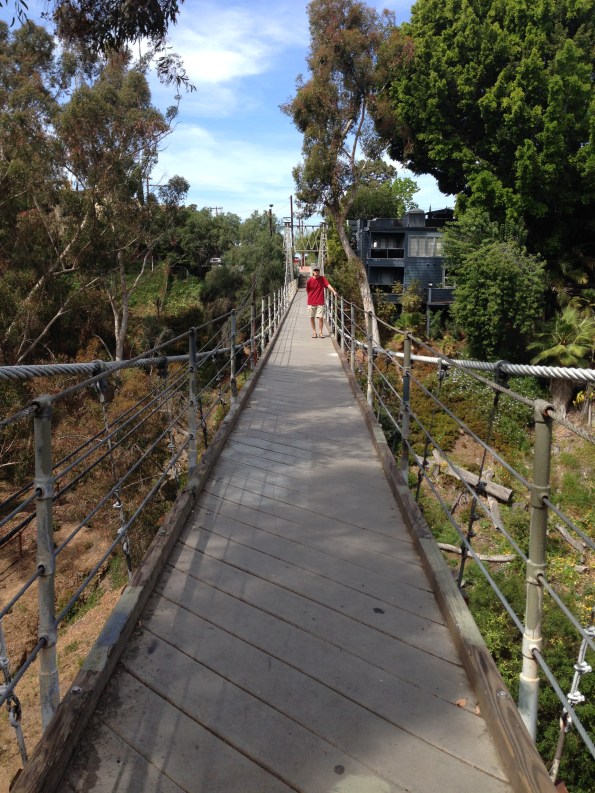
Probably my favorite bridge on our walk is the Spruce Street suspension bridge located in the Bankers Hill neighborhood. It was constructed in 1912 to serve as a passageway for early residents to get to the newly built trolley lines. The bridge stretches 375 feet across and rises 70 feet above Kate Sessions Canyon, named after a horticulturist responsible for many of the plantings found throughout the city. The bridge swayed a little as we walked along it, but it didn’t feel dangerous at all.

After stopping for lunch in the always interesting neighborhood of Hillcrest, we next reached the Vermont Street Bridge. This modern steel bridge was built in place of a deteriorated wooden trestle bridge that dated back to 1916. Rather than replace the beloved original bridge with a merely utilitarian passage, local residents fought for something more interesting and reflective of the two neighborhoods it connects. As we walked over the bridge, we read walking-themed quotes written by people like Martin Luther King, Jr., Kate Sessions, Pythagoras, and even long-time San Diego resident, Theodor Geisel, better known as Dr. Seuss. Can you figure out the word puzzle?

Craftsman

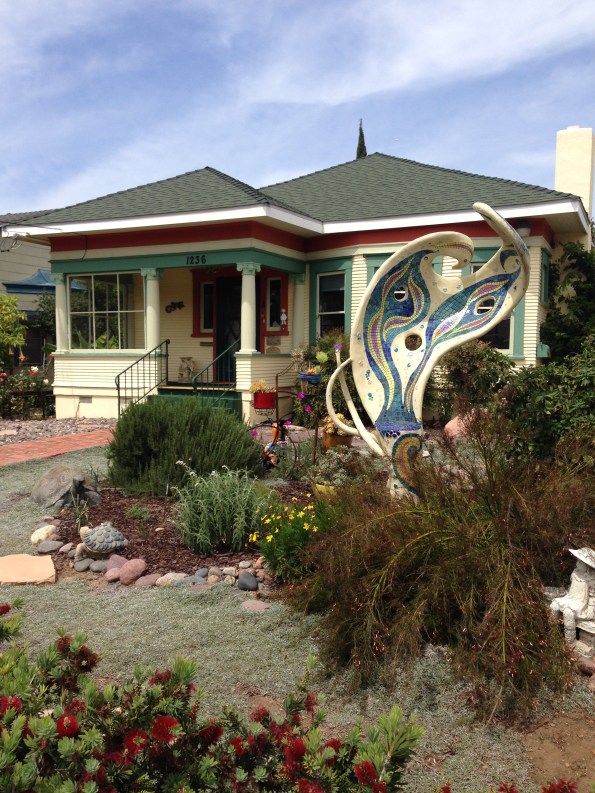
As we journeyed towards our next bridge, we passed through an older neighborhood dotted with beautiful craftsmen bungalows. I imagine an artist lives in this one.

Georgia1

Finally, we reached our seventh and last bridge: the historic but hazardous Georgia Street Bridge. A redwood bridge was originally built here in 1907, but it was replaced in 1914. The “new” concrete Georgia Street Bridge is listed on the National Register of Historic Places. I’ve heard that it is scheduled for an $11 million dollar overhaul, including seismic and structural retrofits… hopefully they will begin soon before the bridge crumbles apart.

After crossing our final bridge, we zig-zagged a bit more, then headed back along Park Boulevard towards Balboa Park and our car. At 5.5 fairly flat miles, the walk wasn’t too strenuous but it was a lot of fun and, when we were finished, we felt a little like we had also traveled through time.

GratiTuesday: Making travel plans in the digital age

My parents were great travelers and encourage us kids to follow in their footsteps. Although I’ve visited many of the places they traveled to—and several they didn’t—I feel as if I’ve just dipped my toe into the deep well of possibilities.

Because they traveled so much, my parents had a close, personal relationship with their travel agent. Helen knew my folks’ likes and dislikes, preferred way to travel, destinations of interest, and budget considerations. Although they seldom encountered any problems while traveling, they knew that they could call Helen if they needed help and she’d work things out.

Despite all online resources, I still love paper maps.

I am currently firming up travel itineraries for two upcoming trips, and making some preliminary plans for a few more that are on our radar. Like most people in today’s digital age, I am not using a travel agent to help me plan and book our trips. The resources available to me online are vast, powerful, accessible, and, sometimes, a little scary.

I can research our destinations using multiple travel websites and helpful blogs. I have reached out to blogging buddies who live in the areas we are visiting for first-hand recommendations (and, hopefully some meet-ups). Using mapping apps, I am able to chart our route and look for points of interest along the way.

Once we know where we will stop on our journey, I can book our hotel rooms (after reading extensive reviews) online. For the first time, we are also going to try Airbnb, whose website is robust and pretty easy to navigate. Tickets for attractions can be purchased in advance and I can often load them to my smartphone so I don’t need to worry about misplacing pieces of paper.

And, of course, any airplane and rental car reservations are completed with a few keystrokes and a credit card.

There are pluses and minuses to planning travel this way, of course. Using a travel agent provided my parents with valuable peace-of-mind and allowed them to tap into Helen’s professional knowledge and years of experience. Since she did most of the work (and, as I remember, the service was provided for no, or very little, cost), my folks didn’t have to spend hours doing research. Helen’s agency was a one (or two)-stop-shop for planning, finalized itinerary, and tickets.

By making our travel plans online, I have a lot of control over our itinerary. I don’t need to rely on someone else’s preferences or affiliations. I can spend time looking at different options and search-out deals and off-the-beaten-path opportunities. Once on the road, we can take advantage of apps that will help us to find places to eat and points of interest to visit. I can read about the history of an area, check out the weather, and even avoid road construction and accidents up ahead.

Although we may not have someone like Helen to provide travel assistance and hand-holding, I am so grateful that the internet has given us the power to design our individual journeys and create our unique adventures.

Spanning seven urban bridges, 1 – 3

One of my very favorite things to do is to get out and walk. I enjoy walking for exercise either by myself or with a friend. I love to walk the hills of my neighborhood, or go down to the bay and walk along the shore, or up to the local mountains and hike the trails. I also enjoy walking as a way to discover hidden gems in unfamiliar places. Walking allows me to see the small details I would miss if I was in a car, or even on a bike. When I’m not trying to raise my heart rate, the less hurried pace allows me to observe my surroundings and to stop and take a closer look or snap a picture.

A while ago, I read about an urban hike in our city called the Seven Bridge Walk and was intrigued. The hike is about 5.5 miles long and meanders through several older neighborhoods and crosses over a mix of historic and newer bridges. The walk sounded like the perfect combination of exercise, sightseeing, and  a bit of history, so I filed it away as something to do in the spring.

Finally, last Tuesday, my husband and I decided it was the perfect day to put on our walking sandals and go.

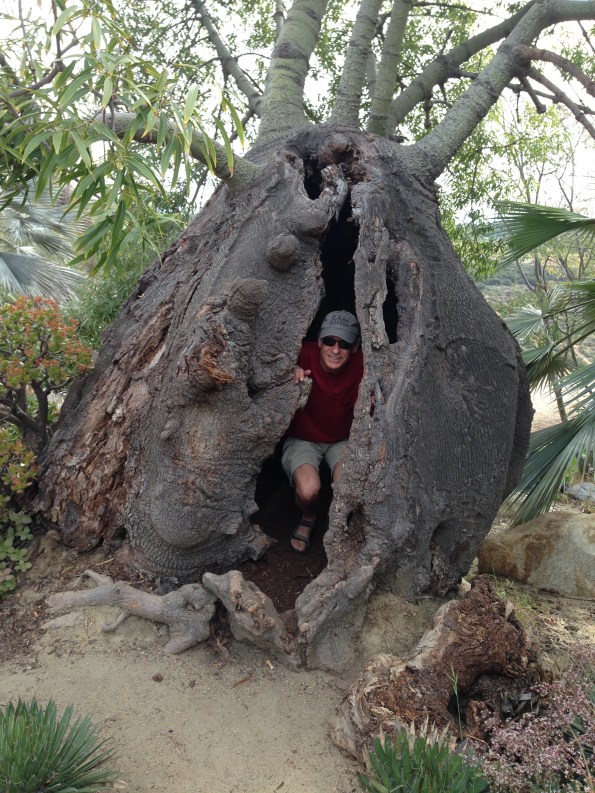
This was the trunk of a very strange tree.

The route begins on the east side of Balboa Park, near the succulent and cactus gardens. After spending some time playing in looking at the plants, we crossed the first – and shortest – of the seven bridges.

A55837D5-5F01-4B1A-BA75-1F86BB66AD02

This concrete walking bridge was built fairly recently to provide safe passage over a busy street. The bridge has a graceful design and it was a nice way to enter Balboa Park, San Diego’s jewel and the nation’s largest urban cultural park (which deserves—and will get—its own, separate post).

Cabrillo_Bridge

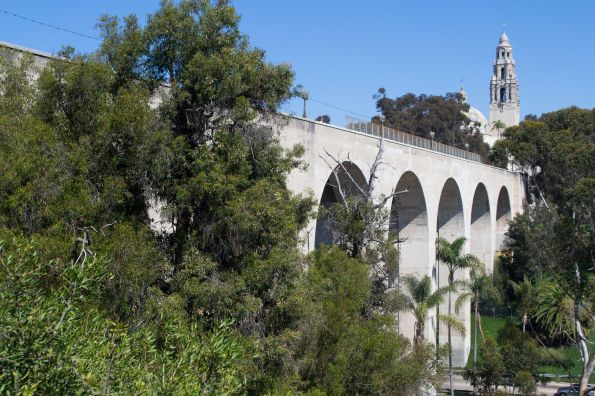
Continuing west along El Prado through the middle of the park, we reached the majestic Cabrillo Bridge. The bridge was constructed in 1914 and is the first multiple-arched cantilever bridge built in California. Although Cabrillo Bridge originally spanned a small lake, cars traveling on State Route 163 now pass underneath its arches.

You can see a downtown high rise, San Diego Bay, and the end of Point Loma off in the distance.

After a few zigs and zags and several stops to take pictures, we reached the third bridge on our walk. Built in 1931, the First Street Bridge is the only steel-arch bridge in the city. It was built in a fabrication plant in the Midwest, dismantled, and then shipped to San Diego to be assembled again.

Come along to see the remaining bridges on our walk in my Spanning seven urban bridges, 4 – 7 post next week.

GratiTuesday: Flexibility

This past Sunday, I wrote a post about feeling a bit of ennui in my retirement. In general, things are going pretty great but I had started to feel that something was missing or incomplete, and I wondered if I needed to… I don’t know… do more.

I was heartened by the response my post received. It was nice to know that what I was feeling wasn’t unusual, in fact several commenters who are also retired shared that they had similar feelings, either now or in the past. I received lots of encouragement, advice, and some good suggestions.

One element that flowed through many of the comments was flexibility: to be open to opportunities that might present themselves, and to be willing to try out different things (and walk away if it isn’t a good fit). But, in addition, to appreciate the flexibility and free time that retirement provides.

Today, I had one of those days that reminded me of the how lucky I am that I my life affords me great flexibility and how important it will be to protect that luxury no matter what else I might choose to do.

When my husband and I woke up this morning and looked outside, we saw that the day had presented us with the perfect weather to go on an urban hike we had read about. There was a little bit of fog that would probably burn off as the day went on, but there was also some cloud cover that promised to keep the temperature from rising too high.

So, out went any plans we had made for the day and we started to get ready for our big adventure. At no time did we have to worry about schedules, obligations, or deadlines. No one was expecting us to show up anywhere or complete a promised project. We were free to do what we wanted.

I still want to look for opportunities to bring more balance into my retired life because I believe that it’s important to contribute and to challenge myself. But, I am very grateful that I have the freedom and flexibility that allows me to take advantage of a beautiful spring day and go for a walk.

Searching for balance in retirement

Sometimes it seems like it’s been much less than two years since I was wrapping up my final weeks of employment and looking forward to the day I retire. At other times, it’s as if I’ve been living this leisurely lifestyle for many years and I can hardly remember having full-time work obligations.

I had a lot of plans for my retirement: I wanted to take classes, travel, socialize with friends, complete household projects, and explore my creative side. I also wanted to allow enough leisure time in my non-existent schedule to relax, read books, and daydream.

Mission accomplished… sort of.

Is it possible to have too much leisure? Maybe so.

Since retiring, my husband and I have gone on some amazing trips (and more are planned), I’ve taken advantage of free—and nearly free—educational opportunities, I’ve joined a wonderful book club, we’ve completed multiple house projects (and have more in the works), and I’ve spent time writing and improving my photography skills. Life is good.

But, just recently, I’ve started to struggle with the feeling that I would like to do more, that I want to have more to show for my time. This doesn’t mean that I desire to go back to full-time work, or even that I want to find part-time employment. What I want is more balance in my life.

Besides receiving a regular paycheck and subsidized healthcare insurance, going to work every day provided a lot of intangible benefits. Daily interactions with colleagues wove a social network that helped to make work a pleasurable experience. Because I worked for a large company, my network web included people from a variety of backgrounds and with diverse interests and skills.

I miss that.

I also miss the feeling of working together towards a common goal. We took on projects and supported each other as we met our objectives. In addition, work gave me opportunities to challenge myself and to enjoy the feeling of satisfaction when I successfully expanded my comfort zone.

I’m not sure where this sense that something is missing will lead me. Exploring volunteer opportunities might be a good start. Perhaps I need to get involved with a cause that I believe in. Maybe some type of part-time employment will supply the diverse community I miss. Perhaps it’s a combination of all three possibilities, or maybe something else.

I fully realize how lucky I am that I actually have a choice about how I spend my time. If I make no changes at all, I have a pretty good life. But if I can find something that allows me to make a positive contribution, I think my retirement could be more purposeful and satisfying. It also might help me re-discover some or all of those missing elements: enjoying an expanded and more diverse social network, being inspired by a vision shared with others, and embracing the opportunity to help others and to challenge myself.

The key will be to find something that also allows me to travel when I want and to enjoy the retirement I envisioned when I said good-bye to full-time employment.

GratiTuesday: Choosing kindness

phonto

A few days ago, I was driving my car to a familiar destination. Because I had driven the route many, many times, my mind was on autopilot. My husband and I were chatting about this and that and I was thinking about that and this. In other words, I wasn’t paying attention.

All of a sudden, I realized that I had taken the wrong route. I was generally headed the right direction, but the street I was on wouldn’t get me to where I wanted to go. I needed to make a right turn, then a left to get back on track. No problem, except there was a line of cars in the right-hand turn lane and, in order to move into it, I needed someone to let me in.

Now, I have to admit that I usually get irritated with people in that situation: those jerks who don’t think they should have to wait their turn like the rest of us so they drive alongside the line of cars, then try to sneak in towards the front. When I see this happening, I’ll be damned if I will let them into the line and I get perturbed when someone rewards their jerky behavior by allowing them to merge.

Except, that wasn’t what had happened. I was just trying to recover from a momentary brain lapse and get back on the correct route. The road I was on wasn’t very busy (which, had I been paying adequate attention, should have been a clue that I was on the wrong street) and there wasn’t anyone in my rearview mirror so I slowed down and switched my signal on so I could move over into the turn lane.

Then, two things happened: a driver come up quickly behind me, honked his horn in irritation, and swerved around me so he could continue going straight, and another driver in the right turn line made room for me so I could merge in ahead of her. One chose to vent his frustrations at me by honking, whereas the other chose to be sympathetic and let me in ahead of her. One probably felt a moment of anger towards me for being in his way and causing him a two second delay. The other reacted with compassion and a smile.

I was a bonehead and the first driver was completely justified for honking at me. The second driver was by no means obligated to let me in. But, she chose to help me out; she chose kindness.

That little bitty, almost inconsequential interaction got me to thinking about the choices I make every day. Do I act with irritation, or do I act with understanding? Do I notice and respond when someone could use a hand, or do I remain unaware and go about my business? Do I attempt to ease someone’s path, or do I put up barriers? Do I choose indifference or do I choose caring?

I hope I make the right choice more often than not.

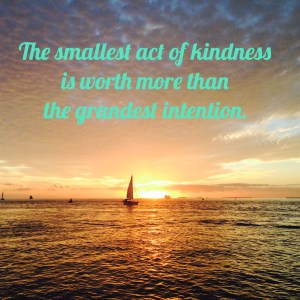
I am grateful for acts of kindness – both big and small, and whether it is directed at me or not. Kindness makes me hopeful and optimistic. It’s so easy to focus on the negative and painful but it’s important to remember that if I want more kindness in the world, I need to put it there.

GratiTuesday: Spring has sprung!

Even though most of us in Southern California hoped the predictions of a wet El Nino would come true (and we still have our fingers crossed), the rainfall we’ve experienced has been underwhelming. Except for two memorable days of torrential rain in early January, our winter – overall – has been pretty mild.

On Sunday, when it officially became spring, we were enjoying the same blue skies and mild temperatures we’d had been experiencing for a long time. Regardless, seeing “First Day of Spring” on my calendar made me almost as happy as someone enduring a winter of freezing temperatures and snow would feel.

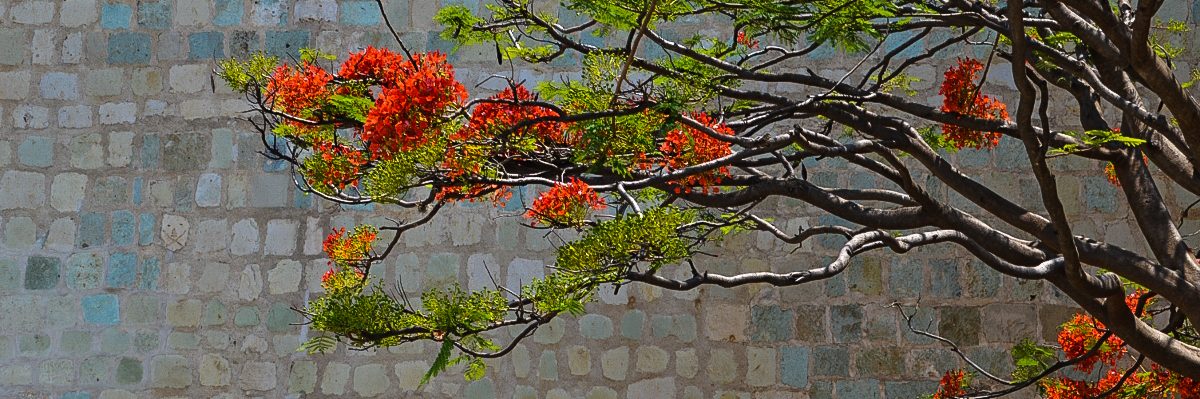
We’ve been seeing evidence of spring all around us for several weeks. Flowering plants are announcing the new season with cheerful colors and gentle fragrances and trees are starting to burst into clouds of blooms. The bees and hummingbirds are buzzing frantically from one flower to the next as if they are worried it could all suddenly disappear under a pile of snow.

Our Grevillea Long John’s whimsical pink blossoms are a favorite of bees and hummers


It looks like we’ll have another bumper crop of blueberries this summer


Even Tiki Mon is displaying spring flowers in his hair
Even Tiki Mon is wearing spring flowers in his hair


I am so very grateful for spring’s arrival. It is a magical season bursting with promise, inspiration, and optimism.


Fasting to lose weight and gain health

The job I had before I retired involved food. Lots of it. Not only did I work with restaurant owners, managers, and chefs to promote energy efficiency in commercial food service, my office was located in an educational facility that regularly provided catered food to those attending our workshops. If there wasn’t something fabulous cooking in the kitchen, there was probably something yummy being served in one of the seminar rooms. I tried to avoid temptation as much as possible, but I’m only human. A little bit here, a little bit there adds up to a lot of bits… and a few more pounds than I was comfortable carrying.

Like a lot of people, I have periodically put on – then tried to lose – five or ten pounds throughout my adult life. I’ve been on various fad diets, unhealthy extreme diets, and mainstream programs like Weight Watchers. They all worked for a while but none offered a long-term solution that I was able to maintain. What I wanted was a healthy way of eating that I could stick with and not feel too deprived.

Enter Public Television. I realize that it’s an unusual place to get diet advice, but it happened when my husband and I watched a three-part BBC series on how the body works and improving ones health. One episode was titled The Truth About Exercise, one was Guts (how our stomachs work), and the third one was Eat, Fast, and Live Longer. The first two were fascinating, but the third one really caught my attention.

In that episode, the series’ host, Dr. Michael Mosley, shared own health journey. He was overweight and had been recently diagnosed with diabetes and high cholesterol and was looking for a path back to health that didn’t involve drugs. His research led him to the concept of intermittent fasting (IF). After testing different forms of IF, he developed what he called the 5:2 diet, which required him to restrict his calories two days a week and eat normally the other five days.

What interested me about the premise of IF as a weight-loss/weight-management program was two-fold: I felt that it was a regime I could follow over a long period of time and there appeared to be some real health benefits beyond just the weight loss. Scientific trials have shown that intermittent fasting could reduce the risk of a range of diseases from diabetes to heart disease and cancer. Other studies indicate it might even protect against strokes, Alzheimer’s and Parkinson’s.

It’s now been three years since I began fasting weekly. At first I fasted two days a week and slowly lost the ten pounds that I had gained. Once I reached my desired weight, I settled into a one-day-a-week maintenance routine.

When I retired, I wondered if I could stay with the regime but it hasn’t been a problem at all. I typically fast on my busiest day each week so I have plenty of distractions and I never choose a day when an event or a party would make me feel deprived. If I’m traveling or have another reason I can’t fast one week, I don’t. But, out of the 52 weeks each year, there are probably only two or three in which I don’t fast. If I see my weight creeping up, I return to fasting two days a week until it comes off.

There is a lot of information – both pluses and minuses – regarding intermittent fasting and the 5:2 diet. A recent New York Times article, Fasting Diets Are Gaining Acceptance, outlined the history and science of IF and highlighted different ways it can be done. The three-part PBS/BBC series that started me going is fascinating and can be found online. Dr. Mosley has written several books based on his findings, including the best-selling FastDiet and a few about managing diabetes.

I realize that IF is not for everyone. I’m not the most disciplined person in the world, but it works for me. I think knowing it is just one day (or two, when I want to lose a few), and that I’ll go back to my normal eating the next day, makes the fasting day doable. I don’t have to eat weird food, I don’t have to keep track of points, and, best of all, I don’t have to say “no” every day… just the day that I choose to fast. The weight loss and easy maintenance is great, but the possible health benefits make this lifestyle choice a good one for me.
GratiTuesday: Daylight Savings Time

This past Sunday, I preformed one of my favorite rites of spring; I adjusted all of our clocks forward one hour. As I made the change, I didn’t mind in the least that I instantly lost one hour of my day. For me, it was a very small price to pay for the extra hour of light I’ll enjoy each evening until November 6, when I have to turn the clocks back.

Daylight savings sunrise

When I was working, I remember that at first it was a little hard to adjust to getting up in the dark. But, slowly, the summer sun would work its way toward the equator and, in a few weeks, my 6:30 am wake-up time would again be bathed in light. What made those dark mornings well worth it was knowing that it would be light out when I left the office and that I’d still have a few hours of daylight when I got home.

Now that I am retired you might think the time change wouldn’t be as exciting for me as it was before. After all, I can get up whenever I desire, spend whatever time I want to outdoors, and then go to bed when the spirit moves me. While that is true for the most part, I still live in a world of appointments and schedules, and sunset at 7:00 or 8:00 pm feels very different from sunset at 5:00 or 6:00 pm.

I realize that not everyone is enamored with daylight savings time. Some people don’t like the hassle of changing their clocks twice a year. Others have schedules that benefit more from having the extra daylight in the morning. Those people might be happier living in one of the several states or territories that have opted out of observing daylight savings time, including Hawaii, most of Arizona, American Samoa, Guam, Puerto Rico, and the Virgin Islands.

I was horrified recently to learn that one of our state senators has introduced a bill that would affectively end daylight savings time in California. Noooooooooooooooooooo! I’m not sure whether there is any threat of having the bill pass, but I would be happy to buy the senator a oneway ticket to Arizona so he can enjoy standard time year-round and leave the rest of us alone.

Switching to daylight savings time makes me happy. It signals that spring is just around the corner, and summer is not too far off. It means baseball and barbecues and drinks out on the deck. I am so very grateful for the extra sunshine at the end of my day, where it belongs.