GratiTuesday: Building bridges, not walls

We had several choices of airlines and flights when we booked our travel to Oaxaca. Several of the major U.S. airlines offer flights, but all of them required stops in between and planes changes along the way. Fortunately for us, we were able to book our flight on a Mexican airline that offered a non-stop flight from the Tijuana International Airport to Oaxaca. By flying out of Tijuana rather than our city’s airport, our flight was quicker, cheaper, and only required a 5-minute walk across the border over a 390-foot-long bridge to reach the airport.
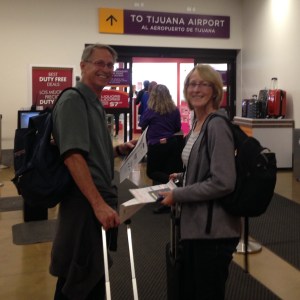
The picture is a little blurry, but so were we as we set off to board our 1:10 am flight to Oaxaca.

The Cross Border Xpress (CBX) terminal and bridge was financed by private U.S. and Mexican investors. Since its opening in 2015, an average of 4,800 passengers walk over the enclosed pedestrian skywalk each day to catch flights originating in Tijuana or return from trips to Mexico. It is believed to be to only such cross-border facility in the world.

This was the second time we have taken advantage of the CBX Bridge to fly domestically from Tijuana to another city in Mexico. Our first experience, when we flew to La Paz a year ago, went so smoothly – even with our limited Spanish language skills – that we did not hesitate to travel that way again.

I am so grateful to those with the vision – and the finances – to imagine bridges across borders rather than envision walls. Although I understand that countries have to protect their borders, by working together and extending a hand of friendship and support, mutually beneficial outcomes can be realized. The CBX Bridge is an example of collaborative thinking and long-term planning. Just what we need more of these days.
Oaxaca’s Street Markets

The tianguis, or open-air street market, is much more than a place to buy and sell merchandise. Throughout Mexico – and maybe especially in Oaxaca – markets are a fundamental element of the cultural structure. They are where people meet and catch up on news and gossip, new babies are shown off, and young romances are kindled. Market day is a ritual that has been celebrated every week – virtually unchanged – for thousands of years. These markets are not set up for the tourists (although tourists certainly can be found there – often with their cameras, like me), they are an important component in the day-to-day lives of many of the citizens.

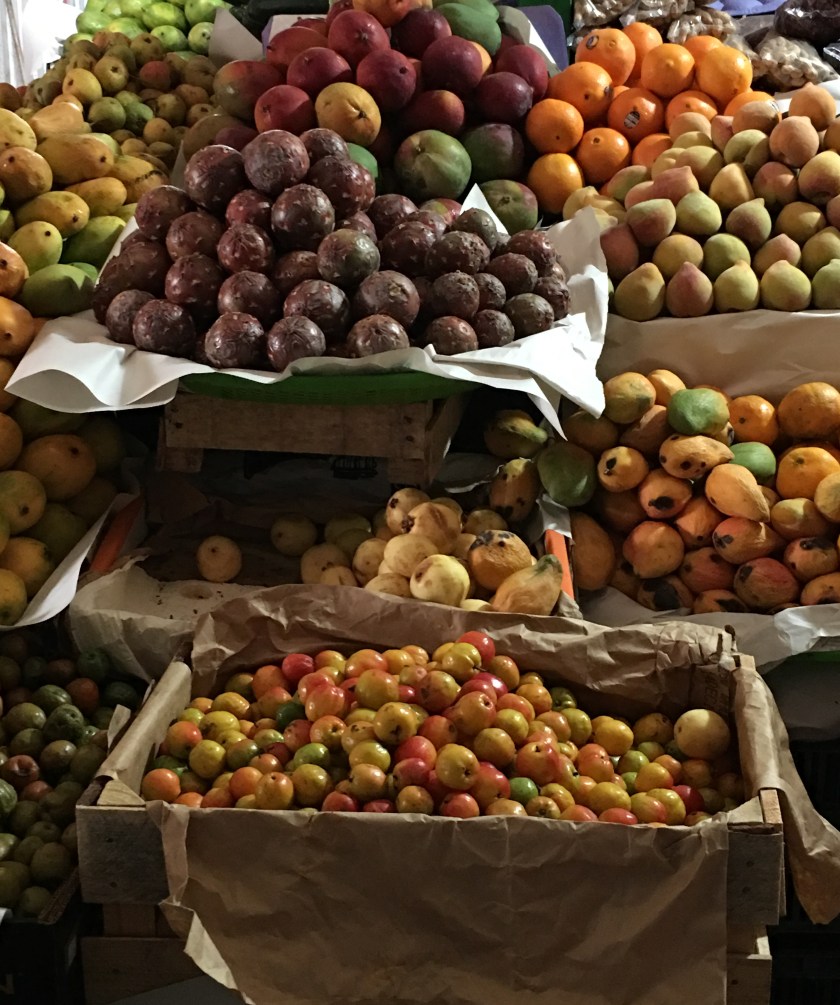
We were able to enjoy amazing fruit every day.

The city of Oaxaca has several tianguis that are open each day. Mercado Sanchez Pasqua, located very close to our house, was our go-to source for fruits and vegetables, as well as freshly made tamales. Just about every day, we stopped by on our way home to purchase delicious, just-picked avocados, mangos, and bananas.

Oaxaca’s original and best known market, Mercado Juarez, is housed in a huge, warehouse-like building. The energy and chaotic mix of sounds, colors, smells, textures, and shapes is an experience not to be missed. Among the multitude of stalls selling merchandise, one can find fruits, vegetables, herbs, flowers, mezcal, sauces, beef, chicken, and seafood. Other stalls tempt buyers with displays of brightly colored clothing, crafts, woven bags, shoes, and blankets.


In addition to the markets in the city center, the Valley of Oaxaca is famous for the tianguis that each of the surrounding villages set up one day a week (each village has its designated day). These local markets not only sell the usual food, flowers, and clothing, but they also feature items that their particular village is known for, such as weavings, cheese, or wooden furniture.

Don’t forget to pick up your Chapulines (fried grasshoppers). And, yes, I tried them.

As unique and exciting as these markets are, there is some worry that they might eventually become a victim of our global society. Oaxaca now has two Walmarts and several large grocery/department stores called Chedraui (all, mercifully, outside the city center). Amazon deliveries are also available. While I understand the ease and time-savings of going to a single location for all ones needs, I fear this convenience will someday lead to the demise of the traditional street markets. A ritual that has been around for thousands of years could be made irrelevant in a few years by big box stores and the internet. That would be an unimaginatively sad and irretrievable loss.

Slow Travel

Since we both retired, my husband and I have done quite a bit of traveling. Sometimes we take a quick drive somewhere close, other times we are away for several weeks or even a month.

Two years ago, a month-long road trip took us through several western and midwestern states, and included a journey along a good portion of Route 66. Last year, we flew to Montreal, rented a car, and traveled through parts of south eastern Canada, and the north eastern United States.

Although we thoroughly enjoyed these trips and relished visiting a lot of different places, each time we moved on we regretted not being able to stay longer and experience all that a specific location had to offer.

This time, we decided to travel in a different way, one that allowed us to slow down, breathe, and relax into life in a foreign country. For a little over five weeks, we rented a private home in Oaxaca, Mexico and enjoyed the luxury of unpacking our bags just once. The house was within walking distance to the central area: close to activity, shops, and restaurants, but far enough away to provide us with a place to enjoy our own company and recharge our batteries.

Our oasis came with a private garden.

By staying in one location for an extended period, we found that our pace slowed and our appreciation for this beautiful city and its culture was allowed to deepen and grow.  Because we weren’t on a tight schedule, we started to match – at least somewhat – our rhythm to that of the city around us.

Santa Domingo at twilight.

This isn’t to say that we didn’t take a few tours or enjoy other “touristy” pursuits – we did. But, because we knew that we had a lot of time to engage and explore, we also could make discoveries that most short-term visitors would probably miss.

What type of travel do we enjoy more? Our answer is that it really depends: it depends on the location, it depends on our curiosity level, and it depends on the time we have to devote to a particular trip.

We just returned home yesterday and I have already found my pace quickening. I have hundreds of photos to go through and pages of notes to organize. Although I promise to not share everything, I do have enough post ideas, along with pictures of doors, murals, churches, architecture, archaeological sites, celebrations, and many other delights we found in this UNESCO World Heritage city, to keep me busy for a while.

Rockabilly Style Comes to Las Vegas

There aren’t many things that would prompt my husband and me to drive 320 miles – through boring scenery and across the desert – with the final destination being a town built on gambling, excessive partying, and staying out late (none of which we are fond of). But, the Viva Las Vegas Rockabilly Weekend event, the largest rockabilly festival in the world, is well worth the trip.

IMG_1672.JPG

People from all over the world gather for this annual event. Some come to the Rockabilly Weekend for the cars, others come for the tattoos, many come to see and be seen, or for the vintage and kitschy merchandise, or maybe the tiki pool parties, pin-up, and burlesque, but almost all come for the music.

IMG_1687.JPG

The car show was great (Over 1,000, pre-1963 vehicles were on display), tattoos were both colorful and plentiful (and you could add even more ink at the event), the people-watching was stellar, you could buy just about anything from parasols to pomades, and rockabilly style ranged from sweet to sexy, but it was the music and dancing that enticed my husband and me to return to Las Vegas for this year’s event.

Although this was only our second year, Viva Las Vegas was celebrating its 20th anniversary, and they – and the attendees – really put on a show. Over 60 bands played on six stages over the 3-day weekend and when they weren’t playing, the DJs kept everyone entertained. Typically, the music started around 3:00 pm and ended well after midnight (or so the schedule said, we were long asleep by then).


We enjoy swing dancing and, for the most part, the music gave us a lot of opportunities to get out on the dance floor. When we weren’t dancing, we were watching others far more talented than us. Although some of the dancers were older, most were young(ish) and it was nice to see the classic dance styles being preserved. Jive, Jitterbug, Balboa, Lindy, Cha-Cha, West Coast Swing, and even some Texas Two-Step and Polka: whatever dance the music inspired.

IMG_1685IMG_1696IMG_1697

Besides the great music and dancing opportunities, we enjoyed watching the young men and women who love the rockabilly style and dressed to impress. Many of them wore classic 1940s clothes and had their hair styled to match (although the colors were often not those found in nature). Some dressed that way just for the weekend, but others had clearly committed themselves to that look.

Whether we go next year or not, we haven’t decided. We have decided, though, to sign up for Lindy classes. It was a dance style that looked like a lot of fun and we want to be ready when the music moves us to get up and out on the floor.

GratiTuesday: Unexpected delights

A couple of weeks ago, my husband and I traveled to Las Vegas to attend the annual Viva Las Vegas Rockabilly Weekend event (more on that in another post). We don’t gamble and we don’t drink a lot (especially when we are dancing) so what Las Vegas is famous for doesn’t hold a great amount of appeal for us.

The weekend event is held at a hotel off The Strip so it’s easy for us to ignore the glitz and “glamor” (but, unfortunately not the cigarette smoke), and at least attempt to eat a fairly normal diet. We were happy to find a local supermarket to buy fruit, snacks, and other items we could keep in our room.

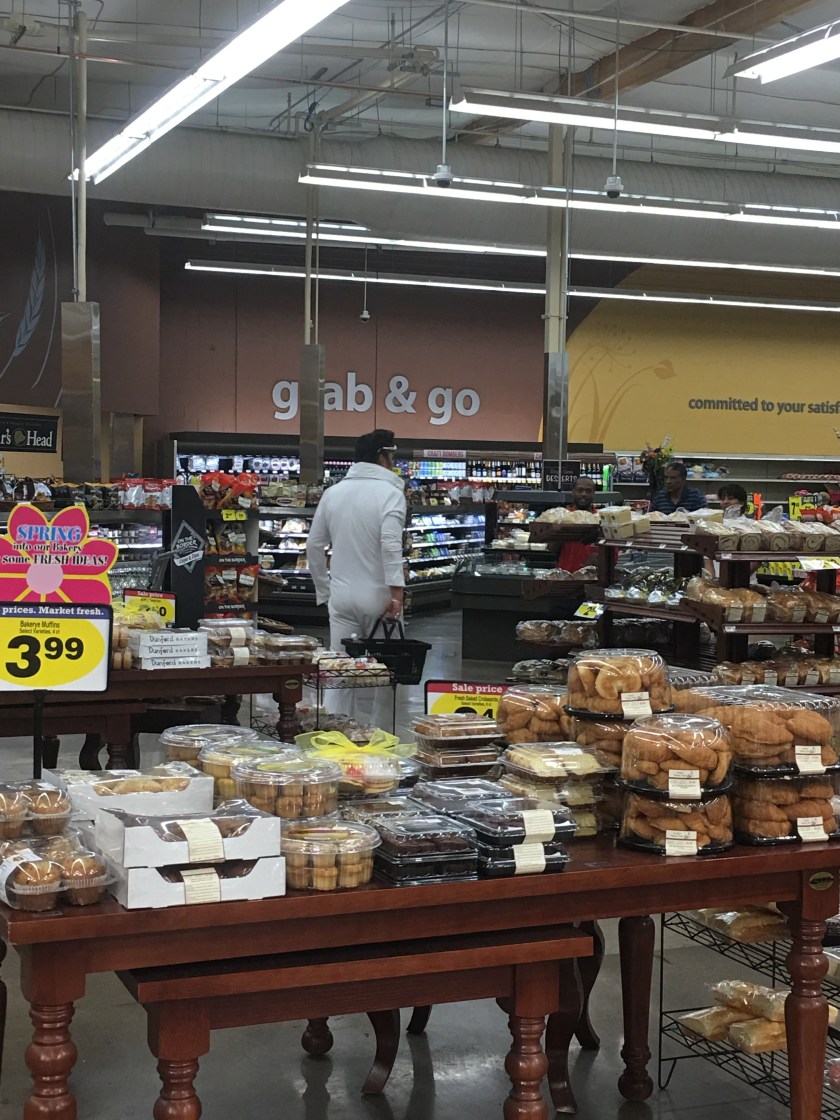
On our first visit to the market, while we were in the produce section, I was surprised and delighted to see Elvis checking out the apples. I’m not sure I would have recognized him had he not been wearing his white jumpsuit, but I’m sure that he was the real deal.

IMG_1581

I wish I could have gotten a better shot, but I was too shy to ask him to pose. Unfortunately, on subsequent visits, Elvis had left the building and was nowhere to be found.

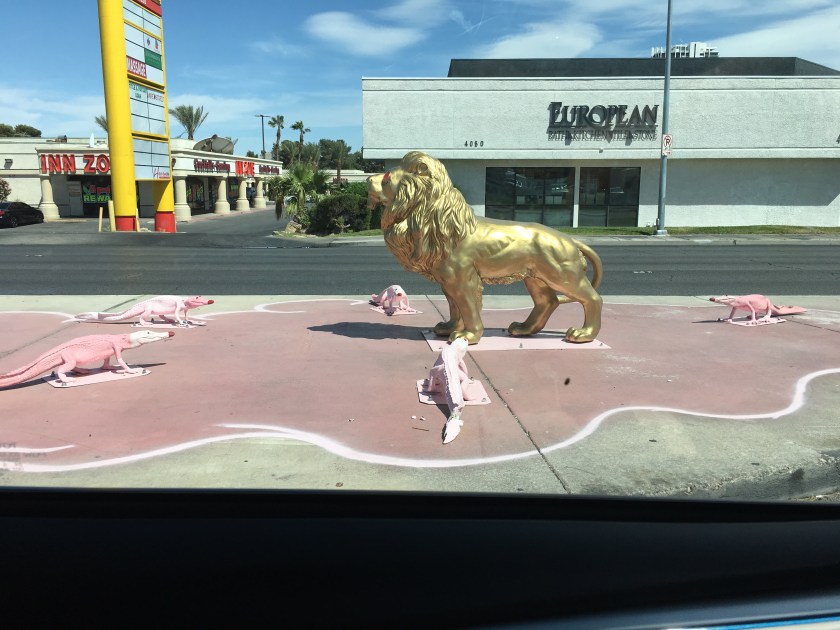
Then, on our drive back to the hotel, I came across a curious scene on the center island of the street we were on.

IMG_1694

I’m not sure what the back story is, but a golden lion with red eyes, surrounded by 5 pink crocodiles (or, whatever they were) has to have one… don’t you think?

Some people are wowed by the noisy crowds and flashing slot machines, others by the glitzy shows and other extravaganzas Las Vegas has to offer. Us, not so much. But I am grateful for the unexpected, silly, puzzling, delightful little encounters we often find when we travel and find ourselves off the well-beaten path.

U.S. National Parks on Sale!

I first posted this last year in February. If you are 62 or older and haven’t already taken advantage of this wonderful offer, the time to do it is now! The National Park Service has announced that the price for its Senior Pass will be raised from $10 to $80 sometime later this year. Here, with a few updates, is information about obtaining your pass.

So little, yet so mighty!

 There are a lot of opportunities to save a few dollars here and there when we pass certain age milestones. Some businesses offer deals for customers as young as 50, but most of these “senior discounts” don’t kick in until we reach age 55, 60, or older. Many restaurants, hotels, airlines, rental car agencies, and retail shops try to attract our money by offering a dollar amount or percentage off… but often only if you ask (so, ask). Some of the deals are good, but many require the customer to purchase something they may not have wanted in the first place.

The very best senior discount opportunity I know of is the one offered by the National Park Service. For just $10 (plus a $10 processing fee, if by mail or online), any U.S. citizen or permanent resident age 62 or over can purchase this lifetime pass to over 2,000 recreation sites. Senior Passes can be purchased online, by mail, or in person and will admit up to four adults (any age) in one non-commercial vehicle for free. How flipping great is that??!!

As soon as my husband turned 62, we drove to our local National Monument for a hike and to get his Senior Pass. We’ve already used the pass several times, and look forward to using it more in the future.

Even if you, like me, won’t be 62 until after the price increase, $80 is still a great bargain, and the increase will help the Park Service address its estimated $12 billion maintenance backlog. If $80 is too steep, another option for seniors is a $20 annual pass. Either way, The National Park System is an amazing resource and, especially with federal funding a bit shaky right now, well worth the investment.

Other discount passes are available, including one for current members of the military, people with disabilities, and 4th graders (I assume I don’t have any 4th graders reading my blog but some of you may have children or grandchildren who qualify). An $80 Annual Pass is available to anyone of any age and is a great deal if you plan to visit more than one or two participating parks during a calendar year.

To learn more about the National Park Service and their discount passes, visit their website (nps.gov), or go straight to: nps.gov/findapark/passes.htm.

Then, get out and explore!

Thursday Doors: Tears for Quebec

I had quite a different Thursday Doors planned for today… until I read Norm’s on his blog Norm 2.0. His post was a departure from his usual intriguing but lighthearted #ThursdayDoors posts. What he wrote today was thoughtful, emotionally powerful, and it hit me in the gut.

Go ahead, read it now if you haven’t already. I’ll be here when you get back.

My husband and visited Quebec City this past June, just days after the horrible massacre at the Pulse nightclub in Orlando, Florida. That shooter killed 49 people and wounded 53 others before being shot and killed by the police. His reason for the rampage: Hate.

U.S. Consulate General office in Old Quebec, 2016.

As we were touring Old Quebec, we came upon the United States Consulate General office located along one of the many lovely streets in this incredibly beautiful city. As awful as the news had been just a few days before, seeing a large rainbow flag flying at half-mast next to the U.S. Consulate door, made us proud of our country and our (then) government. The flag was a clear display of deep sorrow and a show of solidarity with a community that often finds itself maligned.

Now, we read about the massacre that happened in beautiful Quebec City. The gunman used a different religion to justify his action, his skin was of a different color, and his targets were a different “other.” But, his motivation was the same: Hate.

Evil feeds on evil. Rather than speaking words that lift us up and encourage our better selves, people in power – and those who seek power – are speaking words of hate and suspicion. They do it because it works, they do it because some people need to feel “better than” to feel good about themselves.

I’m not sure when this evil will stop, or if it ever will, but I know we need to speak out against it when we can. We need to defend the “others” who are victims of the hate and let them know that they are us and we are them; we are all in this together.

I wonder what flag is flying outside the United States Consulate General office today. I hope very much that it is one displaying deep sorrow and solidarity with a community that often finds itself maligned.

GratiTuesday: Memories of family vacations

As I was growing up, family vacations usually involved long road trips in our Ford (always a Ford) station wagon, pitching tents, and sitting around camp fires. Even if Disney Cruises existed back in the 50s and 60s, I doubt if our sole-breadwinner father supporting a family of five, could have afforded such an extravagance. So, just about every summer, we went camping.

Looking back, I can’t imagine having any richer memories then the ones I have exploring the wonders of our national parks with my family.  Over the years, the parks we visited included Yosemite, Sequoia, Kings Canyon, Crater Lake, Grand Canyon, Bryce, and Zion. We hiked, fished, rode horses, traded stories around camp fires, and learned about the importance of preserving our natural heritage.

On a recent trip to Northern California to visit family, my husband and I decided to take a “slight” detour through Yosemite National Park. It had been over 30 years since my last visit, and my husband had never been there before. Although we only had about a half a day, it was enough time to take in a few of the “must-see” sights and perhaps plan for a longer stay sometime in the future.

As we drove to Glacier Point – which offers commanding views of Yosemite Valley, Half Dome, and the High Sierra – something about the wall along the road looked very familiar. Deep within my memory was an image of a picture my father had taken many years ago of me looking out over the valley. In hopes of recreating the shot, I positioned myself in what I thought was a similar pose and had my husband take my picture.

Although it turned out that we weren’t in quite the same spot as before (Half Dome was much further in the distance in the old photo), I am pretty pleased with the result.

A little later in the day, while hiking around the valley floor, I took a picture of Half Dome from across a meadow. Home from our trip, I was looking through my old family photo album for the picture of me sitting on the wall and found another picture of my father’s that was quite similar to the one I had taken.

I am so grateful that my parents introduced me to the joys of camping and to appreciate the miracles of nature. I cherish the memories I have of those childhood vacations and the times we spent together as a family.

Oh, Ottawa!

Oh Canada you're looking good for 149 and with Justin on the Hill it's only getting better, keep it Trudeau Canada!
Oh Canada you’re looking good for 149 and with Justin on the Hill it’s only getting better, keep it Trudeau Canada!

We had mixed feelings as we left Toronto and made our way to Ottawa, the penultimate stop on our road trip (the last stop would be an overnight stay close to the airport in Montreal). We had been traveling for almost a month and were a bit homesick, but we also were having a great time and didn’t want the trip to end.

Our Airbnb apartment in Ottawa was definitely the nicest one we experienced on our trip. The host, a young, self-described “day-trader” who owned several apartments in the building, was helpful and very welcoming. The apartment was clean, quiet, nicely decorated, and well-located. Once we parked our rental (free parking was included – bonus!), we were able to walk everywhere we wanted to.

This slideshow requires JavaScript.

Parliament Hill is the political and cultural heart of Ottawa. The Gothic-style government buildings overlooking the Ottawa River are open for free guided tours (the tickets are first-come, first-served, so get them early). Our tour of the Centre Block building ended with an elevator ride to the top of the Peace Tower which provided sweeping views of the city and the river.

Another tourist favorite during the summer months is the Changing of the Guard ceremony, which takes place each morning on the front lawn of Parliament Hill.

This slideshow requires JavaScript.

The Rideau Canal is the oldest continuously operated canal system in North America. There are 45 locks along the 125 mile (202 kilometer) length of the canal. It was completed in 1832 as a precaution in case of war with the United States and remains in use today primarily for pleasure boating (and ice skating in the winter). The canal begins (or ends, depending on the direction of travel) in Ottawa where the large wooden lock doors are opened and closed using hand cranks. The park surrounding the locks was beautiful and we spent a relaxing few hours just watching the process of the boats making their way up through the gates.

Standing on very spindly legs next to the world-class National Gallery of Canada is the Maman sculpture by Louise Bourgeois – a 30-foot bronze cast of a spider.  The title is the French word for Mother, which explains the sac on her belly containing 26 marble eggs. Similar Maman sculptures can also be found at art museums in the UK, Spain, Japan, South Korea, and the US.

We also enjoyed exploring the historic and trendy ByWard Market, one of Canada’s oldest and largest public markets. It was just a few blocks from our apartment and the four-block area was full of shops, cafes, pubs, and galleries.

As we left Ottawa after only a few days, we once again felt that our too-short stay only allowed us to scratch the surface of this beautiful city. I’d love to return some day and explore all that we missed this time around.

Vibrant Toronto

IMG_0701

Toronto is Canada’s biggest and busiest city, and its most diverse. Over 140 languages are spoken there and it is estimated that over half of its residents were born outside of Canada. The most populous city in Canada, it is the fourth largest city in North America (behind Mexico City, New York City, and Los Angeles).

Even knowing all of this, I found myself a little overwhelmed at first by the size and vibrancy of Toronto.

Our Airbnb was located on a side street in the downtown area, between two busy boulevards. It appeared that most of the residents of the tall apartment building were students, possibly attending the nearby Ryerson University. The flat itself was quiet and nicely appointed and, because it was up on the 21st floor, we had a nice view of the downtown.

Although we didn't sit around much, our Airbnb flat was very comfortable.
Although we didn’t sit around much, our Airbnb flat was very comfortable.

As we did during most of the other stops along our recent road trip, once we parked our car (free, off-street parking was included – a huge plus in this busy city), it remained unused for the three days we were there. We were able to get everywhere we wanted to go either on foot or using public transportation.

Dancers enjoying the Salsa Festival.

In addition to a high-quality outdoor art show (top picture), we were delighted to discover that there was also a food festival and a Salsa music festival taking place on the days we were in town.

This slideshow requires JavaScript.

All within walking distance from our flat was Toronto’s Chinatown, the funky Kensington Market neighborhood, Old Town Toronto’s famous St. Lawrence Market, the Entertainment District, the busy Waterfront, and lots of tempting places to eat.

This slideshow requires JavaScript.

Like other Canadian cities we visited, street art seemed to be everywhere in Toronto. Much of it was big and gorgeous, but there were also plenty of unauthorized contributions.

After just a three-day stay in Toronto, we felt that we hadn’t even scratched to surface of this amazing city. It’s loud and messy and crowded, but the vitality and energy is infectious. Although our travel schedule didn’t allow us to stay any longer, we agreed that a return trip – one that included much more time to explore other neighborhoods and indulge in additional culinary delights – could quite possibly be in our future.