U.S. National Parks on Sale!

I first posted this last year in February. If you are 62 or older and haven’t already taken advantage of this wonderful offer, the time to do it is now! The National Park Service has announced that the price for its Senior Pass will be raised from $10 to $80 sometime later this year. Here, with a few updates, is information about obtaining your pass.

So little, yet so mighty!

 There are a lot of opportunities to save a few dollars here and there when we pass certain age milestones. Some businesses offer deals for customers as young as 50, but most of these “senior discounts” don’t kick in until we reach age 55, 60, or older. Many restaurants, hotels, airlines, rental car agencies, and retail shops try to attract our money by offering a dollar amount or percentage off… but often only if you ask (so, ask). Some of the deals are good, but many require the customer to purchase something they may not have wanted in the first place.

The very best senior discount opportunity I know of is the one offered by the National Park Service. For just $10 (plus a $10 processing fee, if by mail or online), any U.S. citizen or permanent resident age 62 or over can purchase this lifetime pass to over 2,000 recreation sites. Senior Passes can be purchased online, by mail, or in person and will admit up to four adults (any age) in one non-commercial vehicle for free. How flipping great is that??!!

As soon as my husband turned 62, we drove to our local National Monument for a hike and to get his Senior Pass. We’ve already used the pass several times, and look forward to using it more in the future.

Even if you, like me, won’t be 62 until after the price increase, $80 is still a great bargain, and the increase will help the Park Service address its estimated $12 billion maintenance backlog. If $80 is too steep, another option for seniors is a $20 annual pass. Either way, The National Park System is an amazing resource and, especially with federal funding a bit shaky right now, well worth the investment.

Other discount passes are available, including one for current members of the military, people with disabilities, and 4th graders (I assume I don’t have any 4th graders reading my blog but some of you may have children or grandchildren who qualify). An $80 Annual Pass is available to anyone of any age and is a great deal if you plan to visit more than one or two participating parks during a calendar year.

To learn more about the National Park Service and their discount passes, visit their website (nps.gov), or go straight to: nps.gov/findapark/passes.htm.

Then, get out and explore!
GratiTuesday: A Blank Slate for a New Year

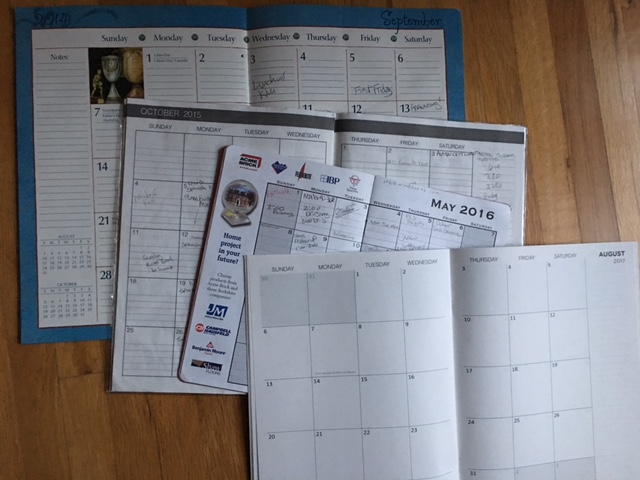
After my husband and I retired several years ago, we looked around a bit to find a good system for keeping track of our day-to-day lives. When we worked, we took advantage of our Outlook calendars on our office computers. Along with scheduling our business-related meetings, travel, and deadlines, we also noted doctor appointments, get-togethers with friends, and other non-work life events. Since we were on our work computers all day and they were linked up with our cellphone calendars, it was easy to keep everything straight.

Once we both were retired, we found ourselves missing a few important dates, including a quarterly tax payment due date (oops). That expensive mistake made us realize that we needed a system to help us manage our schedules. After several unsuccessful attempts at using fancy apps and digital assistants that others had recommended, we found that nothing had the same ease and appeal for us than just a simple desk calendar.

calendars

Now, after three years, we still swear by our yearly date books. We have found that not only do they help us manage our schedules in the current year, but the calendars from prior years can be a valuable tool to help us remember past events that our grey matter has lost. When did we take that trip? How long has it been since I’ve seen the dentist, where were we last February? – it’s all there for us in writing.

Now, it’s time to file away our 2016 calendar and start a new one for 2017. I’ve already jotted down a few appointments, important due dates (including quarterly taxes), and upcoming trips, but most of the 365 squares are blank and waiting to be filled.

I am so grateful to have this blank slate in front of me: empty of words but full of possibilities. Although it looks pretty bare now, I’m looking forward to all the special occasions, interesting classes, and exciting adventures that will soon start appear on its pages.

I Blame Pinterest

Well, not really, but…

When did the holiday season – and especially Christmas – get so over-the-top stressful? My childhood memories of pre-Christmas preparations include buying and trimming a tree, placing decorations around the living room, and stringing lights in front of our house. Granted, most of these tasks fell to my parents, but I don’t recall a heightened sense of stress related to any of these activities.

The tree wasn’t decorated in an overall theme, nor were the trimmings color-coordinated. The ornaments were a mixture of well-loved heirlooms handed down through the generations, holiday crafts that my brothers and I made at school, and decorations that my mother bought over the years at after-Christmas sales.

xmas-tree

Our living room shelves and the credenza beneath it had various Santas, reindeer, and snowman decorations placed among the books and next to the TV. As Christmas cards arrived in the mail, they filled up any remaining spaces.

xmas-house

The outdoor lights – the large, tear-drop shaped, multi-colored bulbs that everyone had – were strung in a straight(ish) line from the far corner of our garage, across the front of our house, then down to a couple of the bushes below.

It was pretty much the same thing every year… and we wouldn’t have wanted it any other way.

Fast forward to the age of social media.

Friends on Facebook post pictures of perfectly decorated homes (inside and out) and lavishly prepared meals, Houzz offers a myriad of ways to accessorize our rooms for the holidays – in prices ranging from a lot to are you kidding me?, and Pinterest is bursting with photos of just the item, product, display, project, recipe, etc. that we need to purchase or create to assure our holiday is perfect.

Now, don’t misunderstand: I am not immune to the eye candy that is everywhere this season. I love to see what others have done to decorate or which appetizers, cocktails, or meals they have planned for their holiday celebrations. But, even as I admire their decorating talents (to say nothing about the off-season storage space they must have) or their creativity in the kitchen, I prefer the low-key way my husband and I choose to celebrate the holidays.

I realize that decorating every nook and cranny with just the right seasonal accessory or wowing family and guests by baking and serving a Chocolate Espresso Bûche de Noël fills some with joy. We’re just happier to eschew the tree (there really isn’t room for one anyway) and put out fewer, but well-loved, decorations. And, while we enjoy attending holiday parties given by friends who love to entertain lavishly, our get-togethers tend to be small and pretty casual.

img_1262

If I find myself grumbling about being stressed out or feeling like I don’t have enough time to do the things I “need” to do, I stop and consider how much unnecessary burden I’ve willingly put on my own shoulders. Am I doing what pleases me, or am I trying to emulate someone else’s version of the holiday? What works for one person, or one family, may not be a good fit for another.

And that’s OK.  This season isn’t about an exquisitely decorated home or perfectly prepared food, it’s about the people in our homes and those who share our food.

That’s where the memories are made.

Friendships beyond the bond of work

There are a few very special people I’ve met through work with whom I’ve maintained contact over the years. Some I met multiple jobs ago, and others I met at my last place of employment before I retired. Although it’s not unusual to have a variety of work friends while being employed under the same roof, continuing the relationships after the commonality of work is over can be difficult. Often you discover that work was the glue. Once the glue is gone, it is easy for the bonds to separate and disappear.

The workplace friends who are still in my life are there because work was the catalyst, not the glue.

One of these friends and I had been trying to arrange a get together for a while. She still works so doesn’t have the same flexibility as I do. Finally, we were able to arrange a time and date that worked for us both. It wasn’t until we met that day that she mentioned that it was her birthday.

This is a woman with lots of friends. She also has family close by. But, she chose to spend part of her birthday with me. How nice is that?

Overlooking Balboa Park, from the top of the California Tower

We chose to meet in one of our city’s most beautiful parks, on what turned out to be a gorgeous fall day. A perfect place and perfect weather in which to stroll, chat, laugh, observe, confide, and just be.

We rendezvoused at about 9 a.m. and we didn’t say good-bye until around 2 p.m. We spent the day enjoying each other’s company as we wondered around the park, visited a few museums, and had a lovely lunch on an outdoor patio. Our conversation easily flowed from one subject to another and we both mentioned how nice it was to spend the day without a schedule or an agenda. Other than encouraging her to retire at the first opportunity, very little of our conversation was about work.  It was a perfect day with a dear friend.

Happy birthday, my friend!

I am lucky that I still live in the community where I grew up and spent a majority of my working life because, like many people, I find it harder to make new friends as I get older. Children naturally gravitate to each other, school often brings kindred spirits together, and most working environments encourage engagement among colleagues. Now that I am retired, it can be difficult to build a new connection beyond superficial interactions. My blogger friend, Liesbet, recently wrote about the difficulties of making friends while living a less anchored lifestyle. If I were to move and start all over, I’m not sure how well I would do.

Fortunately, at least for now, I don’t need to worry.  I just need to get more of my friends to retire so we can get together during the middle of the week.

And not talk about work.

GratiThursday: What I don’t need

I postponed my weekly GratiTuesday post until today when we celebrate Thanksgiving in the United States. So, just for today, this is a GratiThursday post.

cicero

As I took apart our newspaper this morning, I was struck by how many Black Friday ads it contained. Dollars off this, a huge percentage off that. Best of all, you can take advantage of these tremendous offers TODAY! Get to the stores early… fire up your computer… shop!

As I dumped all of the advertising flyers into our recycling bin, I thought about how grateful I am that I don’t need any of what was being advertised. I didn’t even really want any of it either.

At this stage of my life, I choose quality over quantity and I do more with less. Just like an artist knows the worth of incorporating negative space in their paintings or photographs, I don’t need to fill up all of the open spaces of my world. I have fallen in love with my life just the way it is.

I am so very grateful for the abundance in my life.

The tyranny of stuff

When my husband and I retired, getting rid of excess stuff was one of our primary goals. Although our home wouldn’t qualify for hoarder status, it carried the baggage of stuff collecting that had taken place over the years. Because we both had acquired stuff before we met, a good amount of that stuff was transferred from our individual homes into our shared home. And, of course, stuff continued to enter our home after we got married. Then, after my parents died, some of their stuff also found its way into our growing collection.

Now, several years into retirement, we still have too much stuff. Although we’ve done a pretty good job of curtailing the in-flow of more stuff, the out-flow hasn’t gone as easily as we had hoped it would. We don’t have too much of a problem identifying stuff to be tossed or stuff to be donated; it’s the stuff we no longer want but has value – real or sentimental – that is more difficult to manage.

We had high hopes that eBay would be the perfect way to get rid of lots of stuff and bring in some money in the process. Although we’ve used it to sell several dozen items and we intend to sell more, we have found that the process takes a lot of time. When we started out, we put just about anything up for auction, regardless of its hoped for selling price. We once sold some used cycling cleat covers (yes, someone wanted them) for $8.00, plus shipping. But, after we figured the time it took to research an asking price (yes, there were similar cleat covers being sold), write copy,  take pictures, post the ad, then package and mail them when they sold, we were lucky if we made $3 an hour. Other items, of course, have sold for much more, which made the process worth it. As a result, we have become more discriminating about what is worth selling and what we should donate or post for free on Craig’s List.

Stuff headed for the Discovery Shop.

Our push to get rid of stuff has ramped up lately. We are enjoying living a less-cluttered life and a better functioning home. We like having a few cabinets that are actually empty. The closet in our guest room has space for guests’ clothes. I no longer seldom am embarrassed when friends or neighbors stop by unexpectedly. As long as they stay out of our offices and the catch-all room upstairs, the illusion of having a well-curated home is maintained.

But, just living with less clutter day-to-day isn’t the only reason we want to get rid of more stuff. We are also looking at a few long-term advantages. Having a home that we could temporarily swap for, say, one in the south of France would extend our travel budget. Renting our house while we take off for extended adventures could provide income and security. Either possibility would be easier to accomplish if our home had less stuff and more space.

When I was younger, I loved acquiring stuff. Now, I view most stuff as unnecessary, restricting and complicating. Slowly, I’m winnowing down my wardrobe to have fewer, but more versatile clothes. Our shelves are being freed of clutter, leaving only a few, carefully selected items. The tabletop piles of paper are being swept away and replaced with… nothing.

Very gradually, we are freeing our home of the tyranny of stuff and welcoming the liberation of having space.

Oh, Ottawa!

Oh Canada you're looking good for 149 and with Justin on the Hill it's only getting better, keep it Trudeau Canada!
Oh Canada you’re looking good for 149 and with Justin on the Hill it’s only getting better, keep it Trudeau Canada!

We had mixed feelings as we left Toronto and made our way to Ottawa, the penultimate stop on our road trip (the last stop would be an overnight stay close to the airport in Montreal). We had been traveling for almost a month and were a bit homesick, but we also were having a great time and didn’t want the trip to end.

Our Airbnb apartment in Ottawa was definitely the nicest one we experienced on our trip. The host, a young, self-described “day-trader” who owned several apartments in the building, was helpful and very welcoming. The apartment was clean, quiet, nicely decorated, and well-located. Once we parked our rental (free parking was included – bonus!), we were able to walk everywhere we wanted to.

This slideshow requires JavaScript.

Parliament Hill is the political and cultural heart of Ottawa. The Gothic-style government buildings overlooking the Ottawa River are open for free guided tours (the tickets are first-come, first-served, so get them early). Our tour of the Centre Block building ended with an elevator ride to the top of the Peace Tower which provided sweeping views of the city and the river.

Another tourist favorite during the summer months is the Changing of the Guard ceremony, which takes place each morning on the front lawn of Parliament Hill.

This slideshow requires JavaScript.

The Rideau Canal is the oldest continuously operated canal system in North America. There are 45 locks along the 125 mile (202 kilometer) length of the canal. It was completed in 1832 as a precaution in case of war with the United States and remains in use today primarily for pleasure boating (and ice skating in the winter). The canal begins (or ends, depending on the direction of travel) in Ottawa where the large wooden lock doors are opened and closed using hand cranks. The park surrounding the locks was beautiful and we spent a relaxing few hours just watching the process of the boats making their way up through the gates.

Standing on very spindly legs next to the world-class National Gallery of Canada is the Maman sculpture by Louise Bourgeois – a 30-foot bronze cast of a spider.  The title is the French word for Mother, which explains the sac on her belly containing 26 marble eggs. Similar Maman sculptures can also be found at art museums in the UK, Spain, Japan, South Korea, and the US.

We also enjoyed exploring the historic and trendy ByWard Market, one of Canada’s oldest and largest public markets. It was just a few blocks from our apartment and the four-block area was full of shops, cafes, pubs, and galleries.

As we left Ottawa after only a few days, we once again felt that our too-short stay only allowed us to scratch the surface of this beautiful city. I’d love to return some day and explore all that we missed this time around.

GratiTuesday: Our summer has just begun!

Most people mark the beginning of summer in June on the Solstice, or when the kids get out of school, or when the weather turns reliably warm. But, for many people who live in my city – especially those of us who are retired or have flexible schedules – our summer begins after Labor Day.

After months of sharing our city with visitors and putting up with roving packs of teens and pre-teens, all of a sudden a kind of quiet descends over us. Most of the tourists have gone back home, the kids are starting back to school, and we look forward to what is often our best weather in September and into October. We rejoice that our beaches are far less crowded, restaurants are quieter, and we no longer have to share our favorite hang outs with the masses.

This slideshow requires JavaScript.

And, it gets even better: even though we will celebrate the Fall Equinox on September 22 this year, Daylight Savings mercifully doesn’t end until November 6. Then, it’s just over a month until the Winter Solstice, after which the sun begins to make its way north again and daylight hours start to get longer and longer.

Even though we continue to struggle with the drought here in Southern California, I am so grateful that I live in an area where winter doesn’t mean months of snow, spring feels right around the corner even in September, and the delights of summer can often be enjoyed well after those living in colder climates have traded their flip flips for boots.

I’d also be very grateful for a good dose of rain, though.

Vibrant Toronto

IMG_0701

Toronto is Canada’s biggest and busiest city, and its most diverse. Over 140 languages are spoken there and it is estimated that over half of its residents were born outside of Canada. The most populous city in Canada, it is the fourth largest city in North America (behind Mexico City, New York City, and Los Angeles).

Even knowing all of this, I found myself a little overwhelmed at first by the size and vibrancy of Toronto.

Our Airbnb was located on a side street in the downtown area, between two busy boulevards. It appeared that most of the residents of the tall apartment building were students, possibly attending the nearby Ryerson University. The flat itself was quiet and nicely appointed and, because it was up on the 21st floor, we had a nice view of the downtown.

Although we didn't sit around much, our Airbnb flat was very comfortable.
Although we didn’t sit around much, our Airbnb flat was very comfortable.

As we did during most of the other stops along our recent road trip, once we parked our car (free, off-street parking was included – a huge plus in this busy city), it remained unused for the three days we were there. We were able to get everywhere we wanted to go either on foot or using public transportation.

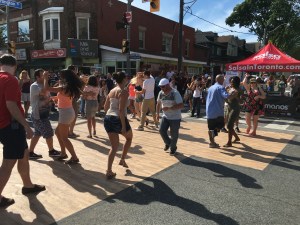
Dancers enjoying the Salsa Festival.

In addition to a high-quality outdoor art show (top picture), we were delighted to discover that there was also a food festival and a Salsa music festival taking place on the days we were in town.

This slideshow requires JavaScript.

All within walking distance from our flat was Toronto’s Chinatown, the funky Kensington Market neighborhood, Old Town Toronto’s famous St. Lawrence Market, the Entertainment District, the busy Waterfront, and lots of tempting places to eat.

This slideshow requires JavaScript.

Like other Canadian cities we visited, street art seemed to be everywhere in Toronto. Much of it was big and gorgeous, but there were also plenty of unauthorized contributions.

After just a three-day stay in Toronto, we felt that we hadn’t even scratched to surface of this amazing city. It’s loud and messy and crowded, but the vitality and energy is infectious. Although our travel schedule didn’t allow us to stay any longer, we agreed that a return trip – one that included much more time to explore other neighborhoods and indulge in additional culinary delights – could quite possibly be in our future.

The Power of Niagara Falls

Horseshoe Falls
Horseshoe Falls

I’ve been very fortunate to have had the opportunity to see many amazing sites over the years – natural wonders, great works of art, and man-made structures of historical significance. Many have inspired genuine awe, but only a few have brought me to tears; bowled over by their impact deep inside of me. The Statue of David, the Grand Canyon, and Mount Rushmore are a few that come to mind. The Niagara Falls is another. I’m not sure where the heightened emotional response comes from, but it’s powerful when it hits.

We arrived in Niagara Falls well after dark but, thankfully, not too late to see the 10pm fireworks display. Our Airbnb was located down-river and as we hurried towards the main observation area, we started to hear the relentless pounding of the water before we could see the falls. When they came into view, my eyes immediately welled up and my heart started to beat with what felt like the force of the falls. Their incredible beauty and power stopped me in my tracks.

My husband and I were back in Canada after spending almost half of our month-long road trip in the U.S. (Vermont and Upstate New York). On the other side of the Gorge from us was Niagara Falls State Park – America’s oldest state park – but we had read that the Canadian side has the better views and accommodations. Our Airbnb – it actually turned out to be a B&B (Lion’s Head http://www.lionsheadbb.com/) – was nicely situated and the delightful owner, Helena, a trained chef, provided incredible breakfasts for her guests each morning.

Our room at Lion's Head B&B
Our room at Lion’s Head B&B

After a restful night’s sleep and sumptuous strata for breakfast, we headed off to see the sites. In order to get the most out of our one full day in Niagara Falls, we decided to purchase an Adventure Pass which allowed us to visited four main attractions (White Water Walk, Journey Behind the Falls, Hornblower Niagara Cruise, and the 4D film, Niagara’s Fury). The pass also included bus transportation.

This slideshow requires JavaScript.

The Niagara Falls were formed at the end of the last Ice Age when the glaciers receded and the water from the newly formed Great Lakes began to carve a path towards the Atlantic Ocean.  The three waterfalls – Horseshoe Falls, American Falls, and Bridal Veil Falls – are geological wonders estimated to be about 12,000 years old. Millions of gallons of water spill over the falls every minute – about 750,000 gallons each second. The water’s force has been producing hydroelectric power since the first generating station was built in 1881.

This slideshow requires JavaScript.

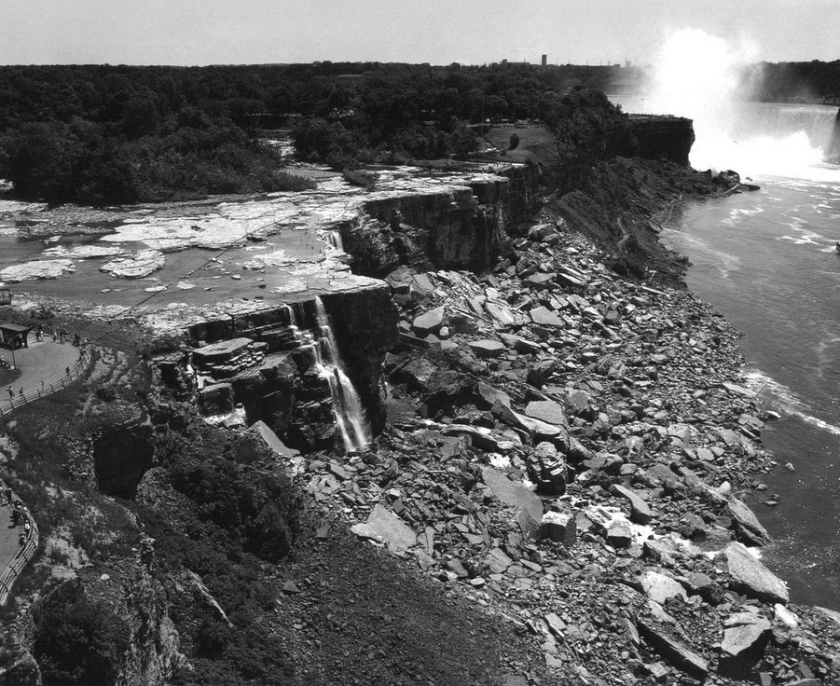
I read recently that New York State is planning to divert the water from the American Falls sometime in the next few years so they can replace two 115-year-old stone arch bridges. If this happens, it will be the first time since 1969 that the water flow has stopped.  The American Falls was slowed to a trickle in 1969 to study the effects of erosion and buildup of rock at the base of the falls. When that happened, people came from all over the world to see the falls turned off.

1969 water diversion. Photo credit: Niagara Falls Public Library

If they do in fact divert the water – a once (or twice) in a lifetime event – it could be a perfect excuse for us to visit Niagara Falls again.