Dropping Ballast

I was going through my husband’s closet the other morning helping him find something (yes, I found it… I always do) and realized that he has a bunch of clothes that he has very little use for just taking up space. Since retiring two years ago, he has seldom, if ever, worn one of his several nice suits. He’s had little need for a sports coat, and I’m pretty sure he hasn’t worn a tie more than a handful of times in many years. His current attire mostly consists of jeans or shorts and a comfortable shirt. He wears khakis once in a while, but often with flip-flops. Now that he’s taking culinary classes (for fun), he heads to school wearing funny striped chef pants and a chef’s jacket.

I suggested that we make some time soon to weed through his clothes. He will keep a few remnants of his past working life for those more formal events that come up now and then, but I hope we can get rid of a lot of items that no longer fit into his life.

In anticipation of my retirement, I stopped purchasing work-specific clothes awhile ago. No more pencil skirts, no more pumps; nothing that tends to function only as business attire. That’s not to say that I envision a retirement wardrobe entirely made up of “play clothes,” but I think the items I will reach for most often will be on the casual side, and definitely comfortable.

I plan to donate many of my work-specific clothes and shoes right away. Those that I can’t quite let go of yet, I will box up—with a date indicated on the outside—and store them somewhere convenient, but outside of my closet. If I go one year without needing the clothes, they will be donated too.

When my husband and I remodeled our house years ago and added the upstairs master bedroom, I got my own, rather large, closet. At first, the clothes I had barely took up half the available space, but, over the years, I’ve managed to fill it up… and then some (I’m much better at intake then I am at outgo).

Culling our belongings is an initial goal of our grand retirement plan. We are looking forward to acquiring more experiences than possessions, and putting greater value on traveling light and often rather than being burdened by schedules and obligations.

Of course, clothes are not the sole focus of our efforts to clear out the cutter. We have too much crap stuff in general and I think it is getting in the way of our ability to enjoy a calmer and more organized home. We are by no means hoarders, but let’s just say that, as we’ve navigated through our life together, we’ve picked up a few barnacles along the way. Many of the things we’ve acquired to complete our home are now just bulk we no longer need to balance our lives.

It will take some time and effort, but we need to scrape off the hull and empty the bilge. Life is too short – and getting shorter. It’s time to drop some ballast and sail on.
Puzzling Together the Pieces

With only eight short weeks remaining before I leave the 8-5 work world and begin my next chapter, I am experiencing an array of emotions. Excitement and enthusiasm, yes, of course, but also… not quite fear… more like apprehension and just a little unease.

Barring a huge economic downturn (which we now know can happen), I feel in good shape financially. Health insurance—at least for now—is available and budgeted for. Because I have a pre-existing condition due to an illness many years ago, without the Affordable Care Act I’d be concerned about the possibility of not finding coverage.

My unease stems mostly from two questions that I can’t answer yet:

What if this is the wrong decision?
Although I could probably find another job if I discover that I absolutely hate not working full time (something I doubt very much), it would be hard to match what I do now – both in salary and in satisfaction. Because my intention to exit work has gone from concept to commitment, I am feeling the finality of my decision.

A part-time job could provide some structure without a major time commitment, but then I would lose the freedom to pick up and go anytime my husband and I wanted to. Consulting? Maybe, but I’d have to spend time marketing my services, which doesn’t sound like much fun.

How will I replace the social network that I’ve developed at work?
Knowing that this was one aspect of retirement that my husband had a hard time with, I’ve become acutely aware of the large and small interactions that occur throughout the work day. Even simple greetings and casual conversations add to my enjoyment and I know that I will miss the easy comradery of being a member of a well-functioning team.

Over the years, I have developed varying levels of friendships with co-workers. Some of them I see outside of work, and I hope that will continue, but most are those types of friendships that are based on our shared circumstance. I imagine that most of these relationships will fade away soon after we are no longer working together. Our intentions might be sincere, but it will really take an effort—most likely mostly on my part—to stay in touch. Because they will still have the constraints of a full-time job, it will be up to me to arrange get-togethers that fit around their schedules.

Bucket

I know that the most effective way to mitigate my concerns is to start putting in place several items on my “bucket list” of activities I want to enjoy in retirement; the ones that I find difficult to do now because of time constraints. A few that come to mind are:

Find—or start—a book club
I have “test-driven” several established book clubs over the years, but have yet to find one with the right combination of serious and social. Great books and stimulating conversation, enjoyed in a social atmosphere that includes shared food and wine… that is what I’ll be looking for.

Identify exercise buddies
Soon I will be able to go to the gym, power walk, ride my bike, take yoga, etc. anytime I want so I need to find others who are on a similar non-schedule. There are lots of things I like to do alone, but friends can make exercise more enjoyable and help maintain the motivation.

Sign up for some classes
After years of reading longingly about classes, workshops, lectures, etc. that I couldn’t participate in because of my work schedule, I can now attend! Although I expect that my desire to learn new things will be ongoing, I want to identify a few possibilities right away so that I am inspired to get up, get dressed, and get going.

Volunteer to usher for a local theater
There are a lot of worthwhile causes and organizations that need volunteers, and I hope to identify several to give my time to. By ushering for a theater company, I not only provide a valuable service, but I will see performances I might otherwise miss. Because these opportunities are seasonal, and most likely have waiting lists and specific training schedules, I want to be sure I don’t miss a deadline.

Between several of these activities, all the projects that need to be done around the house, and a couple of trips we have planned this year, I should be quite busy. I hope that soon whether I made the right decision and how I will create a new social network will no longer be in question.

Road Skills

I am back in Southern California following my two-week vacation (“Practice Retirement”) spent driving across the country with a friend. The trip was a positive experience overall and I’m happy I was able to have the adventure.

Looking back, I have several observations that I need to consider for future road trips I hope to take with my husband after I join him in retirement.

Bring a paper map
In an earlier post, I wrote of my love of paper maps. Although we were well-equipped with a GPS, two iPads, and a smart phone to help us get from here to there, I would have felt lost if I hadn’t had my US Road Atlas with me so I could track our progress along the way.

Keep a journal
I brought along a small tablet for general note-taking, and, every evening, to write a page or two about my experiences that day. Because often details can slip away from the memory banks, keeping a journal helps me capture moments I don’t want to forget.

It will also come in handy, if I ever pass that way again, to help me remember what not to miss – places to eat, things to see, experiences to be had.

Be aware that small moments can become big memories
Random conversations with strangers, eating at a local hole-in-the-wall, seeing a rainbow through an opening in an otherwise cloudy sky. These are the experiences that stay with me and make the journey most memorable.

Don’t be shy
I am not an extrovert by nature, but, over the years, I have become more and more comfortable striking up conversations with people I don’t know. Away from home, I think this practice is even more important. I had a so many enjoyable interactions and learned so much just by opening myself up and initiating conversations.

Two new friends with benefits (they can cook!)

Often a simple “hello” said with a big smile can be the beginning of a memorable exchange. Even if I only got a smile in return, that’s one more smile to add to my day.

Try the local cuisine
Since we were traveling along a southern route, we had the opportunity to chow down on barbeque in Texas, slurp gumbo in Louisiana, and sample fried pretty-much-everything in multiple southern locals. I’m not a big fan of bacon fat and I prefer my vegetables fresh as opposed to being smothered with oil and cooked beyond recognition, but I thought it was important to at least taste everything.

When we wanted to take a break from heavy food, we looked for, and often found, a Panera along the way so we could supplement our diet with fresh salads.

Make room in the suitcase for a little vanity
Because it was just my girlfriend and me for two weeks, I didn’t bother to bring any make-up. Although it was freeing to just wash my face and go, I often wished that I packed a little something to brighten the bare face that stared back at me in the mirror every day.

Although I don’t wear a lot of make-up (and often none at all on the weekends), I know that wearing at least a bit makes me feel perkier.

Allow for alone time
Even though it would have been cheaper to share, it was money well spent to have separate hotel rooms along our route. My friend has very different sleep habits than I do (she stays up late, and rises late in the morning), and, after spending many hours together in the car, I needed to have some time by myself.

Fortunately, my husband and I share sleep schedules so we won’t be needing separate rooms, but having a bit of time by myself allows me to recharge my batteries. I do much better and am much less cranky if I can carve out an hour or two of “Me Time.”

Only pack what is needed (and learn to need less)
I had envisioned that I would post to my blog regularly during my trip. In the end, I managed to make only one post, and it was more difficult than I thought it would be.

I love the writing process. I write, I edit, I rearrange, I delete, I fuss, I re-write. I brought along a laptop because I thought it would be too hard to do that on an iPad. Now, I’m not convinced that the laptop helped at all, and it added bulk and weight to my luggage.

Before going on another trip during which I want to blog, I need to practice writing and posting from my iPad.

“If you never did you should. These things are fun and fun is good.”  ― Dr. Seuss
“If you never did you should. These things are fun and fun is good.”
― Dr. Seuss

In two weeks, we went through three time zones and fourteen states. We experienced temperatures up in the 70’s on down to the low 20’s. We enjoyed warm sunshine, thick clouds, bone-chilling wind, and driving rain storms. I rode a bigger-than-life, cut-out buffalo, visited Elvis’ birthplace, and got to view Edward Hopper’s painting, Nighthawks so close I could almost smell the coffee.

I missed my husband, my house, and sleeping in my own bed, but I’m so happy I didn’t miss this journey.

Going to Abilene

Many years ago, as part of a workshop on effective communication, I saw a video called “Going to Abilene.” It illustrated the “Abilene Paradox,” which is a term used to describe the tendency for group to agree to support a belief or action that directly contradicts what the individual members of the group actually believe is right. This tendency is often referred to as “Groupthink.”

The video dramatized (actually, “dramatized” may not be the correct term since, as I remember, the acting was pretty terrible) the story of a family relaxing on a hot afternoon in Coleman, Texas. One member suggested driving up to Abilene for ice cream. Despite it being a 50-mile drive, someone else said that it sounded like a good idea. Then another family member, not wanting to be disagreeable, also said “let’s go!” Soon, they were all piled into an old, non-air-conditioned station wagon, driving in the heat and dust to Abilene.

When they returned home four hours later, hot, exhausted, and out-of-sorts, they discussed what they had just done. It soon became clear that none of them, even the person who suggested it, really wanted to make the trip in the first place. They had all agreed “just to get along,” because they thought it was something everyone else wanted to do.

I was so impressed with this concept that I told my husband about it, and “are we going to Abilene?” soon became our code question when we needed to check out whether or not we both REALLY wanted to do something. 20 years later, we still use it.

So, of course, when planning my trip across the United States, when I saw that we would be passing near Abilene, I insisted that we make it one of our stops. Fortunately, my traveling partner agreed; not just to get along, but because it sounded like a good idea to her too (at least I think so…).

photo

Abilene turned out to be a charming town. We ate some great Texas barbeque, met a number of terrific people, and found several wonderful photo ops. I think I’d like to make a trip back here when I can spend more time exploring.

I’m sure “are we going to Abilene?” will still be a question my husband and I will ask each other now and then when we need a reality check, but now, after spending some time there, “yes” won’t be such a bad answer.

Practice Retirement

Several months ago – back when I thought I’d be retired by now – I happily volunteered to go on a two-week road trip with a dear friend. She used to live in San Diego before moving to Pennsylvania, and now drives west each winter to spend several months seeing friends and avoiding the snow. I thought it would be great fun to join her on her journey back home.

I am fortunate that I was still able to arrange a two-week block of time off work, and lucky that I have a husband who understands the importance of the trip and is OK with me being away for that amount of time.

We planned this trip before the dreaded polar vortexes (vortices?) hit, so I’m now questioning the wisdom of leaving sunny southern California and heading to the east coast. To avoid as much cold weather as possible, we’ll take a mostly southern route before heading north once we reach Alabama. Since I’ve never lived in the snow, I don’t have the proper clothes, nor do I have a clue how to drive in the stuff. I really hope that the worst will be over by the time we head out in a few weeks.

Remind me again why I'm leaving the orange and yellow part in the lower left to drive to the dark blue and purple parts in the upper right?
Remind me again why I’m leaving the orange and yellow part in the lower left to drive to the dark blue and purple parts in the upper right?

I’m also nervous because I’m an introvert by nature and crave a certain amount of alone time. The thought of being with someone other than my husband, in close quarters, all day, for two weeks is somewhat unsettling. Fortunately, my friend and I share similar interests, and our taste in food, music, books-on-tape, etc. is close enough so I’m fairly certain we’ll be fine.

Although a two-week trip across country could be called leisurely, we won’t make many site-seeing stops. We’ve identified a couple of points of interest that will require longer stays, and plan to see a few friends along the way, but mostly our overnights will be in small towns, strategically spaced to break up the drive into reasonable chunks.

This trip is the type of adventure (albeit with my husband) I am looking forward to the most in my retirement. Without any hard deadlines or schedules, I hope he and I can take off when the desire hits us, and stay away as long as we want. I have no idea how often we will actually do that, but just having the option feels very freeing.

This road trip with my friend will give me a chance to practice being retired. Along with as many warm cloths as I can stuff in my suitcase, I will take my journal and my camera, a commitment to be flexible and open experiences outside of my comfort zone, and, most of all, my sense of adventure.

Opening Our Minds to Skepticism

All too often, we read stories about people who are duped by scammers. Sadly, the victim is often elderly and, tragically, large sums of money – money that they can’t afford to lose – are frequently involved.

As my late father’s physical and mental health started to decline, I worried about him falling for the various come-ons he received in the mail and on the phone. He had a good, analytical mind when he was younger, but I could tell that his aging brain was becoming less and less able to discern fact from fiction. Fortunately, I was able to protect his bank accounts and credit card before anything happened so he and his finances were safe.

Scammers continue to devise more sophisticated and devious ways to separate people from their money, but there are still plenty of victims responding to notices of large lottery wins, promised riches from Nigerian princes, and a variety of phony phishing emails. My innate skepticism will help protect me from falling for these scams now, but I worry that when I am much older, will I still be able to avoid being taken advantage of?

The same critical thinking skills that make me disregard offers that are “too good to be true” lead me to question much of what I read on the Internet and in social media. I can always count on a handful of “friends” posting items on Facebook or forwarding me emails (along with protestations of outrage) with a story sent to them by some equally outraged person. Most don’t pass my “smell test” and, after a quick search on various fact-checking sites, the stories turn out to be just that, stories.

I don’t think these people are stupid or especially gullible but when they read something that fits very neatly into their political or ideological mindset, they tend not to question its authenticity. This is how hate, lies, and rumors are spread; one unquestioned falsehood at a time.

A lie can travel halfway around the world while the truth is still putting on its shoes” Mark Twain

We live in a society of people who self-select their news. If one source’s slant doesn’t lean in the right direction, simply choose another that does. We also tend to socialize, and even live in communities, with like-minded people. That way we don’t have to question our beliefs or, God forbid, alter them in any way. I guess this makes us feel smug comfortable in our convictions, but does it make us better citizens? Does listening to only one side of a story before deciding on its merits support our intellectual integrity? I think most would agree that it does not (although we still do it because, really, it’s others who need to open their minds, not us… right?).

Non-critical thinking makes us more vulnerable to scammers. If we trust a source so completely that we never question its accuracy, why would we question the authenticity of an “exclusive offer” from the same source (or one of its advertisers)? Even better if the offer is also couched in language that supports our biases. If we are distrustful of something or someone, are we not more likely to respond to something that reinforces our paranoia suspicion?

Less incendiary, but maybe in some ways worse, are the “innocent” but untrue items that are re-posted virally. If the poster had done some quick research or applied simple logic, they would have realized that the story doesn’t make any sense. In this category are those emails/posts that promise riches/good luck if you continue the chain (and usually include dire warnings if you don’t), and urban legends like entering your ATM PIN backwards will summon help. Although new myths are being created all the time, many have been around for years and are repackaged and posted over and over again.

When we get in the habit of using magical thinking in place of critical thinking, we make ourselves more vulnerable to hoaxes and fraud. Best case, we just irritate our friends and end up looking stupid, but worst case, we open ourselves up to scammers and thieves.

Recent studies have shown that changes in the brain as we age make the elderly more trusting. The negative “gut feelings” a younger person might experience aren’t felt as strongly by an older person. For this reason, we must be alert when caring for an older adult to protect them from unscrupulous individuals and businesses.

Fortunately, there are things we can do as we age so we aren’t as likely to become victims. We can actually practice our critical thinking skills, learn to be more analytical, and train our brains to question when something just doesn’t ring true.

The enemy of scammers and hoaxters is common sense, questioning, and research.

Be their barricade, not their bridge.

Shifting Sands

Today was supposed to be THE day. On one of my first RetirementallyChallenged posts, Picking a Date, I drew a line in the sand by declaring that I would retire on January 31, 2014. I did this so that I would have a date to focus on and to make the concept of retiring more real to me.

Sand shifts, lines get less defined, plans change.

I knew that when I approached my manager with this date, the resulting discussion wouldn’t be a comfortable one. Although I would be giving plenty of prior notice (months, not weeks), I work with a pretty tight team, both in working style and in numbers. My leaving will create an unwelcomed challenge for my co-workers. The challenge will be temporary; work adjusts, life goes on, but our team is small enough that one person’s leaving impacts the others.

When I approached my manager a few months ago, although she expressed happiness for my new adventure, it was apparent that she was concerned about filling the void my retirement would leave. I felt guilty and conflicted. My resolve began to falter and I found myself looking for ways to “fix” this problem I was creating.

Yes, I whimped out, but only temporarily.

I will stay a few more months more to help with the transition. I will still be able to take my planned two-week road trip with my friend in March. And, when I return, my final two months will be made up of 4-day work weeks. Padding my savings a little bit more before the regular paychecks end probably isn’t a bad thing. Not leaving my co-workers scrambling to cover my absence makes me feel better about my ultimate decision.

Looking back, I’m glad that I set the January date. It prompted me to put the process in motion. The fact that my end date is a few months out doesn’t bother me too much. It would have bothered me more to have added extra stress to the lives of my team.

The more sand has escaped from the hourglass of our life, the clearer we should see through it. – Johann Paul Friedrich Richter

Too Much of a Good Thing

Yesterday, my husband and I had a lovely day running a handful of errands, enjoying a relaxing lunch at an outdoor café, and spending the afternoon exploring a neighborhood we had never been to before. The weather was so sunny and warm we were able to drive around with our convertible’s top down.

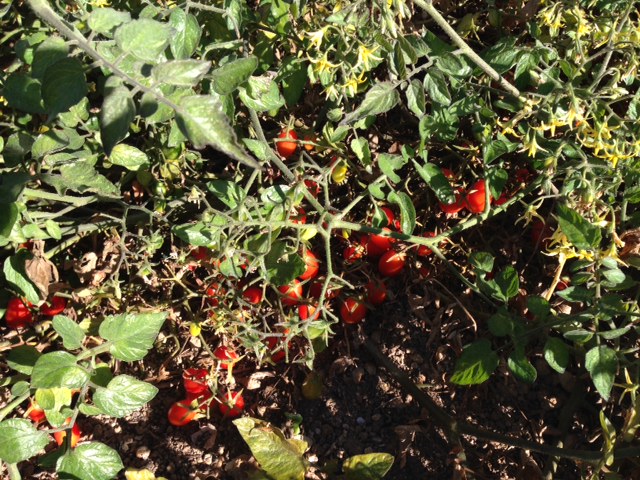
This morning, I got out into our yard early before the bees showed up, to pick tomatoes from a “volunteer” vine that probably arose from the seeds of a discarded fruit from our summer crop.

photo

We don’t live in the southern hemisphere, where it is currently their warm season. We live in Southern California, where we are in the midst of the worst drought in a century. Warnings of possible wildfires, dangers that we are used to hearing about in September and October, are filling the local newspapers and the airwaves. The governor has just declared a drought emergency and we fully expect that water-use restrictions will soon follow.

Fortunately, a couple of years ago, we replaced our thirsty front lawn with drought-tolerant plants. Most of our backyard is either covered in hardscape or planted with bushes and succulents, chosen for their ability to withstand long periods with little water. We realize that, although our home is near the coast, we live in a Mediterranean climate and our landscaping should reflect that. We don’t know what the next few months hold for us rain-wise, but if it continues to be dry, our plants will probably survive, and maybe even thrive.

Sticks of Fire

I love these August-in-January temperatures, but I also know that every season brings with it possibilities and challenges, both abundance and retreat, and each must build on the other for life to flourish and grow. The same dry weather day after day isn’t good for plants, animals, or people. It is dull, it is boring, and it can be dangerous.

As I was picking tomatoes this morning, my thoughts turned (as they do more-and-more these days) to my upcoming retirement. I wondered, as much as I enjoy working in the garden, would I be happy doing it every day? Would I be happy doing anything all the time? Although I am looking forward to having unstructured hours and limitless ways to fill them, I know that too much free time can turn out to be too much of a good thing.

Working five days a week and having only two days on the weekends to get things done, I often find that, come Sunday night, I’ve checked off only a few things on my to-do list, and I didn’t devote much time, if any, to pure enjoyment. After I retire, “enjoyment” will be tops on my to-do list, but that doesn’t mean that I want my days to be exclusively warm and sunny. I look forward to challenging myself by taking classes and learning new skills, obligating some of my time with volunteer work, and creating a certain amount of structure so that I can maintain my physical, mental, and emotional well-being for as many years as possible.

Just as we landscaped our yard in preparation for expected periods of drought and to better reflect the climate we live in, I am laying the groundwork for my retirement. I am setting up my financial life for when paychecks no longer regularly re-fill the coffers, and my personal life to be more self-directed and open to exploration.

Like our current endless summer, a retirement devoted exclusively to relaxation and leisure will soon grow dull, boring, and quite possibly dangerous to health and well-being. It will be important that I search out variety, welcome change, and strive embrace each season for its diversity and its possibilities.

“In seed time learn, in harvest teach, in winter enjoy” – William Blake

Daze of Our Lives

Last night, my husband and I had an “ah-ha” moment that helped to bring into focus some of the challenges we will face when we are both retired. Fortunately it wasn’t too serious, but it made us realize that we had better start putting a few tools in place that will help us keep our lives organized.

I’ve always been the main “keeper of the calendar” in our relationship. I know when we have social events planned, vacations scheduled, and (usually) due dates we must meet. I am the one who is expected to remember birthdays and anniversaries (both for his family and mine), and remember them enough in advance so cards can be purchased and mailed in time. For the most part, I’m able to keep most things straight by utilizing my Outlook calendar at work. Along with work-related meetings, events, and appointments, I add reminders of personal dates that I need to keep track of. Since I regularly access my calendar while I’m at work, and my cell phone is set up to alert me with reminder notices, this system has worked pretty well for us.

After finishing dinner and settling down to watch a little TV last night, I fired up my iPad to check my email and read a few blogs I follow. Good thing I did, because right there, on one of my favorite financial/political blogs (andrewtobias.com) was a reminder to “rush to the mail box with your fourth quarterly estimated 2013 tax payment, if you owe one.” Oh, crap.

Normally, this is something my husband might be expected to remember. He’s always been more focused on our financial lives and it’s mostly because he’s retired that we have to pay quarterly taxes in the first place. But, he’s currently taking a pretty intense culinary arts class which includes a fair amount of homework, so lately, he’s more about sheet pans than spreadsheets. In addition, over the past year-and-a-half of his retirement, I can tell that his attention is slowly shifting (as it should) from number-crunching and calculations, to exploring his creative side and spending time doing the things he’s always wanted to do.

Later this year, when I join my husband in retirement, it will be imperative that we have established a reliable and user-friendly way to organize our lives. The tool (or tools) will have to have a paper component because I like to have something physical in front of me as a reminder, and I don’t expect to be on my computer, tablet, or cell phone as often as I am currently. The tool will have to have an alerting function to ping us when pre-established dates and times arrive, and, it will have to be flexible enough to be able to send the alerts to just me, just him, or to both, depending on how each reminder is set up.

With all of the available computer tools, software, and billions of downloadable apps, I’m pretty sure we will have many serviceable options to choose from. I hope it will be just a matter of picking the one that best fits our needs and then setting it up so that it helps keep track of the day-to-day so we can get on with enjoying our journey.

After realizing our mistake last night, we quickly found the required paperwork, made the needed money transfers, and wrote our checks to the state and federal tax agencies. The postmark will be one day late, and we may get dinged, but it was a relatively cheap wake-up call that won’t go un-answered.

The Vision Thing

“Vision animates, inspires, transforms purpose into action” Warren Bennis

I’ve never been a big proponent of writing New Year’s resolutions. The few times I actually wrote down what I resolved to do (or stop doing) in the new year, I would forget about the list by, say, January 5, and pick right up doing (or not doing) what I’ve done (or not done) all along. I am a creature of habit and it takes much more than a few words on paper to make big changes.

This is not to say that I don’t believe in setting personal goals or having a self-improvement plan. I just don’t think the arbitrary date of January 1 is necessarily the day to begin. I remember when I worked out regularly at a gym, I always avoided going the first few weeks of January because it was overrun with wannabe gym rats. I knew that by the end of January/early February, gym attendance would return to normal and I would no longer have to wait in line to use the machines.

As 2013 ends and the year that I will retire begins, I am going to try something different: writing a personal vision statement. I have written many vision statements over the years for various organizations, but I have never thought to craft one for my own personal goals, ambitions, and dreams. Although I know that, like New Year’s resolutions, just because something is written on paper doesn’t make it so, I think having a well-thought-out vision statement can help me stay focused on creating the future I want.

A simple Google search will yield tons of articles about writing a personal vision statement. Some have handy step-by-step instructions, some give examples of what one might look like. Most of the articles suggest that it be kept to just a few sentences and to write it in the present tense; as if you have already achieved your goals. Your vision statement can cover several areas of your life (e.g. health, education, and relationships) or focus on one particular dream or goal. The important thing is that it speaks to your soul and inspires you to move forward.

Before I started to craft my personal vision statement, I thought it would be helpful to make a photo collage that created a visual representation of my perfect future. I gathered up a pile of old magazines, a pair of scissors, a glue stick, and a poster board and started to cut out pictures and words that resonated with me. As I assembled the pictures and words on my board, I discovered four main areas of focus: health and exercise, travel and recreation, creativity and art, and friends and food.

Photo Collage

Using this collage as my inspiration, I will next capture in words the life I want to create for myself as I move into retirement and beyond. I may not share the final product with anyone but I will re-visit it often to draw inspiration and to make sure I’m doing what I need to do in order to live the life I want to live. If any part of my vision statement no longer resonates, I can simply change it so that it reflects my new path.